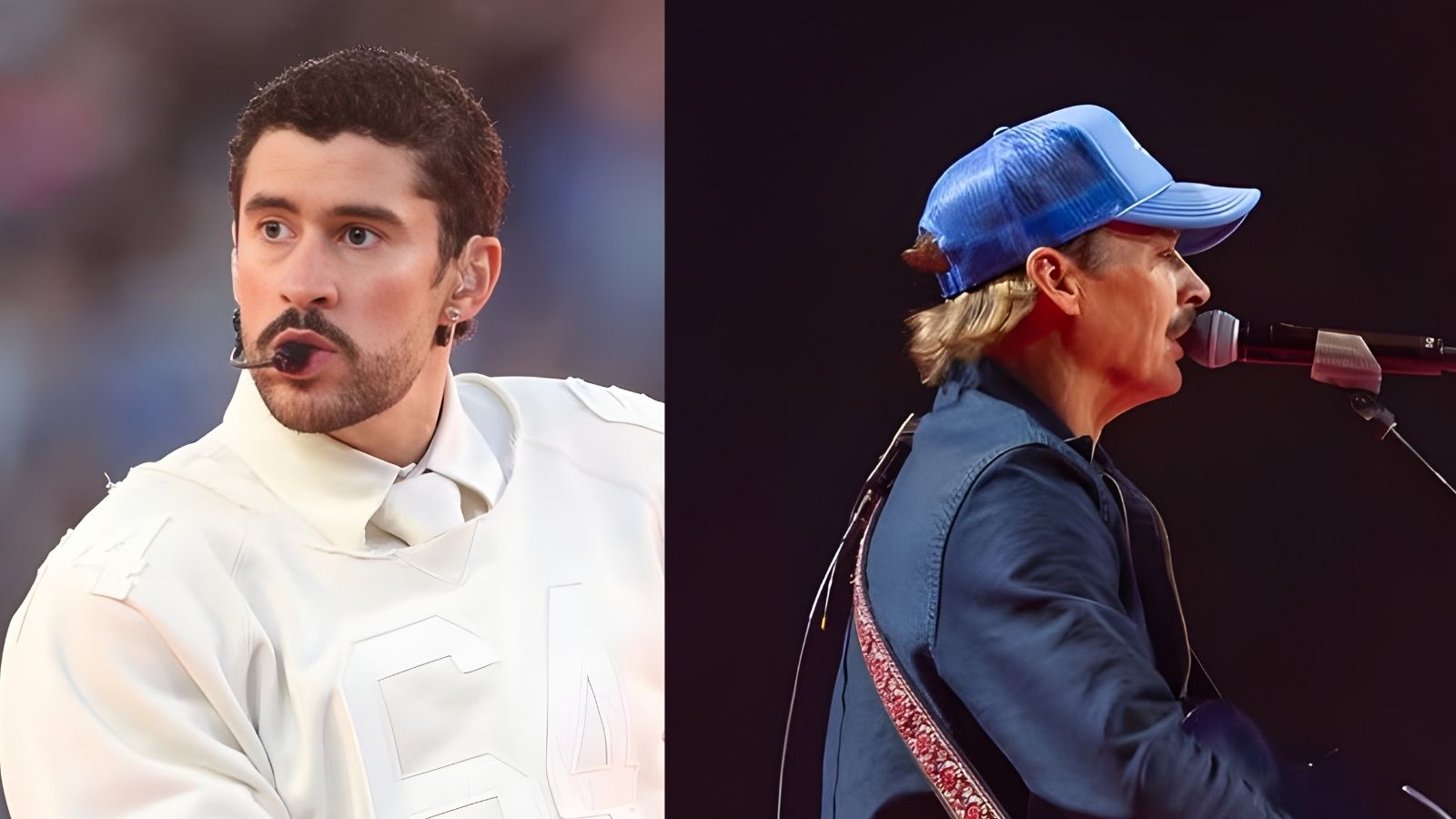
The Super Bowl halftime show always sparks buzz, but this year’s event took things to another level. On February 8, 2026, during Super Bowl 60 at Levi’s Stadium in Santa Clara, California, fans got not one, but two major performances. Bad Bunny headlined the official NFL show, bringing his signature energy and Latin flair to millions watching live.
At the same time, Kid Rock led an alternative “All-American Halftime Show” organized by Turning Point USA, featuring country stars like Brantley Gilbert and Lee Brice. This split created a cultural showdown that had everyone talking. A poll from TMZ Sports captured the moment, revealing a clear preference among voters. Let’s dive into what happened.
The Battle of the Stages
Bad Bunny’s performance was a high-production spectacle. The Puerto Rican superstar, known for hits like “Tití Me Preguntó” and “Me Porto Bonito,” turned the field into a vibrant celebration of Latino culture. He included guest appearances from artists like J Balvin and Rosalía, with themes touching on unity and diversity.
The show drew massive viewership, with the NFL broadcast reaching over 100 million people. Critics praised it for its global appeal, noting how Bad Bunny’s set list mixed reggaeton beats with messages of inclusion. For many, it represented the evolving face of American entertainment.
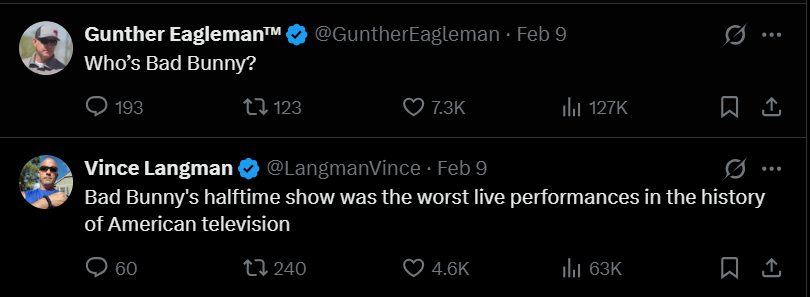
On the other side, Kid Rock’s event aimed for a different vibe. Broadcast live on YouTube and other platforms, it pulled in millions of online viewers. Kid Rock, the rock-rap veteran behind songs like “Bawitdaba” and “All Summer Long,” focused on patriotism and classic American rock.
He shared the stage with country acts, delivering high-energy anthems that resonated with fans seeking a more traditional feel. Turning Point USA promoted it as an “All-American” alternative, emphasizing English-language lyrics and red-white-and-blue themes. Attendees and streamers described it as a rally-like experience, complete with fireworks and crowd chants.
This duel wasn’t just about music; it highlighted broader divides in pop culture. Some saw Bad Bunny’s show as progressive and inclusive, while Kid Rock’s was viewed as a nod to heartland values. The contrast set the stage for public opinion to weigh in, and that’s where the TMZ poll entered the picture.
The TMZ Poll Takes Center Stage
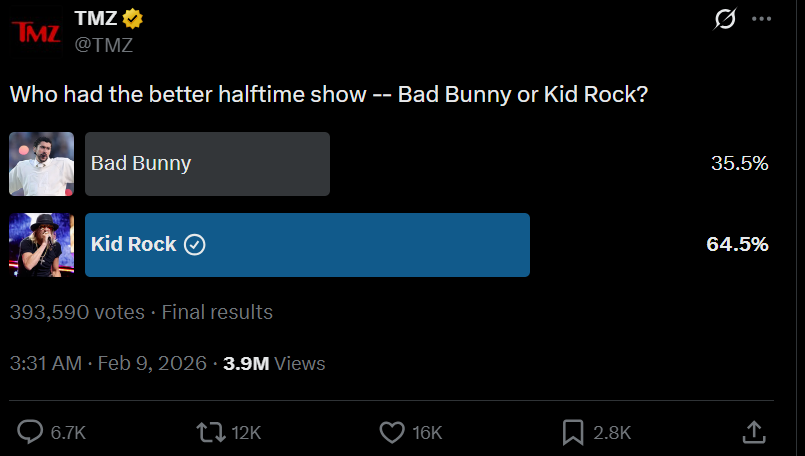
Right after the game ended, TMZ Sports dropped a simple question on their X account: “Who had the better halftime show — Bad Bunny or Kid Rock?” It was an opt-in poll open to anyone on the platform, and it exploded in popularity. By early morning on February 9, it had already racked up over 250,000 votes. As the day went on, the numbers climbed to nearly 400,000, making it one of the most engaged polls in recent entertainment history.
TMZ, known for celebrity gossip and quick takes, likely expected a close race given the stars’ fan bases. Bad Bunny boasts a massive global following, with over 45 million monthly Spotify listeners, while Kid Rock has a loyal audience in rock and country circles. The poll ran for a set period, but reports surfaced that it ended earlier than planned, around 20 hours before its scheduled close.
This sparked speculation among users, with some suggesting the results caught the outlet off guard. Regardless, the poll’s accessibility on social media allowed for widespread participation, turning it into a viral snapshot of fan sentiment.
What the Results Revealed
The final tally was decisive. Kid Rock’s alternative show won with 64 percent of the votes, while Bad Bunny received around 36 percent. Early counts showed even higher margins, with Kid Rock peaking at over 66 percent when votes hit 250,000. By the end, with nearly 400,000 responses, the gap held steady at 64 percent for Kid Rock and 36 percent for Bad Bunny.
These numbers surprised many, especially since pre-game surveys like one from YouGov showed slight overall interest leaning toward Bad Bunny among a general U.S. sample. That poll, conducted before the performances, had 35 percent favoring the official show versus 28 percent for the alternative, with a strong partisan split. Democrats preferred Bad Bunny by a wide margin, while Republicans backed Kid Rock. The TMZ results, however, flipped that narrative, suggesting a different story among engaged online voters.
It’s worth noting that this was not a scientific survey. Social media polls can attract motivated groups, leading to brigading where fans rally to vote en masse. Some users pointed out that similar polls on other platforms showed opposite outcomes, with Bad Bunny dominating at 88 percent in one reported case. Still, the sheer volume of votes in TMZ’s poll made it hard to ignore, fueling headlines across outlets like Outkick and The Spun.
The Bigger Picture in Pop Culture
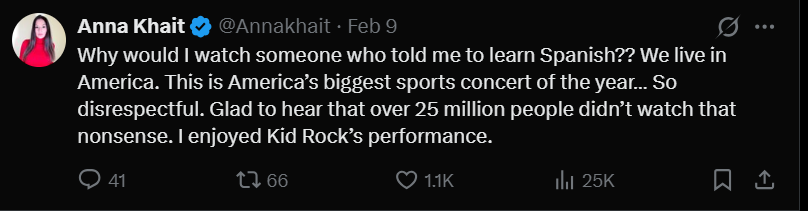
This poll highlights how entertainment choices reflect deeper societal trends. Kid Rock’s win in the TMZ vote was celebrated by those who felt the official show pushed too far into multicultural themes, with comments praising the alternative for its focus on “English, patriotism, and rock ‘n’ roll.” Bad Bunny’s fans, meanwhile, defended his performance as a proud representation of diverse America, noting its record-breaking streaming numbers post-show.
Viewership stats add context. The NFL’s broadcast drew tens of millions live, dwarfing the alternative’s online audience of over 5 million on YouTube. Yet, the poll suggests that among those who compared both, Kid Rock’s straightforward style resonated more. Moments like Kid Rock’s guitar solos and Bad Bunny’s dance breaks became talking points, showing how personal tastes drive preferences.
In the end, the TMZ poll clearly pointed to Kid Rock as the favorite in this head-to-head. It may not represent all Americans, but it captured a vocal segment’s voice. As pop culture evolves, events like this remind us that music unites and divides in equal measure. Whether you sided with the official spectacle or the rebellious alternative, Super Bowl 60’s halftime saga proved entertainment is never just about the tunes.
What do you think?