The NYC first lady apologized for the slurs she posted at 15. The Oct. 7 Instagram activity got a different kind of silence
Rama Duwaji finally spoke.
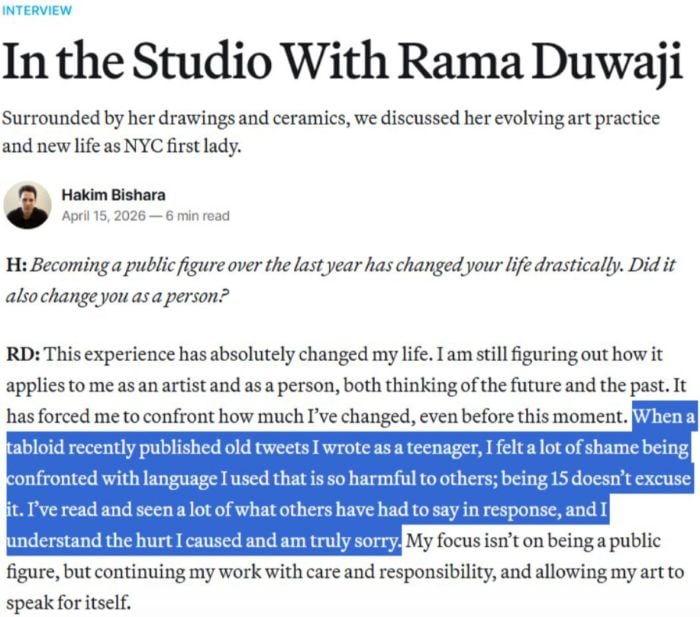
In a Hyperallergic interview, Duwaji said she felt “a lot of shame” over “old tweets I wrote as a teenager,” and the “language I used that is so harmful to others.” She added that “being 15 doesn’t excuse it” and said she was “truly sorry.” It was her first public response after weeks of scrutiny around old posts and likes tied to her online history.
The apology was precise, and that precision is the real story. Because the controversy around Duwaji was never just about what she wrote at 15.
The Associated Press noted that she did not specify which posts she was apologizing for and did not address other, more recent social media activity regarding Israel that has drawn scrutiny while Mayor Zohran Mamdani tries to ease concerns among some in the city’s Jewish community.
She addressed the easiest part
The easiest material to isolate was the slur material. AP reported that Duwaji used a racial slur for Black people while affectionately addressing a friend and an abbreviated anti-gay slur in 2013, when she was 15. Those posts are politically toxic across almost every faction that matters in New York. There is no serious upside in defending them, and no serious downside in apologizing for them. Hyperallergic gave her room to do exactly that.
But the record does not stop in 2013.
According to Jewish Insider, Duwaji liked multiple Instagram posts on Oct. 7, 2023 — when she was 26 years old — that celebrated Hamas’ assault on Israel as “breaking the walls of apartheid” and showed fighters on a captured Israeli military vehicle captioned “resisting apartheid since 1948.” She liked posts the following day promoting a pro-Palestinian rally in New York City. The New York Jewish Week put the contrast plainly: she apologized for old posts, but not for the more recent likes praising Oct. 7 “resistance.”
In her Hyperallergic interview, Duwaji referred to “old tweets I wrote as a teenager” as the frame for her entire apology. The Oct. 7 Instagram likes are not tweets, not old, and were not liked by a teenager. She used one age defense to cover content from two very different periods of her life.
That turns the apology from a moral event into a political one.
Hyperallergic gave her room. Politics gave her reason
The venue helped. Duwaji did not sit for a hard political interview where someone could ask, line by line, which posts she regretted and which she did not. The apology emerged in an arts profile in response to a question about adjusting to life as a public figure. It arrived as a sidebar. Then she pivoted back to her work, saying her focus is on continuing it “with care and responsibility” and allowing her art to speak for itself.
Mamdani preserved the ambiguity. Asked by reporters which specific posts his wife regretted, he declined to say, offering only that she had “shared some of her reflections in this interview.” Two people in the same household had a chance to define the boundaries of the apology. Both chose not to.
For weeks, the Mamdani line on Duwaji was that she is a private person with no formal role in City Hall — a line he used three times across three separate revelations, including when we documented the deletion of her X account in March. That argument created distance between the mayor and his wife’s online history and suggested the public should stop treating her like a political actor. But the moment Duwaji stepped forward and addressed “old tweets I wrote as a teenager,” she stopped being a ghost in the story. She became the author of the next chapter. And the chapter she wrote was narrow.
The apology maps onto politics a little too neatly to ignore
Mamdani is already trying to calm concerns among Jewish New Yorkers over his criticism of Israel’s treatment of Palestinians. An apology focused on slur posts costs nothing with his base and may recover ground with voters alienated by that language. A fuller apology directly addressing the Oct. 7-related activity would be riskier and far more divisive. That is an inference from the politics, not a proven statement of motive. But the fit is hard to miss.
The apology was broad enough to sound remorseful, narrow enough to leave the most explosive recent activity untouched, and soft enough to keep the real argument unresolved.
That is why what matters is not that Rama Duwaji apologized. She did. It is what the apology refused to address.
The “private person” defense always had one last move. This past week, it looked like selective remorse.