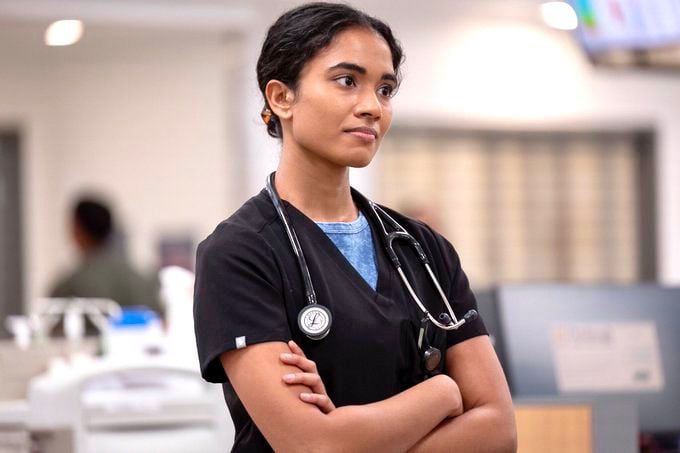
There’s a version of Supriya Ganesh that’s easy to write. South Asian actress. Medical drama. A two-season run on The Pitt. Done. Like everything lines up neatly.
But spend a little more time with her story, and something starts to resist that summary. Not dramatically. She’s not out here trying to disrupt anything. It’s calmer than that. More like she keeps adding context until the neat version is no longer accurate.
The Season 2 finale of The Pitt drops at 9:00 PM tonight, closing out her run as Dr. Samira Mohan. And almost at the same moment, she publishes an essay that gently reframes how you’re supposed to read her. Same person, but the picture shifts.
She Felt Fine Until She Landed in America
Supriya Ganesh wrote a personal essay on gender dysphoria for New York Magazine 🤍
“Growing up in India, I never questioned my gender. When I moved to the U.S. at 18, I began to feel disconnected from my body.” pic.twitter.com/1eGAj87eXV
— best of supriya ganesh (@bestofsupriya) April 15, 2026
Ganesh wasn’t raised in one place with one fixed perspective. She was born in Austin, Texas, and then moved to New Delhi when she was three, where she spent most of her childhood before returning to the U.S. at 18 to attend Columbia University. And in her essay, she’s very specific about how she understands herself. Upper-caste, upper-class, Hindu, and Tamil. Not vague, not generalized. Very precise.
She didn’t grow up questioning her gender. At all. She’s clear about that. She felt like a girl, moved through the world as one, and didn’t experience that internal conflict people often expect in these kinds of stories. It only started after she got to the United States.
And not slowly either. She describes it as this sudden, almost disorienting disconnect from her own body. Which is interesting because it flips the usual narrative. You expect the tension to exist first, then clarity later. For her, it’s the opposite. Stability first, then confusion.
She even brings up something very specific. Growing up in Delhi, she noticed Sikh women who didn’t necessarily conform to Western beauty standards around things like body hair. It wasn’t her identity, but it was part of what she saw as normal. A wider range of what womanhood could look like.
Then she gets to the U.S., and that range tightens. Suddenly, there’s a very narrow idea of what her body is supposed to look like, how it’s supposed to read. And that’s where the discomfort begins.
It’s not just about gender in isolation. It’s about context. About what changes when the environment changes.
Precision in the Emergency Room
And the funny thing is, while all of this is happening internally, her external path looks almost hyper-focused.
Before acting fully took over, she was deep in the world of science. Neuroscience degree, 99th percentile on the MCAT, tutoring on the side. This wasn’t casual. She was on a very real track toward a career in medicine.
At the same time, she’s building an acting career in that very New York way. Small roles, steady work, showing up where she can. A therapist on Blue Bloods, back in 2018, got her a SAG card, and from there, the credits started to stack up. She appears in The Enemy Within, The Village, New Amsterdam, and Law & Order: SVU. None of them is a big breakout moment on their own, but together they start to tell a different story.
Nothing about it screams overnight success. It’s gradual. Methodical. Honestly, a little unglamorous in the way real careers tend to be.
Which is why her role on The Pitt makes so much sense.
On the show, she plays Dr. Samira Mohan, a senior resident in an emergency room that’s constantly on edge. And you can feel that she understands that world beyond just memorizing lines. There’s a kind of precision in how she moves through the role that makes sense when you remember she almost lived that life for real.
It’s also important not to overstate it. She wasn’t the singular lead. The show leans on an ensemble, with actors like Noah Wyle anchoring it. But she’s right there in the center of it for two seasons, which, for a South Asian actor in American television, still carries weight.
So by the time the show ends, she’s not just another name cycling through a medical drama. She’s visible in a way that opens other doors.
Why the Usual Gender Labels Don’t Quite Fit Her Story
Now this is where people usually try to simplify things, and where she kind of refuses to let them.
You’ll see the labels floating around. Nonbinary. Genderqueer. The usual shorthand. But she’s been pretty clear that those don’t fully fit.
Instead, she identifies as a queer South Asian woman. Still a woman. That part doesn’t go away. But she uses she and they pronouns in a way that feels more like… a signal than a category.
She’s mentioned being inspired by Lily Gladstone in that sense. Using language to open things up, not lock them down.
And if you listen closely to how she talks about it, she’s not trying to step outside gender completely. She’s trying to loosen its meaning, especially for someone who exists at the intersection of race, culture, and expectation.
Also worth noting, she doesn’t frame her experience in clinical terms. There’s no public narrative about medical transition. No emphasis on hormones or surgery. What she keeps coming back to is how her body is read, and how that reading changed when she moved.
It’s social. Cultural. Environmental.
Which, again, makes the whole thing harder to package neatly.
The Parts of Her Story She Hasn’t Explained Yet
There are still parts of her story that aren’t fully mapped out, and honestly, that’s part of why people keep paying attention.
For example, she’s very clear that this sense of dysphoria started in the U.S. But she doesn’t go into detail about how she understood it at the time. Whether she had language for it or if that came later.
And that gap leaves room for interpretation, but not in a messy way. More like a reminder that identity doesn’t always arrive fully formed. Sometimes you only understand what you were feeling after the fact.
The same thing shows up in how she talks about the industry.
She’s mentioned the limitations placed on South Asian actors, the feeling that there’s only so much space to go around. But she doesn’t name names or point to specific projects where she felt boxed in. It stays at the level of pattern, not accusation.
Even when she responded to a troll earlier this month who made colorist and casteist comments, it didn’t turn into a long-running public fight. She addressed it, made her point, and moved on.
Hey so this is supremely fucked up and I truly hope you deal with your self hate. Colorist, classist, garbage take https://t.co/sleZD2MOHT
— Supriya Ganesh (@SupriyaGanesh) April 9, 2026
There’s a kind of restraint there that feels deliberate.
What Stays With You After
Looking at everything together, what stands out isn’t just The Pitt ending or Ganesh’s next step.
It’s that her story doesn’t resolve in the way you expect it to.
The U.S. is where her career took off. It’s also where she first felt out of sync with her own body. Those two things sit side by side without canceling each other out.
And maybe that’s the part that feels familiar, even if you can’t immediately explain why. The idea that the same place can give you opportunity and discomfort at the same time. That progress doesn’t always feel clean.
Ganesh doesn’t try to smooth that over. She just… names it. And let it sit there.
Which, in an industry that still prefers things to be easily understood and quickly categorized, might be the most interesting thing she’s doing right now.