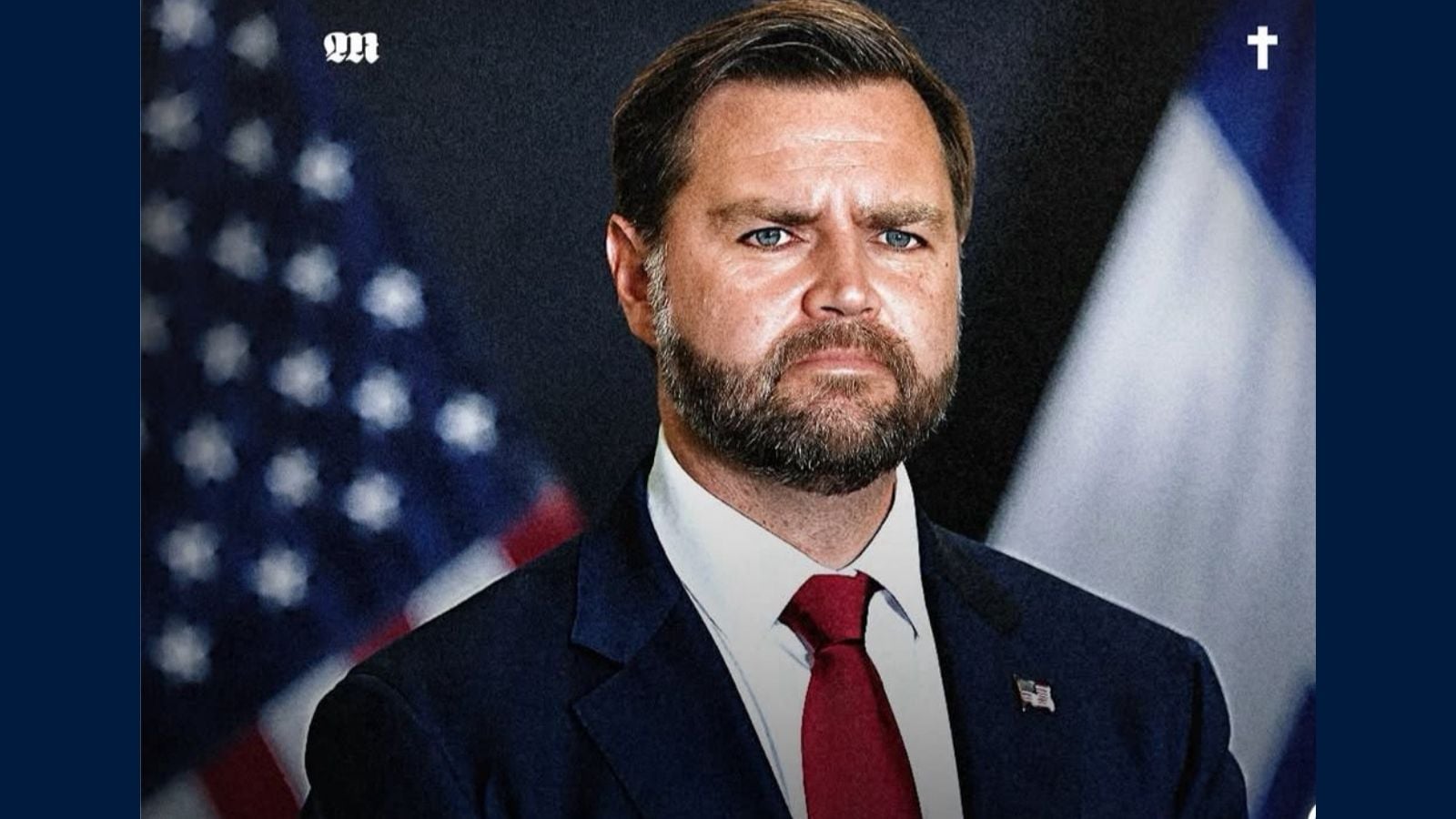
If you have ever watched someone fresh out of a beginner’s yoga class start correcting a seasoned instructor mid-pose, then you already understand the exact flavor of chaos that unfolded on Tuesday night (April 14) in Athens, Georgia. It was that same bold, slightly confusing confidence, except this time the stakes were not downward dog form; they were theology, politics, and global influence.
JD Vance, the Vice President of the United States and a man who converted to Catholicism in 2019 at the age of 35, stepped onstage and decided to publicly caution Pope Leo XIV, the head of the Catholic Church, to be careful when discussing theology.
If that alone sounds like a headline that should not exist, just wait. Because this was not a one-off comment tossed into a speech and forgotten.
Vance had previously made his stance known in a separate media appearance, suggesting the Vatican should stick to internal Church matters and leave American public policy to the president, which is a sentence that feels like it belongs in satire, except it very much happened in real life, on camera, with a straight face.
Online, the reaction landed exactly where you would expect. People immediately clocked the energy, and it was giving “new hire correcting the CEO in the first week,” except the CEO in this case is the Pope, and the internet does not let that kind of irony slide quietly.
So… What Actually Lit the Match Here?
This whole situation started with a post that sounded exactly like something you would expect from the leader of the Catholic Church, which is part of why the reaction that followed felt so explosive in comparison.
God does not bless any conflict. Anyone who is a disciple of Christ, the Prince of Peace, is never on the side of those who once wielded the sword and today drop bombs. Military action will not create space for freedom or times of #Peace, which comes only from the patient…
— Pope Leo XIV (@Pontifex) April 10, 2026
Pope Leo XIV took to X and stated that” God does not bless any conflict”, adding that followers of Christ are not on the side of those who wield the sword or drop bombs, a message that was direct, unambiguous, and deeply rooted in traditional Gospel teaching.
That message alone was enough to trigger a full week of escalating reactions.
On Sunday, April 12 Donald Trump took to Truth Social and called the Pope “weak on crime and terrible for foreign policy”, which already set the tone. Then came the extra layer, an AI image of Trump in a Christ-like pose that pushed the entire situation from tense to outright surreal.
By the time Vance stepped onto that stage in Athens, this was no longer a simple disagreement. It had become a cultural flashpoint where politics, religion, and internet spectacle collided in real time.
A “Baby Catholic” Walks into the Chat and Starts Setting Rules
A baby Catholic walking into a global theological debate and somehow taking center stage is where this story really starts to feel unreal, because the irony is doing the heavy lifting here. Vance is not just any politician speaking on faith; he is the highest-ranking Catholic in the United States government right now, which gives his words weight, but he is also someone who only joined the Church in 2019, a detail that the public has refused to ignore.
He has previously referred to himself as a baby Catholic, and that label is now following him everywhere.
So when he stood there and told the Pope to be careful when speaking about theology, social media did not hesitate to respond. The moment instantly turned into commentary, jokes, and full-blown discourse about confidence versus experience.
For many viewers, the vibe was unmistakable. It felt like someone who had just gotten comfortable in the group chat was suddenly trying to rewrite the rules, and as you can imagine, the reactions matched that energy in real time.
Trying to Out-Theology the Vatican Using World War II as Exhibit A
Then came the part where Vance took things from bold to definitive by bringing history into the argument, which shifted the conversation into something much bigger. He pushed back on the Pope’s stance by pointing to World War II, asking the audience whether God was on the side of the Americans who helped liberate France and free Holocaust camps from Nazi control, and answering his own question with a confident yes.
It was a calculated move designed to challenge the idea that followers of Christ are never aligned with force.
At the same time, it opened up a deeper conversation. The concept of “just war” is something the Catholic Church itself has shaped over centuries, so watching a relatively new member attempt to reinterpret that framework on a political stage created a moment that felt both strategic and deeply ironic.
It turned what could have been a simple rebuttal into something people could not stop unpacking.
Hecklers, Interruptions, and a Night That Turned into Pure Chaos
The Athens event itself quickly stopped feeling like a controlled political appearance and began to look more like a live, unscripted debate that no one had planned for. While Vance was speaking, hecklers interrupted repeatedly, breaking the rhythm of his speech and forcing him to respond in real time, which only added to the already chaotic atmosphere.
One person shouted that “Jesus Christ does not support genocide”, a line that immediately cut through the room.
Vance paused, acknowledged the interruption, and continued, but by that point the tone had already shifted. The moment was no longer just about a speech; it had become a spectacle.
Coverage from multiple outlets highlighted how the interruptions gave the night a meme-ready quality, turning what should have been a routine appearance into something much more unpredictable.
NEW: JD Vance, who converted to Catholicism in 2019, tells Pope Leo XIV to be “more careful” when “opining on theology.” pic.twitter.com/aub7h9J7kI
— Christopher Hale (@ChristopherHale) April 15, 2026
And Vance Was Not Alone in This
What makes this even more layered is that Vance is not the only one making these kinds of arguments, which suggests this is part of a broader pattern rather than a one-off moment. Figures like Tom Homan have also expressed the view that the Pope, which at the time was Pope Francis, should stay out of issues such as immigration, while House Speaker Mike Johnson has argued that when the Vatican wades into political debates, it should expect political pushback.
At the same time, many of the same conservative figures who bristle at the pope’s comments, also lean heavily on Christian identity and moral language when defending their own policy positions.
That contradiction becomes hard to ignore once you see it clearly. On one side, faith is being used as a framework for political messaging, and on the other, the central authority of that faith is being told to step back when it speaks on those same issues.
It creates a tension that feels bigger than any single headline.
So What Is Actually at Stake Here
Zoom out, and this stops being just a clash between a vice president and a pope. It starts to look like a deeper shift in how religion and authority are being negotiated in public life, especially in a country where millions still identify strongly with their faith.
Pope Leo XIV has shown no signs of backing down from his message about peace, and there has been no formal response directly addressing Vance’s remarks, which only adds to the sense that this is an ongoing story.
But the bigger issue sits underneath all the headlines. This whole situation only shows that there is a growing idea that faith can be something you reference when it aligns with your position, but not necessarily something that holds authority over your decisions, and that is where the real friction begins to show.
Whether that approach holds, especially among the millions of American Catholics watching this unfold, is a question that will likely outlast this entire news cycle and shape conversations for a long time to come.