
A Texas business owner’s discovery of unauthorized payments in a company checking account led investigators to an alleged employee theft totaling $1,748,901.35. Authorities say the money was used to pay the employee’s personal credit card bills over nearly seven years.
Thalia Meri Powers, 51, of Port Neches, was arrested on Oct. 1, 2026, in connection with the suspected theft from BioMedical Waste Solutions, a medical waste disposal company in neighboring Port Arthur.
According to a probable cause affidavit described by the Beaumont Enterprise, investigators obtained financial records through subpoenas and identified 154 online payments and Automated Clearing House (ACH) transfers to credit card accounts associated with three financial institutions.
The Jefferson County Sheriff’s Office has now confirmed Powers’ booking, listing a first-degree felony theft allegation involving property valued at $300,000 or more and a $750,000 bond. Powers has not been convicted in connection with the allegations.
Business Owner Discovers Unauthorized Charges in Company Account
In February 2025, the owner of BioMedical Waste Solutions, located at 9665 Jade Avenue in Port Arthur, noticed several transactions he had not authorized on a business checking account. He began reviewing previous bank statements and identified additional payments to major credit card companies, according to the Beaumont Enterprise.
The owner eventually suspected Powers because she had access to the account. A customer testimonial published by business-payments provider Bottomline identifies Thalia Powers as an accounting manager at BioMedical Waste Solutions.
Investigators Trace 154 Payments to Personal Credit Cards
Through subpoenas, investigators obtained financial records identifying payments from the business’s checking account to Powers’ personal credit card accounts. The transactions involved American Express, Bank of America Visa and Comenity Capital Bank.
The payments included online credit card payments and ACH transfers, which electronically move money between financial accounts. Investigators allege the transactions paid personal credit card obligations using business funds without the owner’s authorization.
Nearly Seven Years of Transactions Come Under Investigation
The questioned payments occurred between April 2, 2018, and Feb. 5, 2025. The Association of Certified Fraud Examiners examined 2,402 occupational fraud cases across 143 countries and territories in its 2026 Report to the Nations. The study found that the median workplace fraud scheme lasted 12 months before detection.
Schemes continuing for more than five years produced median losses exceeding $1.1 million. The research also associated management reviews, proactive transaction monitoring and other anti-fraud controls with earlier detection and lower losses.
Sheriff’s Record Confirms First-Degree Theft Allegation and $750,000 Bond
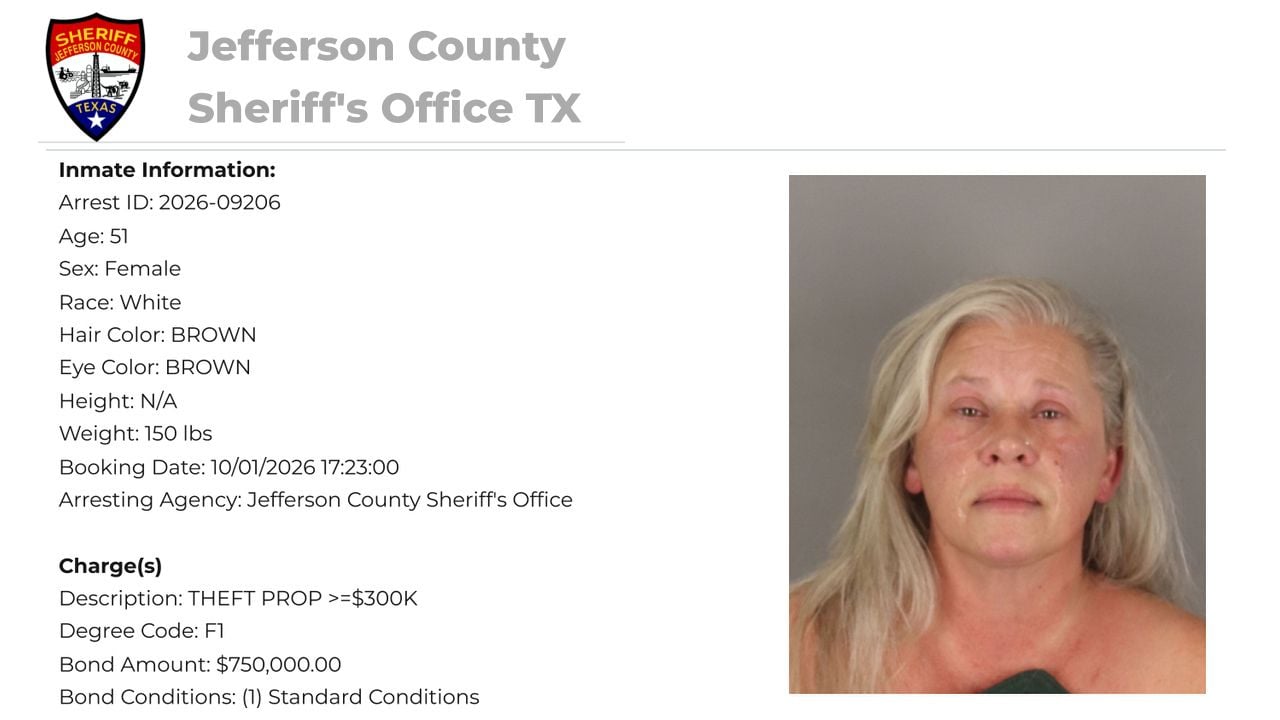
An official booking record from the Jefferson County Sheriff’s Office identifies Powers under arrest ID 2026-09206. The record shows that she was booked at 5:23 p.m. on Oct. 1, 2026, and names the Jefferson County Sheriff’s Office as the arresting agency.
Under Texas Penal Code Section 31.03, theft involving property worth at least $300,000 constitutes a first-degree felony. Section 31.09 allows amounts from multiple acts to be aggregated when they arise through one scheme or continuing course of conduct and satisfy the statutory requirements.
A first-degree felony conviction generally carries five to 99 years in prison or life imprisonment, with a possible fine of up to $10,000 under Section 12.32. The penalty range does not predict the outcome of Powers’ case, and she is presumed innocent unless proven guilty.
How Businesses Can Detect Unauthorized Credit Card Payments
Business owners should review bank statements independently and match outgoing payments against approved expenses. Recurring payments to credit card companies warrant closer examination when they cannot be connected to legitimate business purchases. Separating payment authorization from account reconciliation can prevent one employee from controlling both functions without independent oversight.
Federal banking guidance identifies transaction alerts, debit blocks and other payment controls available to business customers. Companies can ask their banks about ACH debit filters and dual approval for outgoing payments, recognizing that protections against unauthorized debits may not cover every type of online payment initiated by an authorized account user.
If suspicious payments are discovered, owners should contact their bank promptly, review account access permissions and preserve transaction records, payment confirmations and supporting invoices. An independent review can help document disputed withdrawals and provide investigators with a reliable account of the transactions.