
Jael Watts and her husband, Luis Pino-Copete, have been convicted in a federal fraud case involving a nonprofit transit company that prosecutors said used stolen identities and fabricated records to seek more than $13 million in government reimbursements.
Watts, 45, of Alloway, New Jersey, and Pino-Copete, 42, of Bogota, Colombia, were convicted after a multi-week jury trial in Utica, New York. The U.S. Attorney’s Office for the Northern District of New York announced the convictions Oct. 2.
Watts operated Pearl Transit Corporation, a New Jersey nonprofit that claimed to provide transportation, homeless outreach and other services funded through programs administered by the U.S. Department of Transportation and Department of Housing and Urban Development. Prosecutors said the broader fraud attributed to Watts ran from July 2019 through October 2025. Pino-Copete joined the scheme in January 2024, according to the Justice Department.
Trial evidence showed that more than $1.6 million was actually obtained through programs administered in Georgia, California and North Carolina. Sentencing before U.S. District Judge Anthony J. Brindisi is scheduled for Jan. 21, 2027.
Stolen Identities Became Supposed Drivers and Passengers
Prosecutors proved at trial that Pearl Transit did not employ the nationwide network of drivers it claimed to have and did not perform the transportation services used to support numerous reimbursement requests.
Real people’s identities were inserted into employment and customer records without permission. The Justice Department said some people listed as Pearl Transit passengers had already died by the dates the company claimed to have transported them.
Other people appeared in company records as drivers despite not having driver’s licenses. Prosecutors said some had never driven a car, while one supposed driver had only a learner’s permit during the period in which Pearl Transit claimed that person was providing transportation.
The government said Watts and Pino-Copete used names, addresses, dates of birth and driver’s license information belonging to other people to create documents that falsely portrayed them as Pearl Transit employees or customers.
New York Auditors Kept Asking for Proof
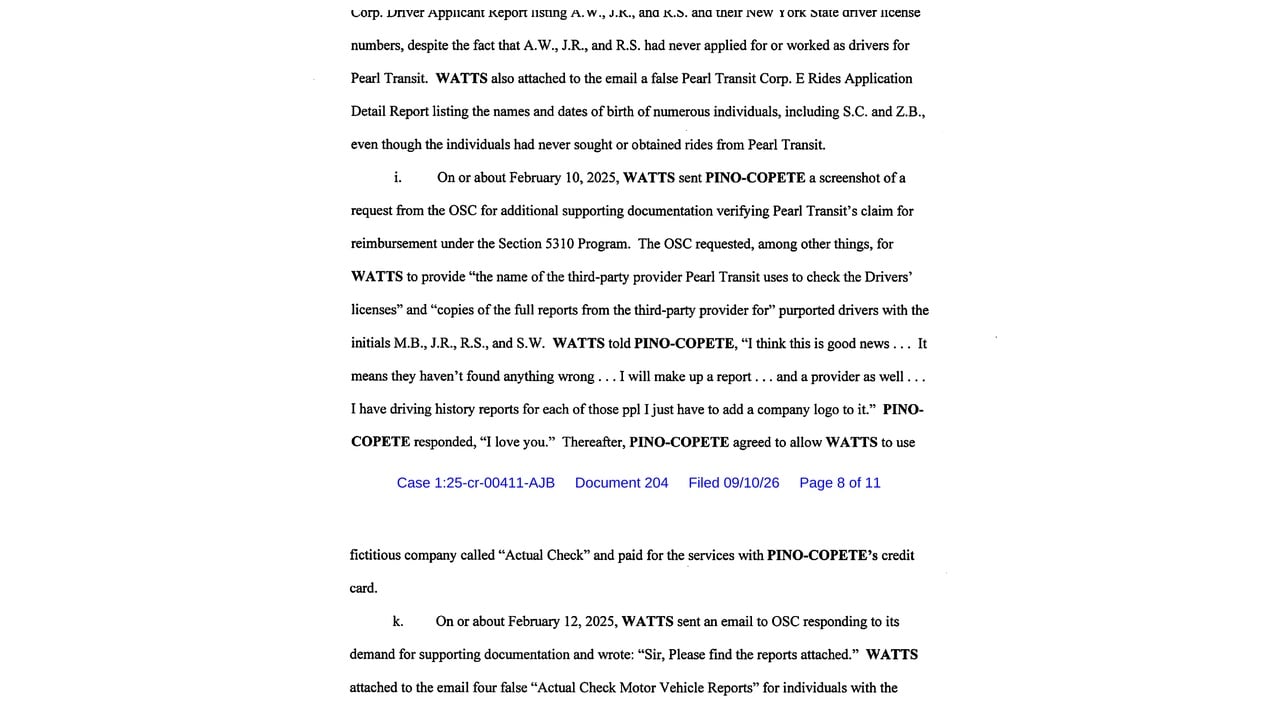
The third superseding indictment describes how the fraud came under increasing scrutiny after Pearl Transit sought reimbursement through the Federal Transit Administration’s Section 5310 program, which supports transportation for older adults and people with disabilities.
The New York State Comptroller’s Office said Watts submitted three false invoices totaling $1,275,550 for trips investigators determined had not occurred. The state’s pre-payment review identified inconsistencies before any of that money was released.
As auditors demanded records supporting Pearl Transit’s claimed drivers and passengers, prosecutors allege Watts and Pino-Copete used information belonging to real people to create additional documents.
The indictment says Pino-Copete obtained dates of birth through a TransUnion Risk and Alternative Data Solutions account. Watts later submitted a driver report and rider records containing information belonging to people prosecutors said had never worked for Pearl Transit or received rides from the company.
When auditors asked for reports from the third-party company supposedly used to verify driving histories, the indictment says Watts told Pino-Copete she would create both a report and a provider. Prosecutors allege the defendants then used a third-party freelancer to create an internet domain, logo and voicemail system for a fictitious company called Actual Check.
Watts subsequently sent auditors four purported Actual Check motor-vehicle reports, according to the indictment.
Auditors later requested records showing payments to drivers and insurance coverage for vehicles used by Pearl Transit. Prosecutors allege Pino-Copete supplied Watts with a Bancolombia bank statement and an older Colombian insurance policy, which she used to create false records portraying Pearl Transit as paying New York drivers through a Colombian account and insuring a Mercedes Sprinter van in Colombia.
The Scheme Obtained More Than $1.6 Million

Although prosecutors said Pearl Transit sought more than $13 million in federal funds over the life of the scheme, trial evidence showed the defendants fraudulently obtained more than $1.6 million.
The Justice Department identified $529,500 in Community Development Block Grant money administered through Gwinnett County, Georgia; $429,885 in Section 5310 transportation funding through Los Angeles County; $283,000 in Emergency Solutions Grant funding through Kern County, California; and $379,149 in transportation funding administered through Raleigh, North Carolina.
Those four payments total more than $1.62 million.
Federal prosecutors said bank-account evidence showed more than $1.5 million obtained from Georgia, North Carolina and California was spent on the defendants’ lifestyle. Trial evidence included more than $100,000 in Porsche rentals and more than $100,000 in purchases from luxury clothing retailer Loro Piana.
The Justice Department also described extensive travel in 2024, including trips to Colombia, Aruba and approximately four months in Europe. Photographs introduced at trial showed Watts and Pino-Copete at a spa in Tuscany and visiting a BMW facility.
Prosecutors Say the Scheme Continued After Watts Was Detained
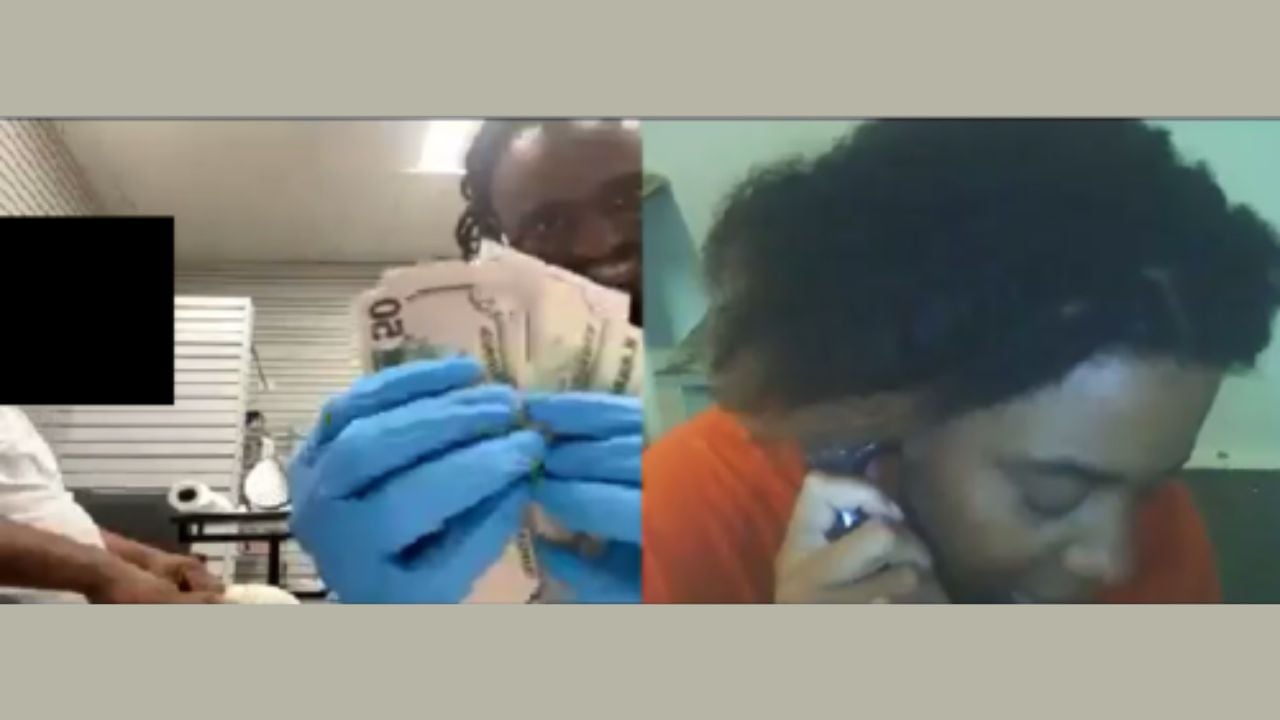
The third superseding indictment alleges Watts continued directing activity involving Pearl Transit after she was detained in 2025.
In September 2025, prosecutors allege Watts instructed Pino-Copete to conceal her wire-fraud charge and detention while Pearl Transit was attempting to obtain Community Development Block Grant money from San Bernardino, California.
The indictment says Pino-Copete then sent an email while pretending to be Watts and attributed her delayed response to the sudden death of an immediate family member.
In October 2025, prosecutors allege Watts instructed him to digitally sign her name on a Pearl Transit funding contract with San Bernardino. Pino-Copete submitted the contract in Watts’ name, according to the indictment.
The scheme also extended beyond transportation. Trial evidence showed the defendants sought housing-program reimbursements while claiming Pearl Transit provided free dental prostheses to homeless people. The Justice Department said dentures were instead produced at their home with what prosecutors described as an unsanitary 3-D printer while clients were charged for mouth scans and fittings.
Watts Was Convicted on 10 Counts and Pino-Copete on Three
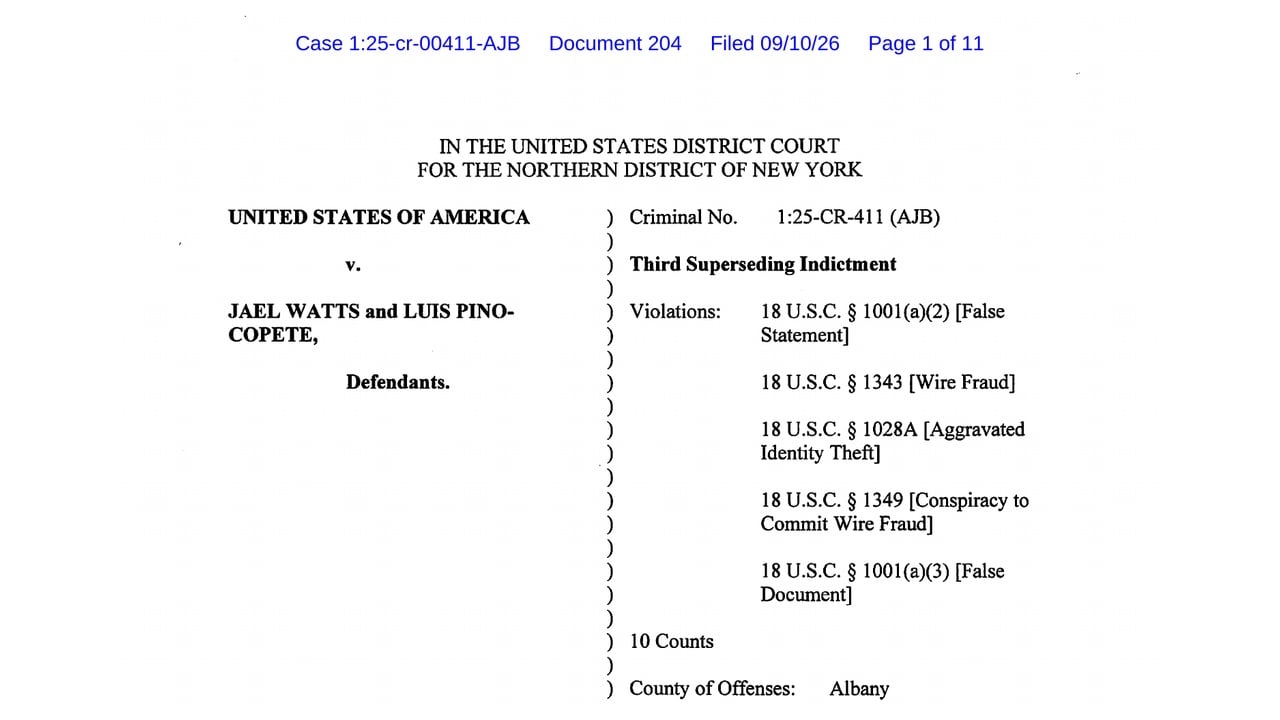
The third superseding indictment contains 10 counts. The jury convicted Watts on every count against her: one false-statement count, two aggravated identity-theft counts, five wire-fraud counts, one conspiracy-to-commit-wire-fraud count and one false-document count.
Pino-Copete was convicted on all three counts against him: conspiracy to commit wire fraud, use of a false document and aggravated identity theft.
The false-statement and first aggravated identity-theft counts against Watts stem from a March 2022 federal transportation grant application. Prosecutors said the application carried an attorney’s affirmation even though the attorney had not reviewed or signed it.
Counts Three through Seven charged Watts with wire fraud tied to reimbursement requests submitted to New York agencies in September and October 2024. Count Eight charged both defendants with conspiracy to commit wire fraud.
Count Nine accused both defendants of knowingly using a false document containing names and dates of birth of purported Pearl Transit clients who prosecutors said had never been customers of the company. Count Ten charged both with aggravated identity theft based on the alleged use of one person’s name and date of birth in connection with that false document.
Both defendants are scheduled to be sentenced Jan. 21, 2027. The Justice Department says they face a mandatory minimum of two years in prison, statutory exposure of up to 20 years, fines of up to $250,000 and up to three years of supervised release. Prosecutors also say they face restitution of at least $1.9 million.
Identity Theft Can Appear in Employment and Financial Records
The Federal Trade Commission’s IdentityTheft.gov provides recovery steps for people who discover their personal information has been used without permission.
The Social Security Administration recommends reviewing a Social Security earnings record for employment or wages that do not belong to the account holder and obtaining credit reports from all three major credit bureaus.
People who discover unfamiliar employment, financial accounts or other activity tied to their identity can report identity theft through the FTC and contact the organization that created or maintains the inaccurate record.