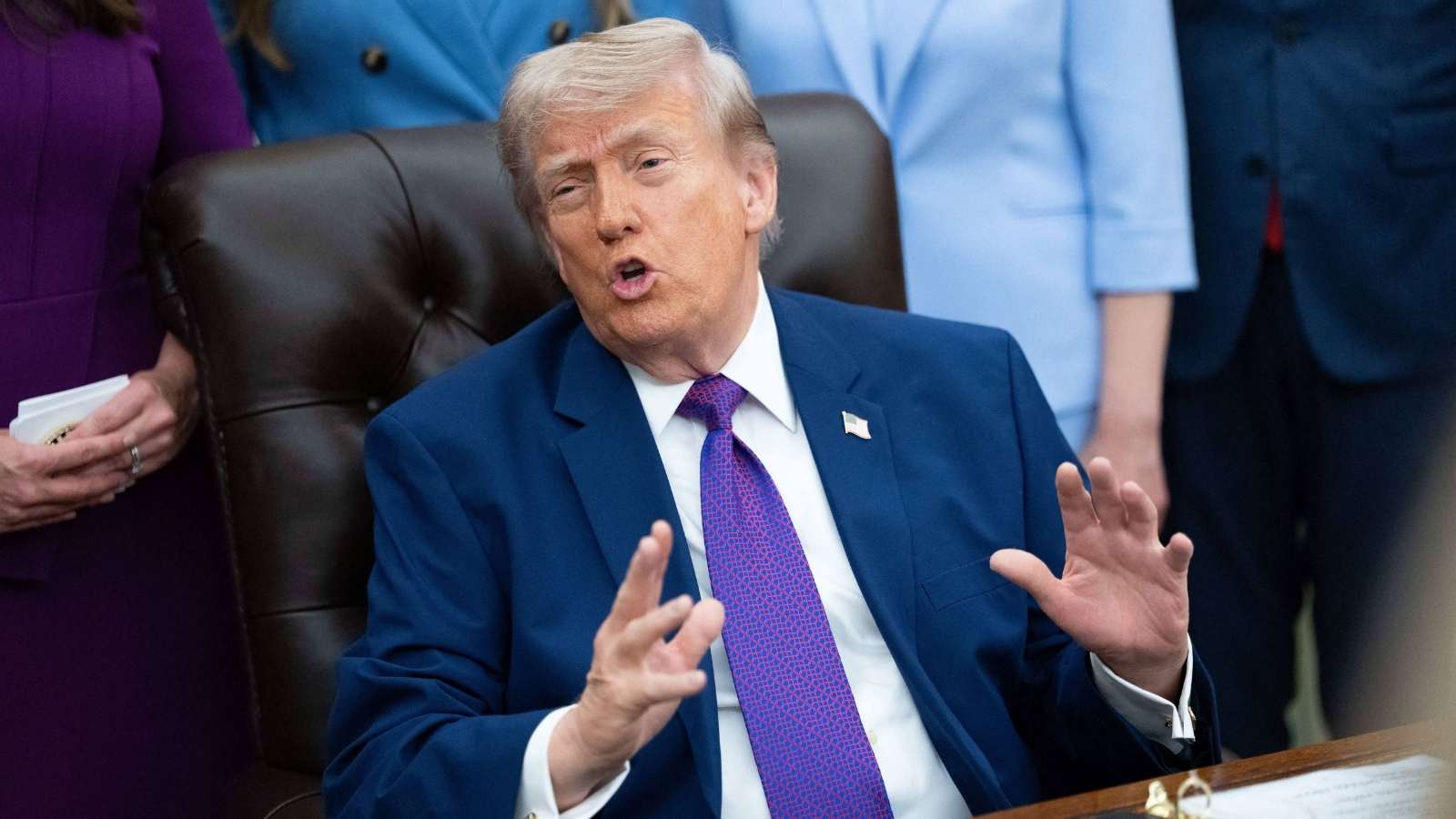
Donald Trump’s latest financial disclosure has turned a routine ethics filing into a major political and financial talking point.
Newly released documents from the U.S. Office of Government Ethics show that Trump’s trust carried out 3,642 securities transactions in the first three months of 2026. That includes 2,346 purchases and 1,296 sales between January and March, with the total reported volume estimated between $220 million and $750 million because the forms list broad value ranges rather than exact figures.
Analysts are already calling this one of the most active reported trading periods for Trump since he returned to the presidency. And the companies involved are not small names; we are talking Apple, Netflix, Disney, Nvidia, Goldman Sachs, Warner Bros. Discovery, Comcast, and more.
So what exactly is going on here? Let me walk you through it.
Trump Trust Invests in the Same Media Giants His Company Claims To Compete With
Trump’s own company, Trump Media & Technology Group, has been publicly positioned as an alternative to legacy media, basically, a competitor to the exact entertainment giants that dominate Hollywood and streaming. But while that narrative was being pushed publicly, Trump’s personal trust was quietly buying stock in those same companies.
The filings show his trust traded securities tied to Paramount Global, Warner Bros. Discovery, Netflix, Disney, and Comcast, all in the first quarter of 2026. One specific entry records a purchase of Comcast securities in the $1,000,001-$5,000,000 range on January 12, 2026. Another shows a Paramount purchase worth between $15,001 and $50,000 on March 25, 2026.
Warner Bros. Discovery investments total at least tens of thousands of dollars based on the banded entries, and Disney-related trades may exceed $1 million for the quarter. His public brand says one thing; his private portfolio says another.
Trades Raise Questions Amid Major Media Mergers Under His Administration
Now, this is the part that had ethics experts and watchdogs talking, and it is not hard to see why.
On December 5, 2025, Netflix publicly announced its intention to acquire Warner Bros. Discovery in a deal with a total enterprise value of approximately $82.7 billion, including an equity value of $72 billion. Shortly after that announcement, a financial disclosure showed Trump’s trust purchased up to $2 million in bonds tied to Netflix and Warner Bros. Discovery between mid-November and mid-December 2025.
Those late-2025 trades were flagged as potential conflicts of interest because they came immediately after a massive merger announcement involving companies that his own administration would be responsible for regulating. Then, on January 8, 2026, Paramount Skydance announced that its rival bid for Warner Bros. Discovery, valued at roughly $108 billion, including debt, was the superior deal to Netflix’s offer.

So now you have two competing mega-deals, both under regulatory review by Trump’s administration, and Trump’s trust is actively buying into the companies at the center of both deals. The commentators have been clear that these concerns remain expert opinion, not formal findings of wrongdoing, but the optics alone are doing much of the heavy lifting here.
Trump Trust Focuses on Big Tech, AI, and Crypto-Linked Companies
Beyond Hollywood, the Q1 disclosures show a serious concentration in tech and AI-related assets. The filings record at least nine trades in Nvidia, and at least nine in Apple, with individual transactions ranging from $1,001 to $5 million.
Trump’s largest disclosed Nvidia transaction, valued at $1-$5 million, occurred on February 10, 2026. His largest single Apple transaction, also in the $1 to $5 million range, occurred on March 2, 2026.
On the other side of the ledger, his trust made large sales of Microsoft, Amazon, and Meta, with each individual divestment falling in the $5 million to $25 million range. The trust also invested in an S&P 500 index fund, recording purchases in the $1-$5 million range.
And then there is the crypto angle. The portfolio shows a clear pivot toward crypto-adjacent equities, with purchases in MARA Holdings, Coinbase, Strategy, and SoFi. These are companies that are heavily tied to whatever regulatory decisions get made about digital assets, which, again, Trump’s administration has direct influence over.
Disclosures Reveal Gaps and Opaque Trading Strategies
Jessica: We just saw Donald Trump made at least $220 million of purchases in stocks. Paramount. Netflix, Warner Brothers, Palantir.
Watters: So did I. Everyone is buying those stocks.
Jessica: He should not be able to do that. You want to talk about Nancy Pelosi but you don’t… pic.twitter.com/wbcgYfMvnd
— Acyn (@Acyn) May 15, 2026
For all the numbers in these 3,642 transactions, the public records still have some significant gaps. The Office of Government Ethics forms require only broad ranges, not exact trade dates for each entry, so the total values remain rough estimates. The filings also often do not specify whether a given security is common stock, corporate bonds, or another instrument entirely, though some entries do explicitly reference ETFs or index funds.
Who is actually making the day-to-day buy-and-sell calls within the trust? The filings do not say. What specific strategy is driving the volume? Also not disclosed.
One outlet estimated that Trump appears to be significantly in profit across many positions based on price change calculations, but those are estimates, not audited returns. There is currently no definitive evidence establishing a direct link between specific policy decisions and specific trades.
What the Q1 disclosures do tell us, clearly and loudly, is that the president of the United States is running one of the most active investment portfolios of any sitting head of state in recent memory. Capital is moving through tech ecosystems, crypto-linked companies, and legacy entertainment simultaneously, while those same industries wait on policy decisions from the very administration managing the trust.
That boundary between regulating an industry and investing in it? It is getting harder to see with each new filing.