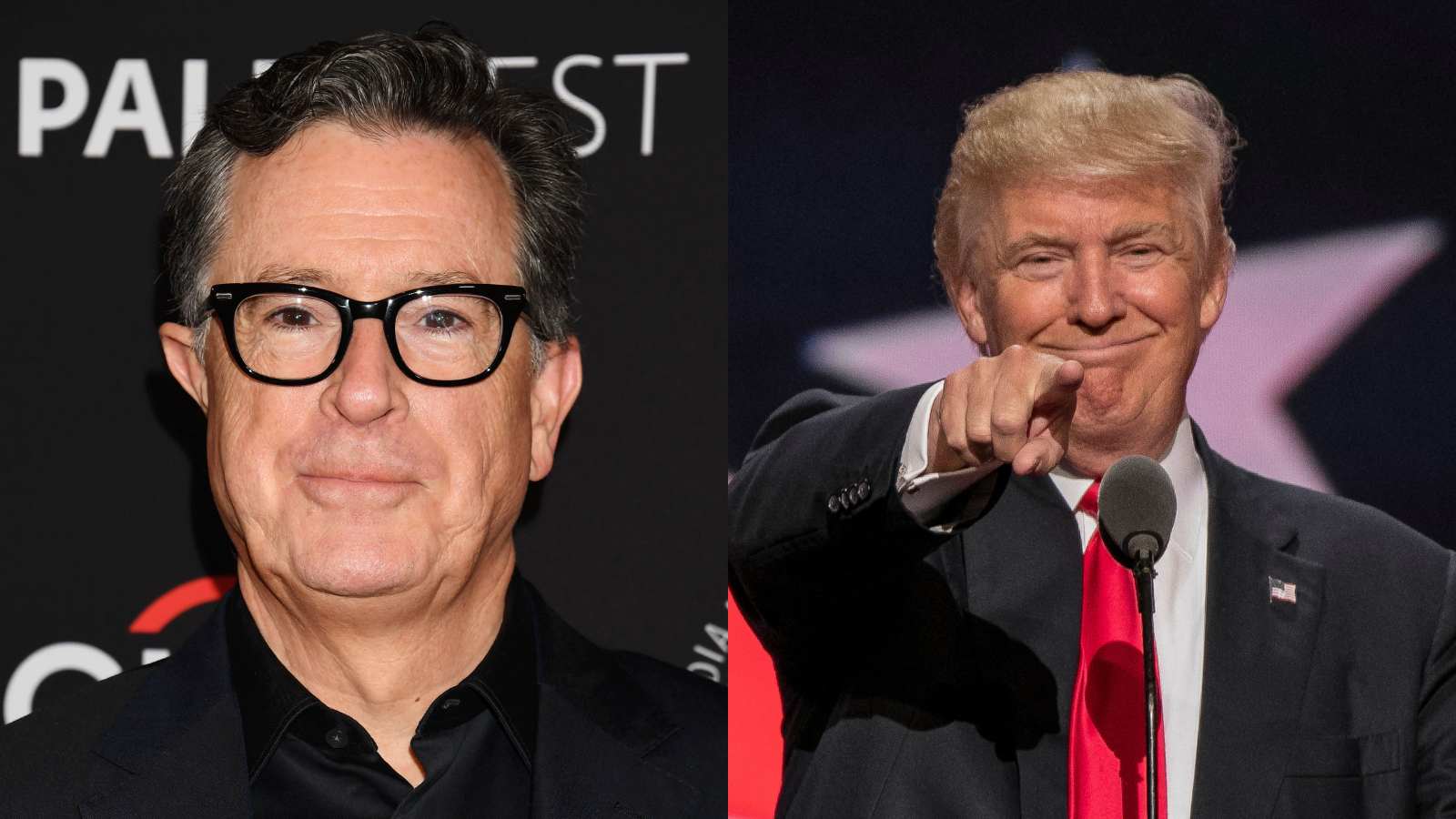
When you’re burning through $2 billion a day fighting a war that was supposed to last “four to six weeks,” and the president you elected is across the planet schmoozing dictators with tech billionaires while your gas prices are spiking… well, someone’s gotta laugh. And right now, that someone is Stephen Colbert.
Wednesday night’s Late Show was less a comedy monologue and more a perfectly timed gut-punch at a White House that simply cannot stop stepping on its own story.
Between Trump’s “fabulous billionaire boys trip” to Beijing, the slow-motion implosion of the FDA’s leadership, and classified intelligence reports blowing up the administration’s rosy Iran war narrative, Colbert had material for a week.
He used it all in one night, and the audience couldn’t get enough. For a show that CBS recently announced will end in May 2026, Colbert is going out swinging. Hard.
The Billionaire Carpool That We Didn’t Ask For
Trump’s delegation to Beijing included more than a dozen executives from some of America’s most valuable companies, Apple’s Tim Cook, Tesla’s Elon Musk, Nvidia’s Jensen Huang, BlackRock’s Larry Fink, Goldman Sachs’s David Solomon, Boeing CEO Kelly Ortberg, and Citigroup CEO Jane Fraser, among others. Seventeen CEOs in total, which is either a trade summit or the world’s most exclusive group chat.
Colbert, for his part, was fascinated by the sheer logistical indignity of it all. “It is so satisfying to realize that no matter how rich or powerful you may be, there’s a chance you might get stuck on a plane with Elon Musk,” he deadpanned to a roaring crowd.
NVIDIA CEO Jensen Huang was a surprise late addition to the trip, joining Air Force One when it refueled in Alaska, with Musk later saying on X that he and Huang were the only business leaders on the presidential plane.
Colbert noted the sheer theatrical excess of the whole scene and then landed the punch. When Trump posted on Truth Social that he’d be asking Xi to open up China so these “brilliant people” can “work their magic,” Colbert was ready: “Oh yes, these people can work magic. They’ve already made their taxes disappear.”
Upon arrival, Trump introduced the group to Xi by calling them all “distinguished representatives from the American business community” who “all respect and value China.”
View this post on Instagram
The delegation, in turn, told Xi they “highly value the Chinese market” and hope to do more business there. Xi welcomed “mutually beneficial cooperation” and assured them that American companies “will have broader prospects in China.”
That’s a lot of warm handshakes for a trip that, per Colbert, was really just a very expensive photo op with an empire the U.S. is simultaneously trying to contain.
Brett Ratner, the Hollywood director behind the Rush Hour franchise and most recently the Melania Trump documentary, was also on the trip, marking his first major project since 2017, when he was accused of sexual misconduct by numerous women.
Ratner has denied the allegations. Colbert, wisely, left that one sitting in the room like a dropped fork at a dinner party. The audience knew.
The War That’s Not Talked About Accurately
Here’s where the laughs get a little harder to swallow. The Iran conflict, launched on February 28 under the banner of “Operation Epic Fury,” was sold to the American public as a swift, decisive takedown. Trump himself predicted a wrap-up in four to six weeks. That was eleven weeks ago.
According to classified intelligence assessments, Iran still fields about 70 percent of its mobile launchers across the country and has retained roughly 70 percent of its prewar missile stockpile.
Most alarming to some senior officials is evidence that Iran has restored operational access to 30 of the 33 missile sites it maintains along the Strait of Hormuz, the narrow waterway vital to global oil trade.
That waterway, Colbert was quick to note, has a nickname. “Experts call it the poop chute,” he told his audience, referring to the Strait of Hormuz’s outsized role as the passage through which roughly 20 percent of the world’s daily oil supply flows. The joke landed. The math behind it is not so funny.
View this post on Instagram
“So what is America getting?” Colbert asked. “Well, less than we were promised… because we just learned that Trump has been drastically overstating US military success in Iran.”
The Pentagon said Tuesday that the direct cost of the war has now risen to $29 billion, up from an earlier estimate of $25 billion provided to Congress just two weeks prior.
And Harvard Kennedy School public policy expert Linda Bilmes projects that the total long-term cost to American taxpayers could reach at least $1 trillion, once future military repairs, weapons replacement, and veterans’ healthcare costs are factored in.
Bilmes put it bluntly: “I am certain we will spend $1 trillion for the Iran war. Perhaps we have already racked up that amount.” For context, her track record is credible: after the Iraq War, the official CBO estimate was $500 billion, and she and economist Joseph Stiglitz recalculated the actual cost at over $2 trillion. For Afghanistan and Iraq combined, she later put the figure at $4 to $6 trillion.
Colbert’s mock-MAGA response to the trillion-dollar figure was perfect: “Operation Sledgehammer, bro? OK, I’m back onboard. Take another trillion.”
The Name Game
That “Operation Sledgehammer” joke wasn’t just a punchline… it’s a real and genuinely alarming policy discussion happening inside the Pentagon right now.
The U.S. military is considering officially renaming the Iran conflict to “Operation Sledgehammer” if the current ceasefire collapses. Any new military combat operations would be conducted under a new name, and from the administration’s point of view, this would effectively restart the clock with Congress.
Why does that matter? Because the clock has a timer. The 1973 War Powers Resolution requires the president to notify Congress within 48 hours of starting combat; if that authorization isn’t obtained, troops must be withdrawn within 60 days, or Congress must formally authorize the action.
By declaring “Operation Epic Fury” concluded after the ceasefire, and then relaunching under a new name, the Trump administration could argue that the 60-day countdown resets entirely.
Secretary of State Marco Rubio told reporters that “Operation Epic Fury is over,” saying, “The president notified Congress. We’re done with that stage of it.”
Meanwhile, Pentagon officials continued publicly describing the conflict under the name Epic Fury, saying the ceasefire had simply “paused major combat operations.”
Those two descriptions cannot both be true. Which is, of course, exactly the kind of double-speak that keeps late-night writers employed.
The Other Shoe That Dropped
Amid all the geopolitics and war spending, Tuesday also brought the unceremonious exit of FDA Commissioner Marty Makary, who lasted just 13 months in the job.
According to NPR’s reporting, the final straw for Makary was White House pressure to approve flavored vapes, something he did not agree with. That pressure had been building for a while.
Makary’s tenure was marked by internal dysfunction, leadership turmoil, and mounting backlash from drugmakers, physicians, and patient groups over regulatory decisions.
His replacement? Kyle Diamantas, the FDA’s top food regulator and a lawyer, not a medical doctor, is an unusual choice to lead a science-based agency.
As Peter Lurie, director of the Center for Science in the Public Interest, put it with zero diplomatic pretense: “Kyle Diamantas now has a nearly impossible charge, leading, as a non-scientist, a science-based agency under an unqualified secretary who puts his own medical and nutritional pet peeves over evidence-based public health.”
Colbert connected the dots quickly: in one 24-hour window, the man overseeing your food and drug safety was out; the war everyone said was over is apparently not; and the president was 7,000 miles away on a field trip with Silicon Valley royalty.
The audience laughed, the way people laugh when something is genuinely absurd and also genuinely real.
The Angle That is Too Harsh to Look
Here’s the take that deserves a fair hearing. There’s a credible school of thought among media critics and political scientists that says relentless late-night ridicule of Trump doesn’t hurt him; it may, in fact, help him.
Every Colbert monologue that mocks Trump’s base as MAGA rubes who’d “take another trillion” for a cool op name reaches an audience that already agrees.
The people watching The Late Show at 11:35 on CBS were not, statistically speaking, the Americans who felt left behind by the economy and voted for disruption.
Comedy that preaches to the converted doesn’t convert anyone; it just reinforces the cultural chasm that political analysts say was one of Trump’s greatest assets in 2024.
Trump has always thrived in opposition. His brand is built on being the guy the coastal media laughs at. When Colbert mocks the “poop chute,” the Rust Belt hearing about it third-hand sees, once again, someone from New York making fun of them by proxy.
That doesn’t mean Colbert should stop. It means the jokes land differently depending on where you’re sitting. And in a country where gas just jumped 27 cents in a week because of a war that’s costing $2 billion a day, the people footing that bill aren’t all watching CBS at midnight.
The economic pain is real. The comedy is real. The question of who’s actually listening to which one, that’s the story nobody in late-night wants to tell.