
Both families lost a husband and father. Both had supporters ask the public for help. Both received millions.
The disparity isn’t in their grief. It’s in how the public chooses to respond to it.
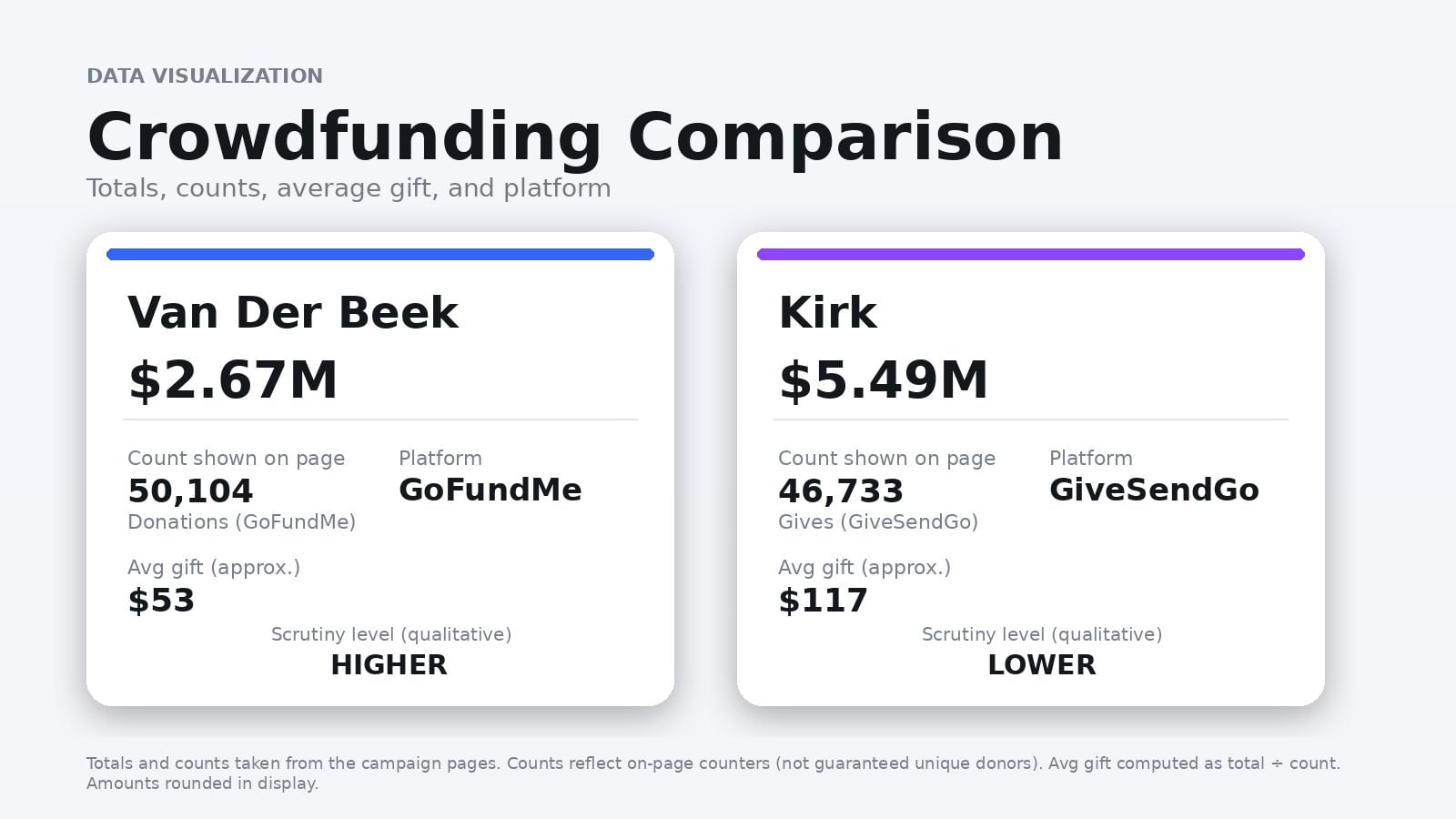
James Van Der Beek’s GoFundMe has raised $2,665,793 from 50.1k donations as of Tuesday, Feb. 17, at about 7.00 a.m. ET, about 77% over its $1.5 million goal. The campaign, created by Friends of the Van Der Beek family, lists Kimberly Van Der Beek as the beneficiary
Charlie Kirk’s main GiveSendGo fundraiser showed $5,490,055 raised toward a $6 million goal from 46,733 gives as of Tuesday, Feb. 17, at about 7.00 a.m. ET. The campaign is created by ALP Pouches, and the page lists Erika Kirk as the recipient of the funds. Newsweek previously reported that the ALP GiveSendGo was at $5.4 million in late September 2025, with other related fundraisers also raising additional money.
Both campaigns succeeded. But the public response couldn’t have been more different.
Van Der Beek’s GoFundMe Sparked Debate

The scrutiny began with one phrase from the GoFundMe page, as our earlier reporting detailed:the family being “out of funds” while trying to stay in their home after Van Der Beek’s death from colorectal cancer at 48 on Feb. 11, 2026.
Then came the detail that intensified questions. Entertainment Weekly reported that Van Der Beek had finalized a $4.76 million Texas ranch purchase shortly before his death. The outlet also reported that a representative said he secured the down payment with help from friends through a trust.
Comments focused on assets. Why not sell the ranch? What about other properties? How can a family with millions in real estate be “out of funds”?
Entertainment Weekly also noted Van Der Beek’s past comments about getting “almost nothing” in Dawson’s Creek residuals, undercutting the assumption that TV success automatically equals permanent wealth.
The debate became about who qualifies as “deserving.”
Kirk’s GiveSendGo Got Tributes
When Charlie Kirk, 31 at the time of his death, was fatally shot at a Utah Valley University event on Sept. 10, 2025, the fundraising response was immediate. Newsweek reported that a GiveSendGo fundraiser set up by ALP had raised millions toward a $6 million goal, with other related fundraising efforts also pulling in additional support.
The visible tone around the campaign was different. Many donors framed contributions as honoring Kirk’s legacy, not auditing a balance sheet. Questions about assets or financial planning were far rarer in the public conversation.
The Platform Difference

GoFundMe operates in the mainstream space where skepticism comes with the territory, especially when the recipient is famous. People default to means-testing. They look for contradictions. They demand receipts.
GiveSendGo has a different cultural footprint. TIME has described it as a “Christian crowdfunding site” that grew by positioning itself as an alternative when GoFundMe cut off high-profile, politically charged campaigns. The community norms are different even before anyone clicks donate.
On GoFundMe, skeptics ask, “Do they really need this?” On GiveSendGo, supporters ask, “How can we help?”
The platform shapes the conversation before a dollar is donated.
Two Different Rulebooks

Rulebook A says: Liquidate assets first. Downsize if necessary. Crowdfunding is for people with no other options. Transparency matters.
Rulebook B says: Don’t interrogate the grieving. Supporting the family honors the person who has passed away. Community takes care of its own.
Neither is objectively right nor wrong. Both reflect sincere moral frameworks. The tension comes when they collide in public view.
Need vs. Cause
Van Der Beek’s campaign was framed as a need: medical care depleted funds, stability for six children.
Kirk’s campaign was framed as a need and a cause: support for a family, plus a statement of solidarity tied to identity and values.
When giving connects to identity, it plays by different rules. Support becomes communal, not just charitable.
What Both Families Share
Despite different public reactions, both Erika Kirk and Kimberly Van Der Beek face similar realities: raising children alone, managing estates while grieving, navigating public attention at their worst, and trying to create stability when everything shifted overnight.
Erika Kirk lost her husband to violence. Kimberly Van Der Beek lost hers to cancer. Both received millions in support. Both are trying to move forward.
Same grief. Different rulebooks.
The Numbers Behind the Noise
Nearly 100,000 on-page actions were recorded on these pages as of Tuesday, Feb. 17, 2026, about 7:00 a.m. ET. The Van Der Beek GoFundMe showed 50.1K donations, and the Kirk GiveSendGo page showed 46.7K gives on its “Give” counter.
While some commenters argued about whether Van Der Beek’s family “deserved” help, the campaign still climbed far past its goal.
While Kirk’s fundraising wave faced far less public skepticism, the numbers rose rapidly and kept rising.
The vast majority didn’t comment, didn’t debate, didn’t demand receipts. They just gave. And that’s the part that gets lost in the loudest parts of the conversation.
The average donation tells a different story too. Van Der Beek’s GoFundMe averaged $53 per donor. Kirk’s GiveSendGo averaged $117—more than double. The platform difference wasn’t just about scrutiny. It was also about the depth of commitment. Higher average gift size, smaller gap in total gifts.
What the Difference Reveals
The disparity between these campaigns holds up a mirror. The questions we ask, or don’t ask, reveal assumptions about wealth, celebrity, politics, and who qualifies for compassion.
Some people see a multimillion-dollar ranch and think, “Liquidate first.” Others see long-term medical costs and understand how resources disappear.
Some people see a Hollywood actor and assume forever money. Others see a family trying to survive a financial cliff after a prolonged illness.
Some people see a political activist and treat giving as a sign of loyalty. Others see a young father killed at an event and respond with protective instinct.
All of these perspectives exist. Many are sincerely held. The question isn’t which one is correct. The question is why we apply them so inconsistently.
No Simple Answer
Both families received support because people wanted to help. The difference in reaction shows how platform, community, framing, and timing determine whether the internet scrutinizes or shelters, and what that says about the rulebook we rely on when money meets grief.