
A North Carolina tax preparer who fabricated business income and expenses on clients’ federal tax returns to increase their refunds has been sentenced to more than two years in federal prison.
Danielle Melissa Staten, 40, owned and operated Precise Tax Preparation LLC. Federal prosecutors said she prepared false Forms 1040 for clients over several years, inserting information that allowed them to claim larger refunds than their legitimate tax information supported.
The U.S. Attorney’s Office for the Eastern District of North Carolina placed the resulting tax loss at approximately $1.5 million. The court also ordered Staten to pay $1,508,171 in restitution to the Internal Revenue Service and serve one year of supervised release.
A central part of the scheme involved Schedule C forms used to report business profit or loss. Prosecutors said Staten made up income and expenses on those forms to generate fraudulent Earned Income Tax Credit claims and increase the refunds her clients could receive.
False Business Figures Changed Earned Income Tax Credit Claims
Schedule C is used by sole proprietors to report business income and deductible expenses. The resulting net profit or loss becomes part of the taxpayer’s federal return and can affect credits tied to earned income.
Earned income affects both eligibility for the Earned Income Tax Credit and the amount a taxpayer can claim. Prosecutors said Staten fabricated Schedule C income and expenses to alter those calculations, producing fraudulent EITC claims and larger refunds.
IRS guidance for paid preparers specifically addresses self-employment income on EITC returns. The agency tells preparers to make additional reasonable inquiries when information appears incorrect, incomplete or inconsistent and to determine whether the self-employment figures used to calculate the credit are accurate and complete.
State Records Show the Tax Business Was Formed in 2018
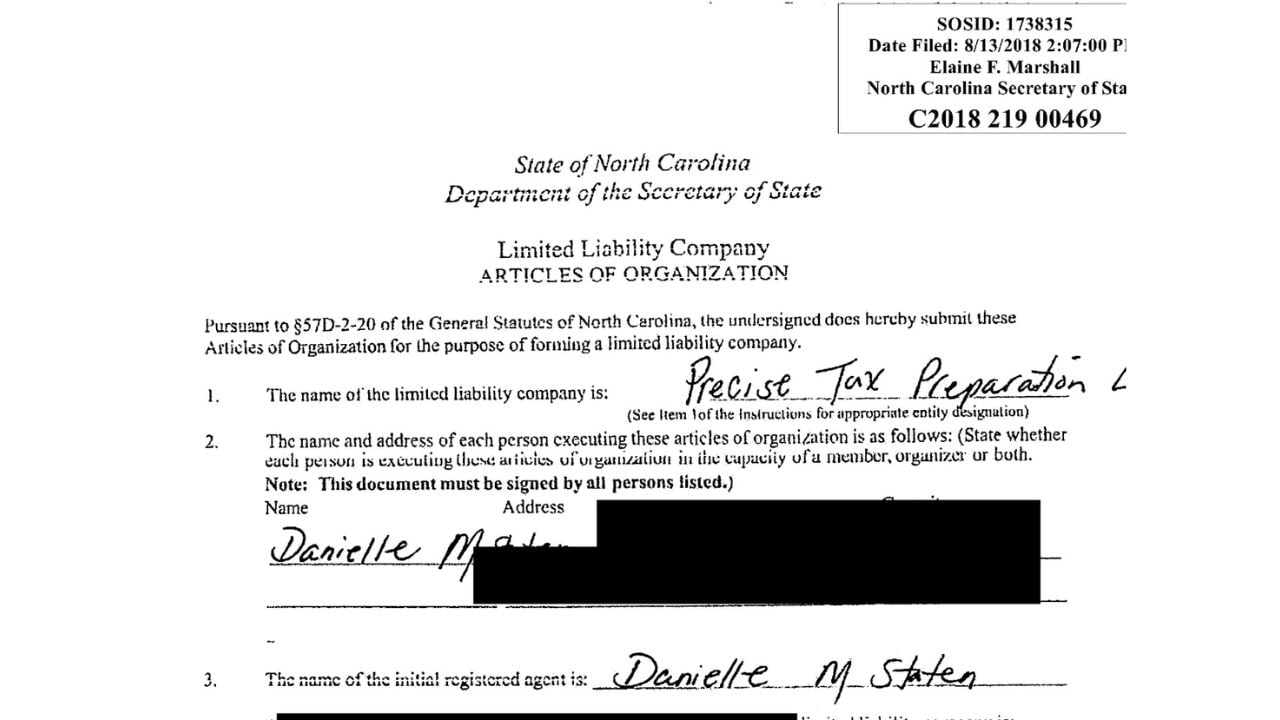
North Carolina records show that Precise Tax Preparation LLC was created on August 13, 2018, the same year prosecutors said Staten’s false-return conduct began. The company’s Articles of Organization identify Danielle M. Staten as the person who executed the filing and as the initial registered agent, with a principal office in Greenville.
An amended 2022 annual report continued to identify Staten as chief executive officer. It described the company’s business as tax preparation, accounting and consulting and listed its principal office in Rocky Mount at that point.
The state’s administrative dissolution certificate shows that North Carolina dissolved Precise Tax Preparation LLC on October 5, 2023, for failure to file an annual report.
The Court Ordered More Than $1.5 Million in Restitution
Staten was sentenced for aiding and assisting in the preparation of a false tax return. IRS Criminal Investigation’s Charlotte Field Office investigated the case, which was prosecuted in the Eastern District of North Carolina as United States v. Danielle Melissa Staten, case number 4:26-CR-15-D.
U.S. District Judge James C. Dever III sentenced Staten to more than two years in federal prison followed by one year of supervised release. The court also ordered her to pay $1,508,171 in restitution to the IRS.
Taxpayers Can Check Schedule C Before a Return Is Filed
The IRS advises taxpayers to review a completed return before signing it and ask questions about information that appears incorrect or unfamiliar.
Schedule C should reflect income and expenses from a taxpayer’s actual business activity. A taxpayer who did not operate the business shown on the form, or who sees income or expenses that do not match their records, should resolve those entries before the return is filed.
Paid federal tax preparers must sign the returns they prepare and include a valid Preparer Tax Identification Number. The IRS also says taxpayers remain responsible for the information reported on their returns even when a paid professional prepares them.
Taxpayers who believe a preparer entered false information or changed a return without permission can use the IRS preparer complaint process. The agency’s complaint guidance covers conduct including fictitious income or expenses, false information and returns altered or filed without the taxpayer’s proper authorization.