
A 32-second video shouldn’t be able to break a country’s self-image. But here we are.
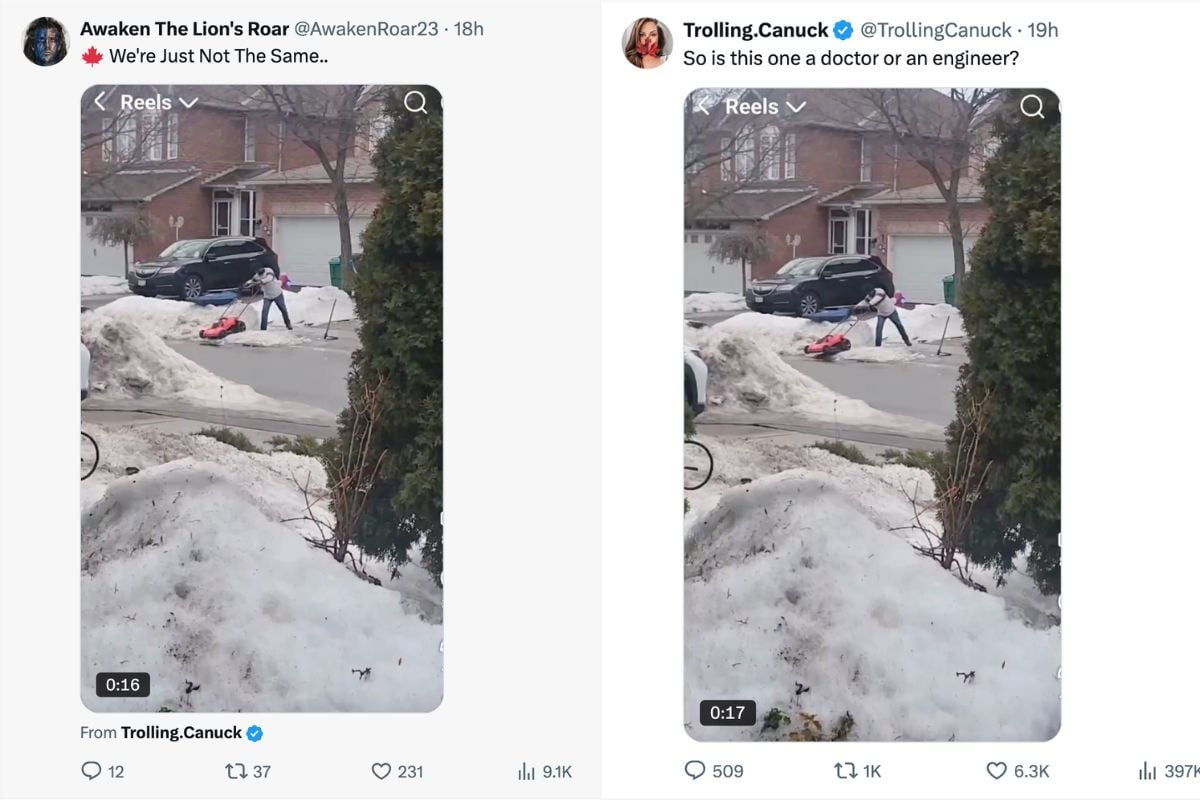
The clip, posted to X on March 8, shows a man in Brampton, Ontario pushing a red electric lawnmower through snow on a residential driveway. Not a snowblower. Not a plow. A lawnmower — the thing you use to cut grass — with an extension cord trailing through the slush behind him. A broom leans against a pile of snow nearby, unused, almost judging him.
Within hours, it had over a million views. Not because the internet found it funny — though it is — but because the comment sections turned it into something else entirely.
The video’s exact location and authenticity have not been independently verified, but the internet had already made up its mind: this was Brampton.
4 million people like this in Canada. Notice this guy has 3 cars in his driveway of his $750,000 townhouse. They are scamming to survive and every scammer loophole needs to be closed and they need to go go immediately. They don’t belong here. pic.twitter.com/rsiliTRCyz
— bu/ac (@buperac) March 8, 2026
The Driveway That Became a Debate
The posts that pushed the video viral didn’t focus on the lawnmower. They focused on the man.
“So is this one a doctor or an engineer?” one account wrote, racking up hundreds of thousands of views. Another pointed to the cars in the driveway and the $750,000 townhouse: “They are scamming to survive and every scammer loophole needs to be closed… They don’t belong here.” A third: “We absolutely need 60,000,000 more of these in Canada as your neighbour.”
None of them were talking about snow.
They were talking about Brampton. And if you’re American, you probably haven’t heard of it — but in Canada, it’s the single most charged word in the country’s immigration debate.
The City That Changed
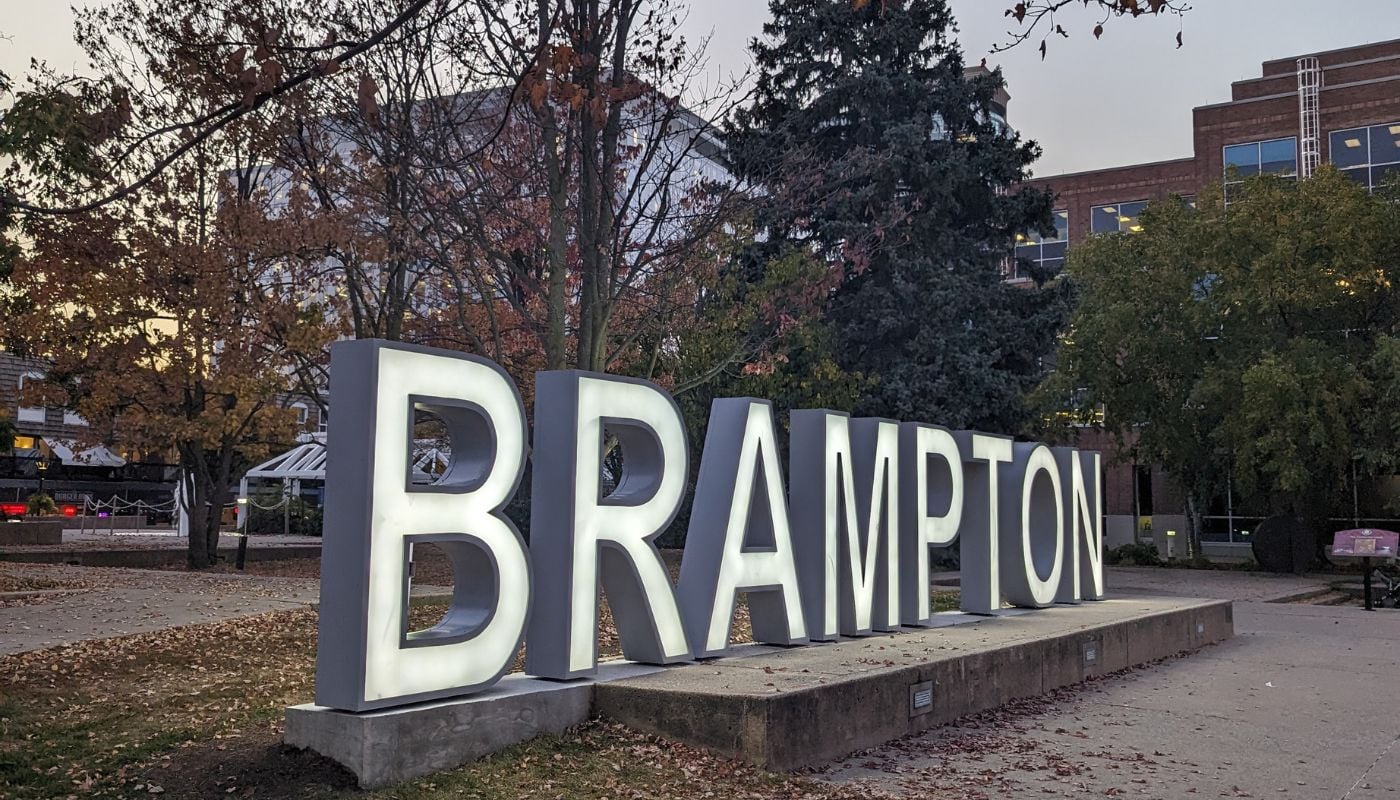
Brampton is a suburb of Toronto with about 650,000 residents. It was named after a town in Cumberland, England, and for most of its history, it looked the part. In 1996, the city was roughly 70% white and 13% South Asian.
By 2021, South Asians made up 52.4% of the population. The white population had dropped below 19%. A quarter of residents identified as Sikh. The most common country of birth for immigrants was India. More than half of all residents were foreign-born.
Gurdwaras and Hindu temples replaced churches. Punjabi bakeries filled strip malls. The internet gave the city nicknames: “Browntown,” “Bramladesh,” “Singhville.” Brampton’s own mayor accidentally used one during a speech in 2021, then refused to apologize.
Brampton was 75% White in 1993. Today it’s 19%. Yes, Brampton Ontario in fucking Canada in less than 20% White now. pic.twitter.com/JaEy5bOfli
— Caulin (@caulin001) November 18, 2025
For some, the city represents what Canadian multiculturalism looks like when it works — a thriving, middle-class community that happens to be majority South Asian. For others, it’s proof that something went wrong.
Canada’s Quiet Identity Crisis
Here’s the part most Americans don’t know: Canada is having a reckoning about immigration that would sound eerily familiar south of the border.
For decades, welcoming newcomers was the foundation of Canada’s brand. Multiculturalism wasn’t just a policy — it was in the constitution. When Syrian refugees needed resettlement in 2015, Canadians showed up at airports with winter coats and signs. “Diversity is our strength” felt like a national slogan, not a bumper sticker.
That consensus has collapsed. As of late 2025, 56% of Canadians believe the country accepts too many immigrants — more than double the number from three years earlier. The shift is sharpest among young Canadians. Respondents aged 18-29 now show the strongest opposition — a complete reversal of the pattern that held for decades.
The reasons aren’t abstract. Housing in the Greater Toronto Area has made homeownership a fantasy. Emergency rooms have wait times measured in days. A generation told they’d inherit a compassionate country can’t afford a one-bedroom apartment.
And in Brampton — the most visible example of demographic change in the country — all of those frustrations have a face.
The Lawnmower, and What It Really Cut
There’s a decent chance the video was staged. The setup — a lawnmower, in snow, with an extension cord — feels designed to generate exactly the reaction it got.
But that’s what makes it matter. Whether the man was clearing his driveway or performing for a camera, the response was real. The million views were real. The calls for deportation were real. The sarcasm about doctors and engineers — a dig at the argument that Canada’s system selects for skilled workers — was real.
A country that spent decades telling the world it had figured out how to be open and stable watched a man push a lawnmower through snow and used it as evidence the experiment failed.
The lawnmower didn’t clear the driveway. But it cut through something — the last thin layer of pretense that Canada’s relationship with immigration is any different from everyone else’s.
What Comes Next
Canada’s government has already started responding. Immigration targets have been slashed — permanent resident admissions dropped 21% in 2025, with further cuts planned. Even among immigrants themselves, support for high intake levels has eroded; polls show first-generation Canadians are now nearly as likely as the native-born to say there’s too much immigration.
The lawnmower video is already fading from the timeline. But the conditions that made it explode — the housing crisis, the demographic anxiety, the gap between what Canada says it is and what it feels like to live there — aren’t going anywhere.
Somewhere in Brampton, the snow is melting on its own. The driveway will be fine. The rest of it is going to take longer.