
For nearly a century, CBS spoke with what many called the “Voice of God.” It was a tradition of polished, unshakeable authority that began with Walter Cronkite and supposedly ended with the rise of the digital fragment.
But this week, the network attempted something radical. It decided to stop being a distant authority and start being a neighbor.
The man chosen to lead this transformation is Tony Dokoupil. His tenure as the solo anchor of the CBS Evening News began not with the expected fanfare, but with a visceral, unscripted apology for the very industry he now represents.
In a “Trust Manifesto” released on New Year’s Day, Dokoupil essentially took a sledgehammer to his own pedestal. He admitted that legacy media had lost its way by listening to “elites and academics” instead of the public.
It was a daring opening gambit. It signaled that the “New CBS”—now under the editorial direction of firebrand Bari Weiss—is no longer interested in the approval of the coastal establishment.
The transition from theory to practice has been anything but smooth. The “Dokoupil Experiment” was meant to launch with a calculated “listening tour.” Instead, a military raid in Venezuela forced him into the anchor chair early.
On Saturday, January 3rd, the polish of a traditional studio launch was stripped away to cover the capture of Nicolás Maduro. By the time his official weekday debut arrived on January 5th, the cracks in the new facade were visible to everyone with an internet connection.
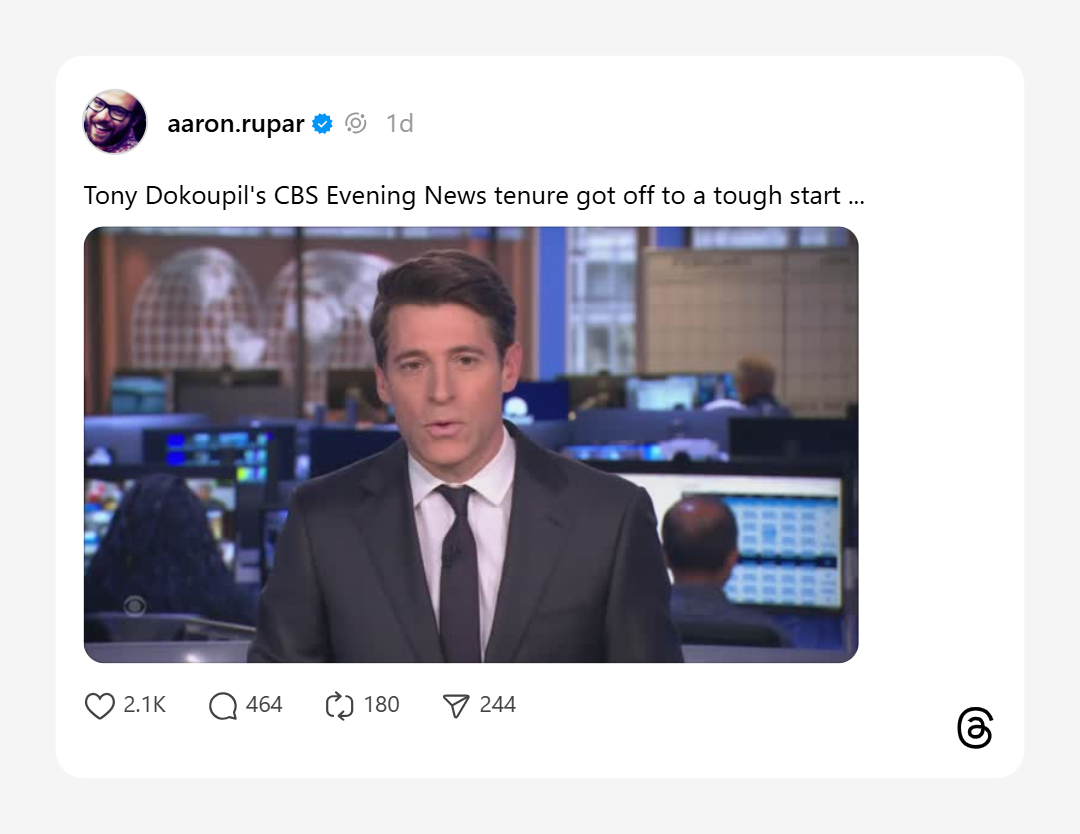
A series of technical failures—from dead air to misidentified politicians—turned what should have been a triumphant rebranding into a viral blooper reel.
When Dokoupil smiled into the camera and muttered, “First day, big problems here,” it was a moment of jarring authenticity. Critics were left wondering if the network was humanizing the news or simply losing control of it.
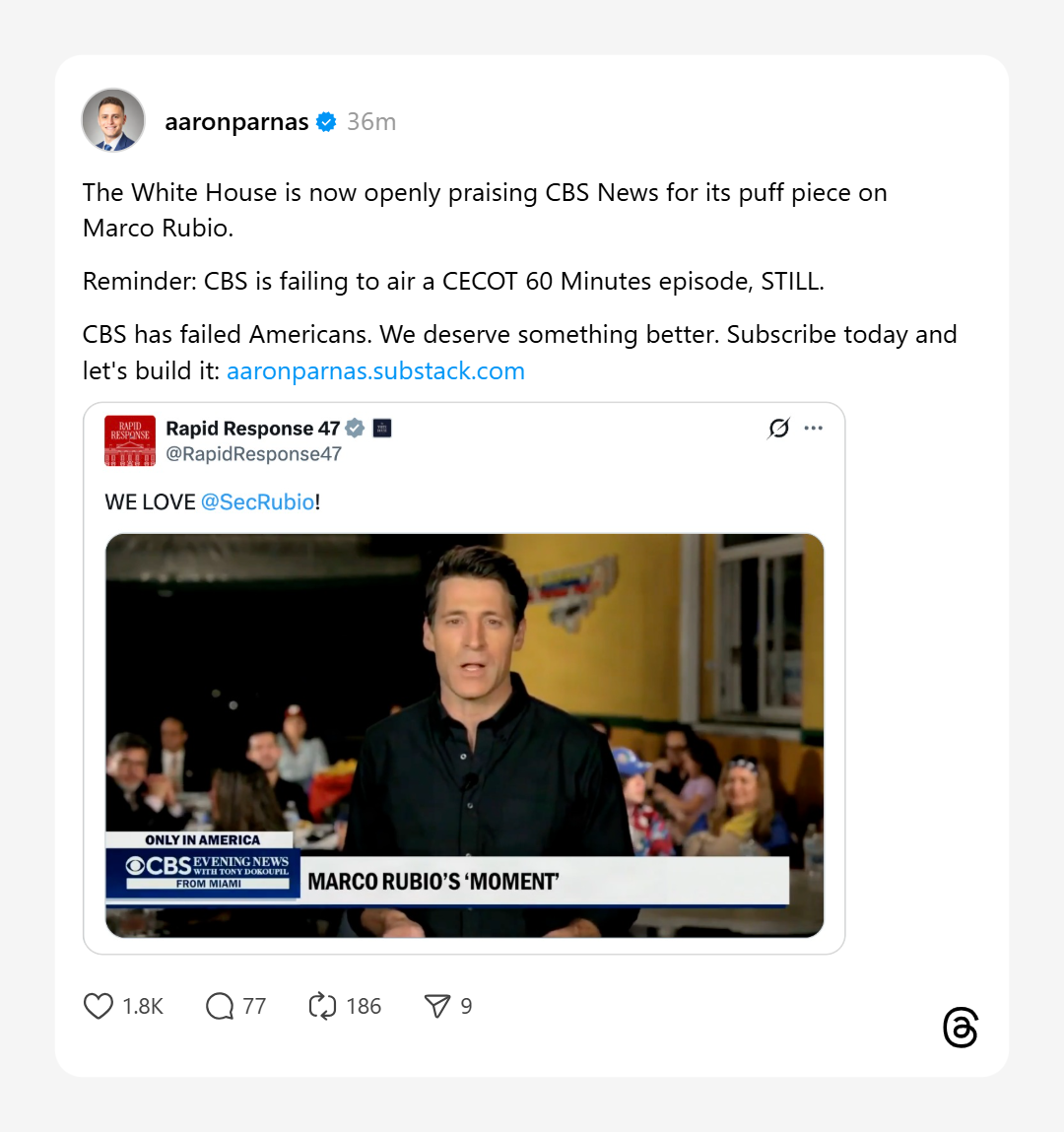
The tension only tightened as the broadcast moved to Miami, where the network’s new populist pivot took a decidedly political turn. In a segment that sent shockwaves through social media, Dokoupil used AI-generated memes to celebrate Secretary of State Marco Rubio.
He declared, “Marco Rubio, we salute you. You are the ultimate Florida man.” To his supporters, it was a breezy, relatable departure from the stilted neutrality of his predecessors. To his detractors, it was a “cringe-worthy” audition for a MAGA-coded audience.
This polarizing energy was compounded by an emotional segment where Dokoupil reflected on his childhood in Florida, even wiping away tears on-air. The display prompted critics to question whether such vulnerability was an earned moment of merit or a manufactured performance for a specific demographic.
To understand why Dokoupil is currently the most polarizing man in American media, one must look past the anchor chair. His identity is rooted in a childhood defined by high-stakes deception.
Growing up with a father who was a massive marijuana smuggler while posing as a real estate developer, Dokoupil lived in a world where the “official story” rarely matched the “actual truth.”
This background left him with a lifelong allergy to institutional narratives. It gave him a self-described “superpower” for detecting when a story feels too polished or “elite.”
Ultimately, what is happening at CBS is a high-wire act with no safety net. As the network prepares for the exit of late-night crown jewel Stephen Colbert in May 2026, the network is betting its entire future on a new philosophy.
It is a $150 million gamble that a “daily conversation” can replace the “nightly news.”
The first week of the Dokoupil era suggests that trust is harder to build than a viral moment. If this experiment fails, it won’t just be the end of a single anchor’s tenure.
It may be the final confirmation that the era of the national news anchor has finally, and irrevocably, passed into history.