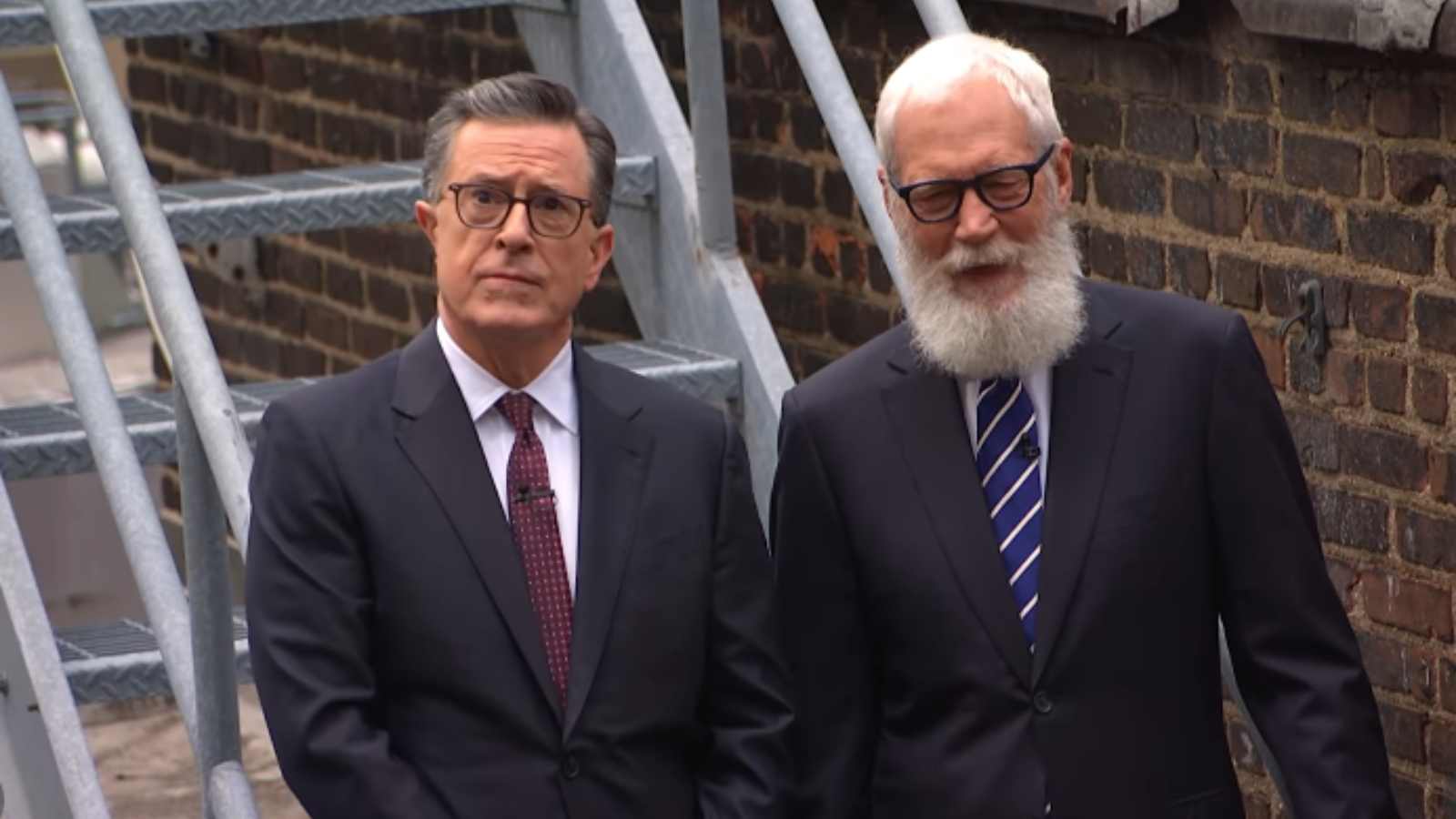
You know those moments where something is so satisfying you want to rewind it, watch it again, and then send it to everyone you know with zero context? That was Thursday night on The Late Show with Stephen Colbert, and you need to hear every detail.
David Letterman, the silver-bearded godfather of late-night television, came back to the building he rebuilt, sat down across from the man he handed his legacy to, and did what every sane person who has watched this entire circus unfold has been desperately wanting someone to do: he pointed his fury directly at CBS and absolutely let it rip.
This was not a sentimental farewell lap, nor was it a teary tribute segment with soft piano music in the background. This was a man who helped build one of the most storied franchises in television history, watching it get dismantled under transparently political circumstances, and deciding that the only appropriate response was to throw the furniture off the roof. Literally.
Because at a certain point, words are not enough, and a couch crashing onto a CBS logo eight stories below says things that no monologue ever could.
Letterman, whose beard has grown so spectacularly bushy it has drawn comparisons to Joaquin Phoenix during his infamous performance art phase, took the stage to a killer “Seven Nation Army” musical intro and a standing ovation that felt earned in every possible direction.

He did not ease into the conversation. He did not exchange pleasantries. He came out swinging with a joke that was really not a joke at all: “Well, you know what happened backstage? I’m standing backstage, and a guy comes over, he says he’s from CBS, and he fires me. What is going on over there?! I have every right to be pissed off, so I’ll be pissed off here a little bit.”
The audience lost it. Because this is the version of Letterman people have been waiting to see on that stage, and he did not disappoint. He then reminded the room of what was actually built inside that theater: “Because this theater, you folks, wouldn’t be in this theater if it weren’t for me. And Stephen wouldn’t be here if it weren’t for me. We rebuilt this theater, and then Stephen came in, and, look at this, it’s like the Bellagio.”
And then he said something that is going to echo around late-night conversation for a long time: “You can take a man’s show, you can’t take a man’s voice.”
How One Visit Became a Television Event
Colbert’s 11-year run as host of The Late Show will end on May 21, and its untimely demise was announced mere weeks before the Trump-loyalist Ellison family finalized their CBS-Paramount takeover.
Many immediately drew the connection, reading it as a move to appease the Trump administration, while the network claimed Colbert’s program was losing around $40 million a year.
That figure prompted friendly rival Jimmy Kimmel to quip that there was “not a snowball’s chance in hell that’s accurate.” Trump, for his part, was not subtle about his delight. He posted to Truth Social: “I absolutely love that Colbert got fired. His talent was even less than his ratings. I hear Jimmy Kimmel is next. He has even less talent than Colbert!”
And Colbert, to his eternal credit, responded on air with the kind of precision that only a man who has nothing left to lose can deliver: “How dare you, sir. Would an untalented man be able to compose the following satirical witticism? Go f*** yourself.”
So when Letterman walked out Thursday night, both men knew exactly what kind of evening this was going to be. It was going to be cathartic.
Letterman eyed the furniture on Colbert’s set and told him, “Yeah, this is nice. Would be a shame if something happened to it,” then confirmed that the pieces belonged to CBS before arranging for a crew of stagehands to strip the stage clean.
With nowhere left to sit, the two men moved into the audience and sat with the crowd, reminiscing about their shared history inside Manhattan’s legendary Ed Sullivan Theater, which Letterman noted had come to “a screeching halt by other hands.”
The detail that makes this whole thing even richer is something Colbert revealed once they made it to the roof: “This is a true story. When I first got this gig, one of the first things they told me before we even moved into the offices is that I would not be allowed to throw anything off of the roof of the Ed Sullivan building, because evidently there was a problem with a previous tenant.”
That previous tenant, of course, was Letterman himself, who was famously known for tossing watermelons out a window at NBC back in the day. The network banned the bit. It took eleven years, a corporate takeover, a politically tinged cancellation, and one very angry former host to finally undo that ban.
They threw the couches. They threw Colbert’s desk chair. They threw watermelons. They threw a wedding cake. And all of it landed on a giant CBS logo painted on the ground below. Letterman capped the whole sequence with a send-off to the network that will be quoted for years: “In the words of the great Ed Murrow, good night and good luck, motherf***ers.”
View this post on Instagram
The Truth That CBS Might be Avoiding
Here is where the story gets genuinely complicated, and where a different reading of this whole beautiful, chaotic spectacle starts to take shape. The roof segment was an incredible piece of television.
It was funny, vicious in a way, and deeply satisfying on every emotional level. But there is an argument to be made that it also served as the perfect pressure valve, and that is not entirely a compliment.
Letterman, who now hosts his own Netflix series, My Next Guest Needs No Introduction, has been vocal in his opposition to the cancellation. He called CBS “lying weasels” in a recent interview with The New York Times, questioning the “humanity” of a network that would deprive millions of people of a late-night respite they clearly still valued.
He went further, laying out what he believed actually happened: “He was dumped because the people selling the network to Skydance said, ‘Oh no, there’s not going to be any trouble with that guy. We’re going to take care of the show. We’re just going to throw that into the deal. When will the ink on the check dry?”
That is a serious allegation dressed up in conversational language, and it deserves to be treated as such. The furniture-throwing was extraordinary television. But the more pointed danger is that the laughter and spectacle let CBS off the hook just a little.
When something ends in a shower of watermelons and a bleeped profanity directed at a logo on the pavement, it feels resolved. It feels avenged. It gives the audience a sense of closure that the situation might not actually deserve.

The Late Show is currently the most-watched late-night program on television, averaging more than 2.7 million viewers according to Nielsen data. In 2025, it earned its first Emmy Award for Outstanding Variety Talk Series.
Those are not the metrics of a dying show. The CBS franchise itself, which dates to August 1993, will now be shelved entirely, with the 11:35 p.m. time slot going to Byron Allen’s Allen Media Group starting May 22, airing syndicated comedy programming that Allen’s company is buying time to broadcast.
The institution gets replaced by a time-buy arrangement. The Emmy-winning, ratings-leading show gets replaced by a game show. And CBS gets away with it partly because the ending has been so entertaining that it almost feels like a victory. Almost.
Jimmy Kimmel has confirmed he will not air a new episode opposite Colbert’s finale on May 21, a gesture he also extended to Letterman during his final show in 2015. NBC has announced a Tonight Show rerun for the same night.
Late-night will go quiet for one evening in solidarity. It is a genuinely moving gesture from a community that has clearly rallied hard around Colbert since the news broke.
The week leading into the finale has brought a parade of guests that reads like a who’s who of American cultural life: Barack Obama, who sat for “The Colbert Questionert” and reflected on mortality and memory, Tom Hanks, who surprised Colbert with birthday gifts including dot matrix paper, and Pedro Pascal and Julia Louis-Dreyfus, each of whom planted a kiss on the host.
And now, with one week to go, Letterman has set the tone for what the finale itself might need to be: not just a goodbye, but a reckoning.
Colbert himself has already announced he will be working on a Lord of the Rings movie alongside his son as a screenwriting project, so the man has places to be.
But the Ed Sullivan Theater, that magnificent room that Letterman rebuilt and Colbert filled for a decade, will go dark on May 21, and what replaces it will not be anywhere close to what it was.
Thursday night was the best possible version of a send-off: loud, funny, a little bit dangerous, and honest in exactly the right places. Letterman called them lying weasels in the press.
Then he came to the building and proved it by throwing a wedding cake eight stories onto their logo. That is as close to justice as late-night television is going to get.