
A North Carolina fraud investigation that began after a 69-year-old disabled veteran reported losing control of her finances has expanded to three additional women whom investigators believe may have experienced similar conduct.
Richard Allen Gilbert, 60, of Clinton, allegedly met the first woman through Facebook Dating after she moved to Sampson County from Virginia. According to the Sampson Independent, Chief Deputy Marcus Smith said Gilbert made claims about connections to government agencies, the military, special operations and other organizations while gaining her trust.
Investigators allege Gilbert eventually obtained access to financial accounts and debit cards and restricted how much of the woman’s own money she could use for everyday needs. She estimated that approximately $120,000 may have been taken from her income, although investigators had not finalized the loss.
North Carolina court records show Gilbert was charged in one 2026 case with financial card fraud and extortion. The Sampson County Sheriff’s Office also lists a second 2026 docket containing charges of exploitation of a disabled or elderly adult and obtaining property by false pretense.
The First Woman Estimated About $120,000 Was Taken
The investigation began Sept. 17 after authorities received information that the disabled veteran may have been financially exploited. She told investigators Gilbert claimed other people needed possession of her debit cards so they could monitor or track her financial activity.
After turning over the cards, the woman said she lost significant control over her finances and was given only limited amounts of her own money for necessities, according to the Sampson Independent.
Detectives reviewed financial records showing ATM withdrawals, debit-card purchases, fees and other transactions. Investigators also obtained surveillance footage and transaction records they said connected Gilbert to the use of one of the woman’s Navy Federal debit cards.
The court-filed arrest warrant adds specific dates to that allegation. In case 26CR409902-810, the financial-card-fraud count alleges that Gilbert used a Navy Federal financial transaction card on Aug. 24, Aug. 28, Aug. 31, Sept. 1, Sept. 2, Sept. 3, Sept. 8 and Sept. 15. The warrant says the value obtained through those transactions exceeded $500.
The warrant’s second count charges Gilbert with extortion. It alleges that he threatened the woman with government-related harm in an effort to obtain money and financial cards.
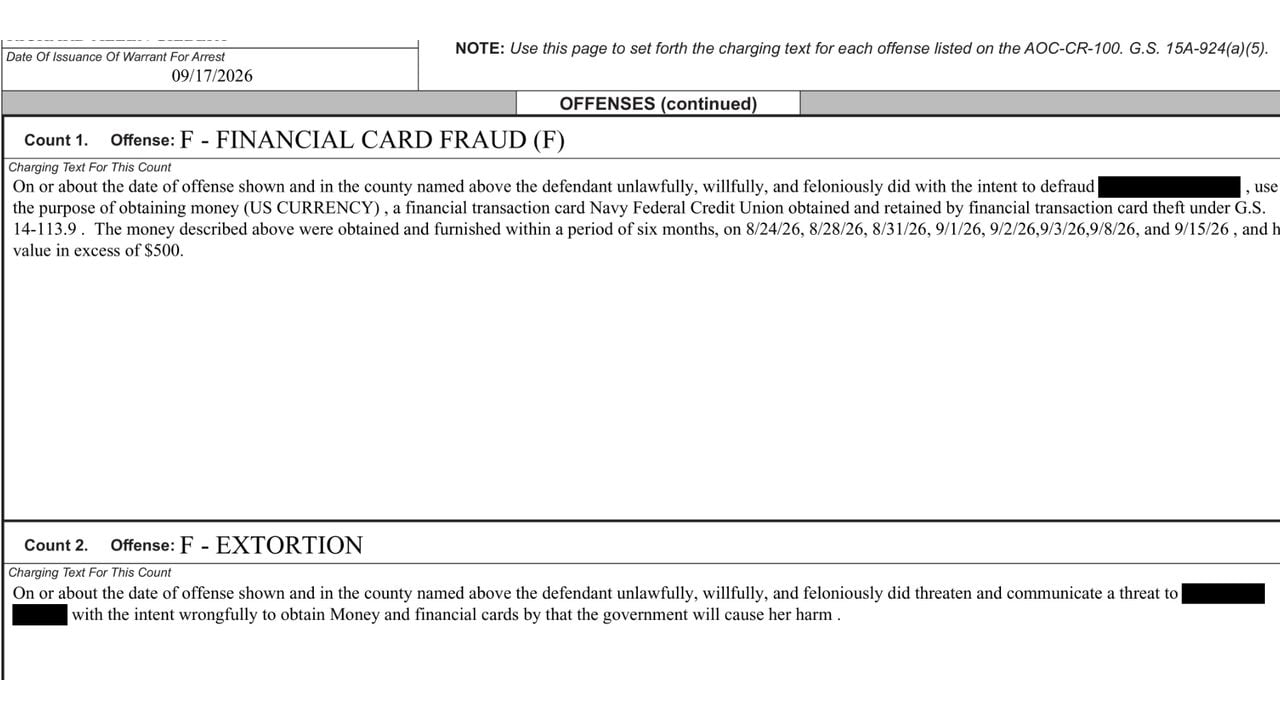
The $500-plus figure in the warrant applies to the financial-card-fraud count and should not be confused with the woman’s broader estimate that approximately $120,000 may have been taken from her income. Investigators were still working to determine the full loss.
Three More Women Described Similar Financial Relationships
As detectives followed the financial evidence, they identified three additional women in Sampson, Harnett and Carteret counties who described similar experiences.
Investigators allege Gilbert developed relationships with the women while making false claims about his identity, employment, professional qualifications, finances, military or government connections, or his ability to provide assistance. Authorities said he then obtained access to money or financial accounts.
Some of the women told investigators they were asked to provide money for supposed legal or real estate services. In one case, Gilbert allegedly represented himself as an attorney and a member of Special Forces while seeking payment for services he claimed he could provide.
By Sept. 28, investigators said four women had been identified in the broader investigation. Detectives believe other people who had financial dealings with Gilbert may not yet have contacted law enforcement.
After Gilbert’s arrest, investigators obtained a search warrant for property and electronic devices associated with him. Detectives were continuing to review those devices alongside financial records and statements from the women.
Court Records Show Four Charges in the Current 2026 Investigation
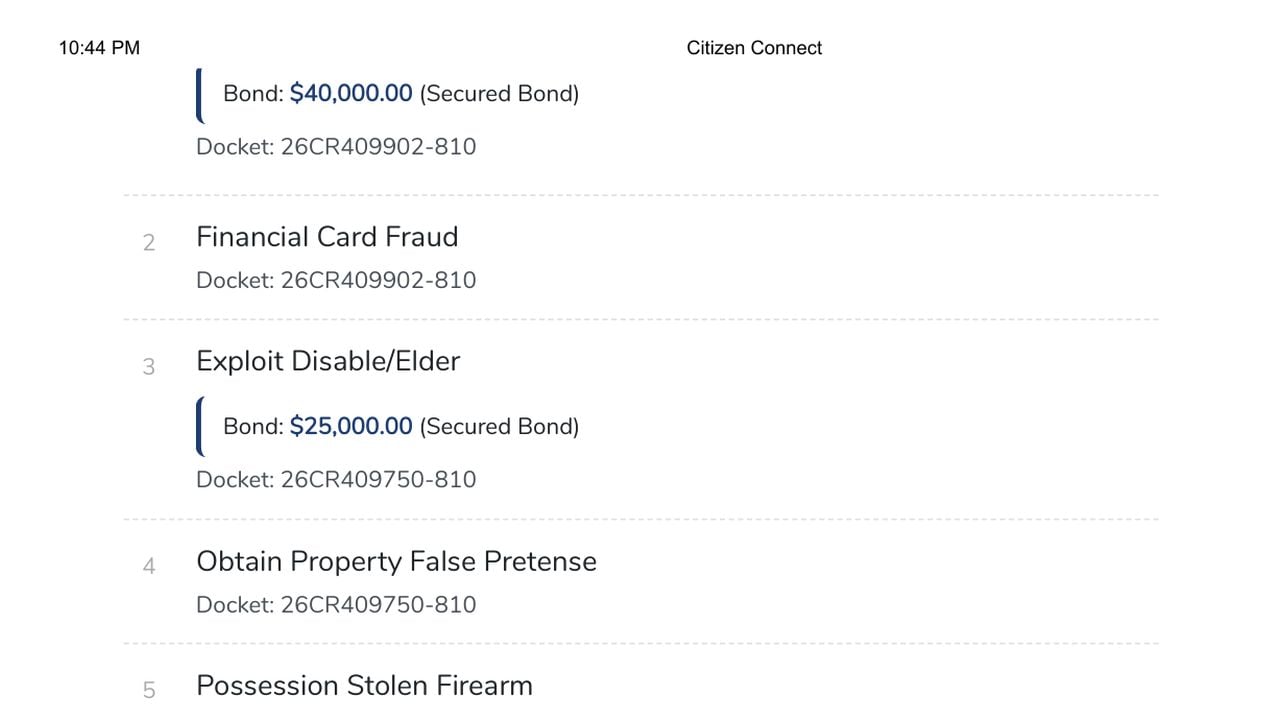
The official records clarify Gilbert’s current charge picture.
North Carolina eCourts lists case 26CR409902-810 as pending. That case contains felony financial card fraud and extortion charges arising from an Aug. 24 offense date.
The Sampson County Sheriff’s Office inmate-confinement page lists two additional charges in case 26CR409750-810: exploitation of a disabled or elderly adult and obtaining property by false pretense.
The sheriff’s page associates a $40,000 secured bond with the extortion and financial-card-fraud docket and a $25,000 secured bond with the exploitation and false-pretense docket.
The same page displays a $95,000 total bond and seven charges overall because it also includes three charges in a separate 2024-numbered case with a $30,000 secured bond. Those three older docket entries are separate from the four charges arising from the 2026 investigation described here.
The eCourts record shows the warrant in case 26CR409902-810 was issued Sept. 17. A return-of-service form says Pine Knoll Shores police served it Sept. 22 at approximately 4:55 p.m. by arresting Gilbert and bringing him before a judicial official.
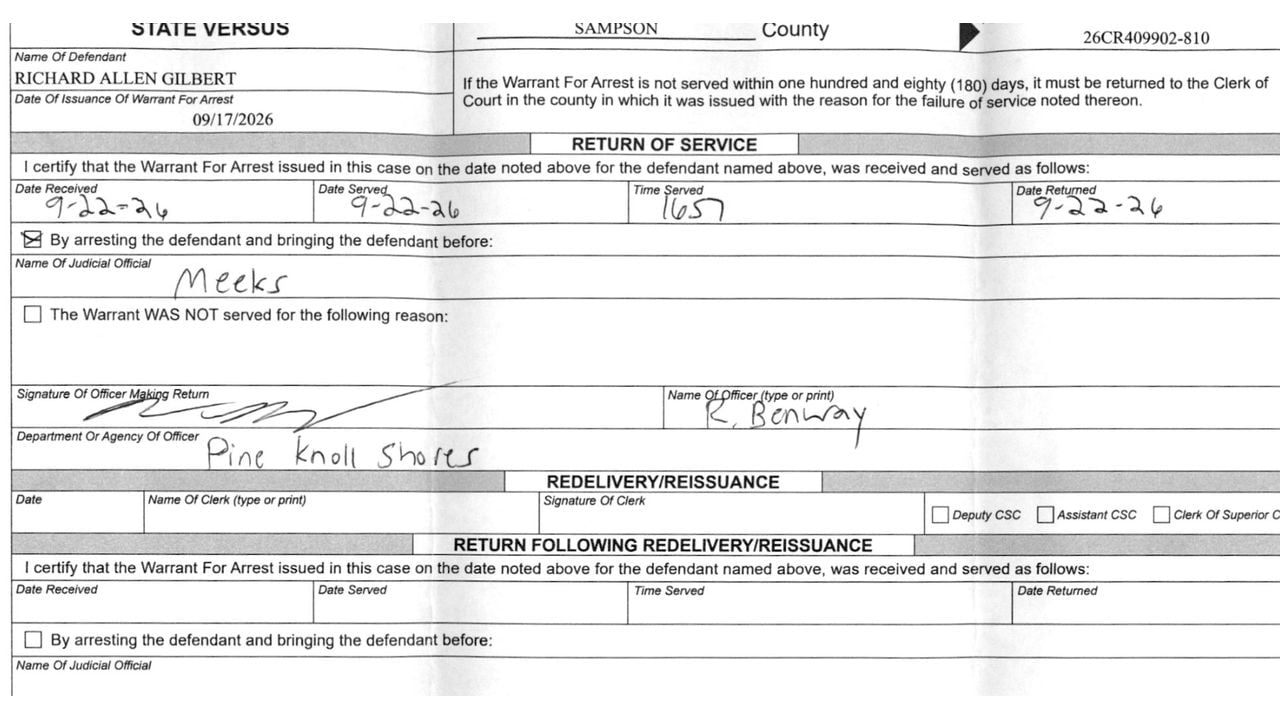
A release order set a $40,000 secured bond in the extortion and financial-card-fraud case and barred direct or indirect contact with the alleged victim or her family. The docket later records a $40,000 secured bond as an amended bond setting.
The case remained pending when the court record was reviewed Sept. 29. The eCourts calendar listed the case for Dec. 4 at 9 a.m. in Sampson District Court.
Investigators Say Financial Control Can Develop After Trust Is Established
Sampson County Sheriff Jimmy Thornton said the investigation illustrates how alleged financial exploitation can develop gradually after someone establishes trust rather than beginning with an immediate demand from a stranger.
The Sheriff’s Office has asked anyone who had financial dealings with Gilbert or believes they experienced similar conduct to contact its Criminal Investigations Division. Investigators said additional charges could follow as financial and electronic evidence is reviewed.
Online Relationships Can Be Used to Build Financial Trust
The Federal Trade Commission warns that scammers on dating sites and social media often spend time building trust before introducing requests for money. The stories may include claims about military service, international work or other circumstances designed to make the person appear credible.
If someone suspects a romance scam, the FTC recommends stopping communication, discussing the relationship with someone they trust and checking the person’s claims independently. The agency also recommends reverse-image searches to determine whether profile photographs appear under another name.
The FTC says people who have already paid through a credit or debit card should contact their bank or card company immediately, explain that the payment involved a scam and ask whether the transaction can be reversed.
The Consumer Financial Protection Bureau also provides resources aimed at protecting older adults from fraud and financial exploitation, including guidance on using trusted contacts and working with banks or credit unions to help protect accounts.