
A Connecticut business reported two checks missing from its mail in March, starting an investigation that eventually led detectives through bank accounts, financial technology platforms and numerous search warrants.
Wallingford investigators ultimately identified 23-year-old Christopher Francis Collins of East Granby and a juvenile in connection with the alleged scheme. According to CT Insider, police said Collins recruited the juvenile to deposit the two checks at different banks in exchange for $5,000.
The checks were written for $21,775 and $12,604.50, a combined $34,379.50. Investigators allege they were stolen from the business’s mail, forged and deposited rather than reaching their intended recipients.
Collins was arrested Sept. 24. Connecticut Judicial Branch records show he was released from custody on a $45,000 professional surety bond and is scheduled for an Oct. 7 arraignment in Meriden.
The Two Checks Were Worth $34,379.50
Wallingford Police Lt. Stephen Jaques said the investigation began after a local business reported in March that two checks had been stolen from its mail and forged. One was worth $21,775 and the other $12,604.50.
Detectives identified a juvenile during what Jaques described as an extensive investigation involving numerous search warrants. Police allege Collins had contacted the juvenile and arranged for the checks to be deposited at different bank locations, promising $5,000 in return.
The Patch account of the police investigation says detectives then followed the proceeds through multiple accounts and financial technology companies before identifying the two suspects.
Detectives Followed the Money Through Financial Platforms
The juvenile was arrested Aug. 21. Police said the juvenile was charged with third-degree money laundering, conspiracy to commit third-degree money laundering, second-degree larceny, conspiracy to commit second-degree larceny, third-degree forgery, conspiracy to commit third-degree forgery, fraudulent use of an ATM and conspiracy to commit fraudulent use of an ATM.
Jaques said the juvenile later appeared in juvenile court.
Collins was arrested about a month later, on Sept. 24. His official Connecticut court record lists six charges arising from an offense date of March 17.
Those charges are third-degree money laundering, conspiracy to commit third-degree money laundering, second-degree larceny, conspiracy to commit second-degree larceny, conspiracy to commit third-degree forgery and conspiracy to commit fraudulent use of an automated teller machine.
Unlike the juvenile, Collins is listed as facing conspiracy counts for third-degree forgery and fraudulent ATM use, without separate substantive counts of forgery or ATM fraud.
Court Records Show Four Felonies and Two Misdemeanor Counts
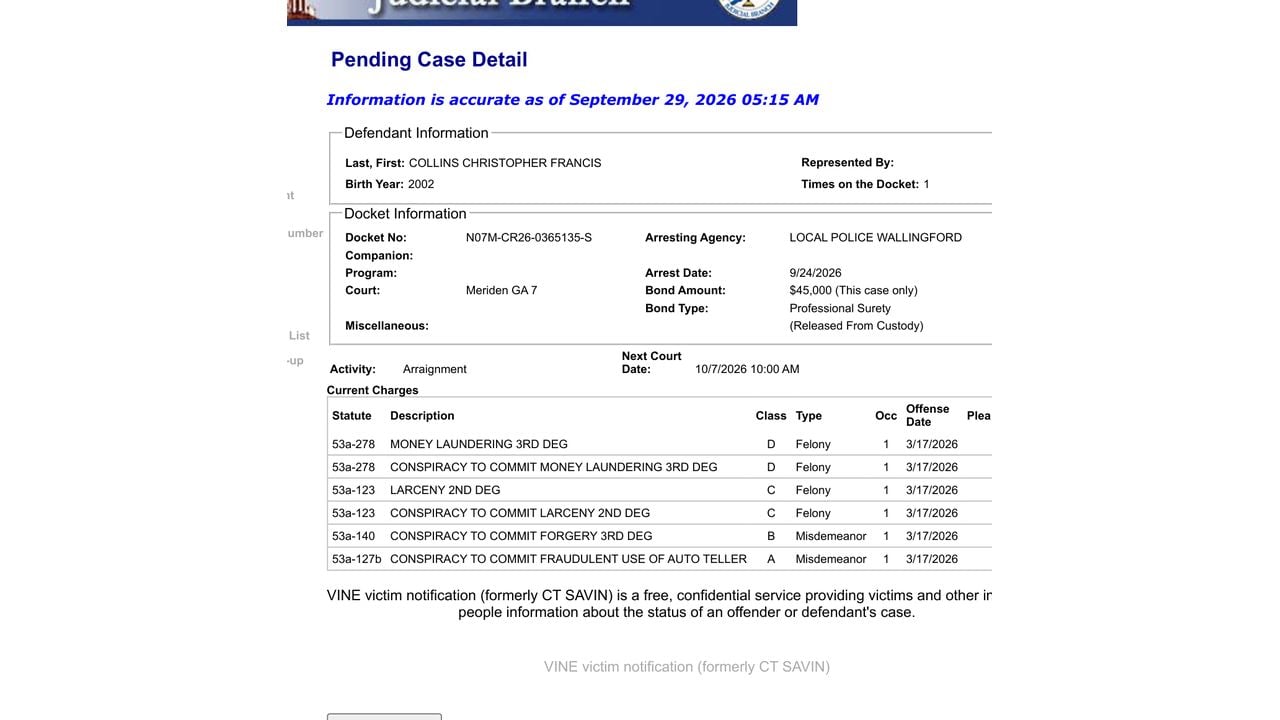
The Connecticut Judicial Branch lists Collins’ case as N07M-CR26-0365135-S in Meriden Geographical Area 7.
The court classifies third-degree money laundering and conspiracy to commit third-degree money laundering as Class D felonies. Second-degree larceny and conspiracy to commit second-degree larceny are listed as Class C felonies.
The remaining two allegations — conspiracy to commit third-degree forgery and conspiracy to commit fraudulent use of an automated teller machine — are listed as Class B and Class A misdemeanors, respectively.
The same record shows Collins was arrested Sept. 24 and released from custody on a $45,000 professional surety bond. His next court date is listed as Oct. 7 at 10 a.m., with the activity identified as an arraignment.
A Connecticut VINE record also lists Collins as 23, identifies the case as open with a pending disposition and shows an Oct. 7 court event at Meriden GA 7.
Stolen Business Checks Can Be Used for More Than the Original Payment
The American Bankers Association warns that criminals often target business accounts because they tend to have larger balances, higher transaction volumes and greater liquidity, making higher-value fraudulent checks easier to hide among legitimate activity.
The ABA says criminals may intercept incoming or outgoing mail, alter legitimate checks or use information taken from genuine checks to produce counterfeit versions. A stolen check can expose account and routing information as well as the format of a business’s legitimate checks.
The U.S. Postal Inspection Service similarly warns that checks stolen from the mail may be altered by changing the payee or amount, while information from legitimate checks can also be used to create fraudulent copies.
Businesses Can Flag Missing Checks Before More Transactions Appear
The ABA recommends confirming that checks and other financial instruments issued by a business actually reach their intended recipients. Outstanding payments should be flagged rather than left unresolved indefinitely.
Businesses can also ask their bank about fraud-prevention tools such as Positive Pay, which adds a verification step by comparing checks presented for payment with information supplied by the account holder.
For mailed payments, joint guidance from the ABA and Postal Inspection Service recommends using letter slots inside a Post Office. The ABA also recommends handing outgoing mail directly to a letter carrier. Businesses should review account activity and processed-check images for altered payees, amounts or endorsements.
If a stolen or forged check has already cleared, the Consumer Financial Protection Bureau advises contacting the bank or credit union immediately, explaining what happened and requesting that the transaction be investigated. The Postal Inspection Service also recommends reporting suspected mail theft and providing investigators with copies of fraudulent checks and details about how and when the original payment was mailed.