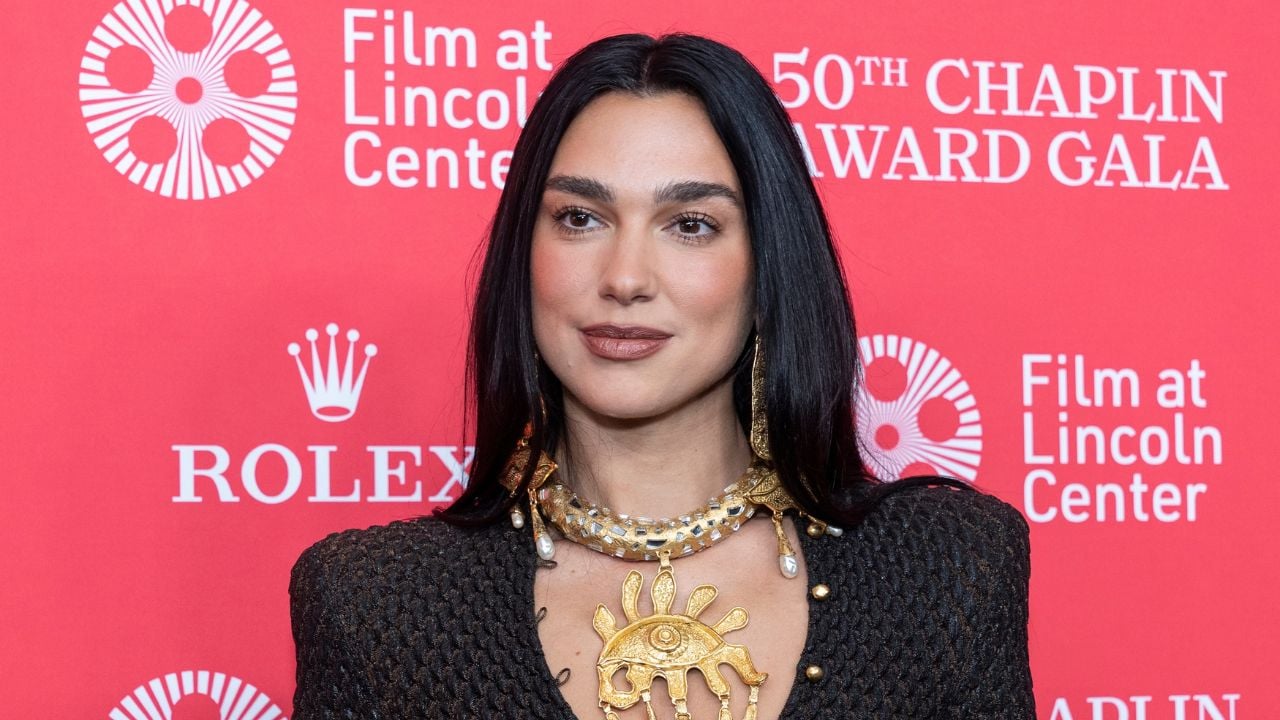
Dua Lipa has publicly reacted to the convictions of four former Kosovo Liberation Army leaders by reposting material from her father that defended the KLA’s place in Kosovo’s history and highlighted the human toll of the 1998-99 war.
The singer shared two Instagram Stories originally posted by her father and manager, Dukagjin Lipa, after the Kosovo Specialist Chambers in The Hague convicted former Kosovo President Hashim Thaçi, Kadri Veseli, Rexhep Selimi and Jakup Krasniqi of war crimes on September 16th.
One of the images carried the words “Freedom has a name” alongside the KLA emblem, according to Gazeta Express.
A second graphic listed 1 million refugees, 11,000 people killed, 1,024 children killed, 20,000 people raped and approximately 1,600 people still missing.
Lipa Reposted Her Father’s ‘Freedom Has a Name’ Message
The two posts originated with Dukagjin Lipa, who is both Dua’s father and her manager. Reporteri and Gazeta Express reported that Lipa redistributed the material through Instagram Stories on the day of the verdict.
The first graphic paired the KLA emblem with the words “Freedom has a name.” The second focused on refugees, deaths, children killed, conflict-related sexual violence and people who remain missing from the war.
Top Channel also reported on the reposts and described Dukagjin’s broader message as one emphasizing the human cost of Kosovo’s struggle and the KLA’s place in the country’s liberation narrative.
The Hague Court Convicted Four Former KLA Leaders of War Crimes
The Kosovo Specialist Chambers found Thaçi, Veseli, Selimi and Krasniqi criminally responsible for four war crimes: illegal or arbitrary detention, cruel treatment, torture and murder.
According to the court’s September 16th summary, the convictions concerned the arbitrary detention of 385 people, cruel treatment of 49 people, torture of 303 people and the murders of 96 people. Thaçi and Krasniqi were each sentenced to 25 years in prison. Veseli received 18 years and Selimi 13 years, with credit for time already spent in detention.
The judges found that the four men made significant contributions to a common criminal purpose targeting people viewed as opponents of the KLA’s political and military goals. The court said those groups included Kosovo Albanians associated with rival political or military organizations, people alleged to have links to Serbian or Yugoslav authorities, and some members of Roma and Serb communities.
The Trial Panel did not accept another major part of the prosecution case. All four defendants were acquitted of crimes against humanity because prosecutors failed to establish beyond a reasonable doubt that there had been a widespread or systematic attack directed against a civilian population. They were also acquitted in relation to a number of specific war-crime incidents.
The September 16th decision is a first-instance judgment. Kosovo Specialist Chambers rules allow defendants to appeal a trial judgment to a separate Court of Appeals Panel. Presiding Judge Charles Smith also emphasized that the proceeding concerned the defendants’ responsibility for charged crimes rather than the legitimacy of the KLA itself.
The Kosovo Memory Book Documents How Many Were Killed
The Humanitarian Law Center’s Kosovo Memory Book, one of the most detailed name-by-name databases connected to the conflict, currently documents 13,625 people killed or missing between January 1st, 1998 and December 31st, 2000.
An earlier verified version of that database contained 13,535 cases: 10,812 Albanians, 2,197 Serbs and 526 Roma, Bosniaks, Montenegrins and people from other communities.
The Kosovo Memory Book category combined people who were killed with those who disappeared, and it also included both civilians and combatants. Humanitarian Law Center Kosovo’s “Once Upon a Time and Never Again” project states that 1,024 children were killed and another 109 remained missing in connection with the conflict.
The Kosovo Memory Book’s “Dignity for the Missing” database currently records 1,636 people who are still considered missing from the armed conflict. Those databases include victims from different ethnic communities and circumstances. They do not establish that every victim in each overall category died, disappeared or was harmed at the hands of the same perpetrator.
The Refugee and Sexual-Violence Numbers Are Estimates, Not Exact Counts
UNHCR recorded approximately 800,000 refugees in neighboring asylum countries at the beginning of June 1999. A United Nations report from that period likewise said roughly 800,000 Kosovo Albanians had sought refuge in Albania, the former Yugoslav Republic of Macedonia and Montenegro, while as many as 500,000 people may also have been internally displaced.
The estimate of 20,000 victims of wartime sexual violence is also widely cited but should not be presented as an exact, victim-by-victim count. A Kosova Women’s Network report published with UNFPA cited research estimating that between 23,200 and 45,600 Kosovar Albanian women were raped between August 1998 and August 1999. The same report cited another estimate of at least 20,000 women and girls.
The researchers stressed that conflict-related sexual violence is exceptionally difficult to quantify because of stigma, underreporting and differences in methodology. More recent United Nations-hosted material has also repeated an estimate of around 20,000 survivors in discussions of the conflict.
Serbian and Yugoslav Forces Also Committed Extensively Documented War Crimes
Human Rights Watch’s major Under Orders investigation documented killings, torture, rape, forced expulsions and other war crimes committed by Serbian and Yugoslav government forces against Kosovo Albanians, particularly during NATO’s 1999 bombing campaign.
Human Rights Watch concluded that Serbian and Yugoslav forces carried out a coordinated campaign involving violence and mass expulsion of ethnic Albanian civilians. International criminal proceedings have also produced convictions of senior Serbian and Yugoslav officials for crimes committed during the Kosovo conflict.
The same Human Rights Watch investigation separately documented abuses by the KLA, including abductions and killings of Serbs, Roma and Kosovo Albanians regarded as collaborators or political opponents.
Those records address different perpetrators and different crimes. Evidence of crimes committed by Serbian and Yugoslav forces does not negate individual responsibility for crimes committed by KLA members, just as the September 16th convictions do not erase crimes committed against Kosovo Albanians.
Dukagjin Lipa Has Long Been Part of Dua’s Connection to Kosovo
Dukagjin is his daughter’s manager and has played a central role in Sunny Hill Festival, which the family developed to bring international artists to Pristina while supporting local music and cultural projects.
During the 2025 edition, Dua invited her father onto the stage and performed “Era” with him in Albanian. On her own Service95 platform, she wrote that Sunny Hill began with her father’s idea for a one-off charity show before growing into a much larger festival.
She also described performing “Era,” a song from her father’s time in the band ODA, as one of the emotionally significant moments of the festival.
Lipa Became a Kosovo Citizen Just Over a Year Ago
Welcome back home, Dua!
Today, by presidential decree, I had the honor of granting the citizenship of the Republic of Kosovo to one of the most iconic cultural figures in our country’s history, @DUALIPA.
Dua and Kosovo have always been inseparable. From the world’s biggest… pic.twitter.com/aNlME6pocG
— Vjosa Osmani (@VjosaOsmaniPRKS) July 31, 2025
Lipa’s formal connection to Kosovo became stronger in July 2025 when President Vjosa Osmani granted her citizenship by presidential decree. The Kosovo presidency announced the decision on July 31st and praised Lipa’s international cultural profile and work connected to Kosovo.
Lipa was born in London to Kosovo-Albanian parents and lived in Pristina between the ages of 11 and 15 before returning to London. She also holds British and Albanian citizenship.