
U.S. Immigration and Customs Enforcement has announced five arrests in a nationwide operation targeting people accused of improperly receiving federal food assistance. The Department of Homeland Security says the arrests are part of a broader effort to investigate suspected fraud involving the Supplemental Nutrition Assistance Program, commonly known as SNAP or food stamps.
DHS identified four Haitian nationals and one Cuban national, alleging that all five entered the United States unlawfully and obtained benefits they were not entitled to receive. The department described the arrests as the beginning of a sustained enforcement campaign.
Homeland Security Secretary Markwayne Mullin said federal assistance programs were “for Americans only.” Federal SNAP law, however, expressly permits certain noncitizens to receive benefits, including people who qualify under the specific Cuban and Haitian entrant category.
Fox News reported the operation late October 20, 2026, after receiving DHS confirmation. The department’s October 21 statement subsequently identified the five people but did not include individual SNAP application records or criminal charging documents establishing how each allegedly obtained assistance.
DHS Identified Four Haitian Nationals and One Cuban National
The four Haitian nationals named by DHS were Rubstony Junior Theodore, Wilbert Jean Baptiste, Louis Jean and Jhensly Charles.
The fifth person was Elizabeth Povea Rodriguez, a Cuban national.
Federal SNAP Rules Include Noncitizens, Despite the ‘Americans Only’ Statement
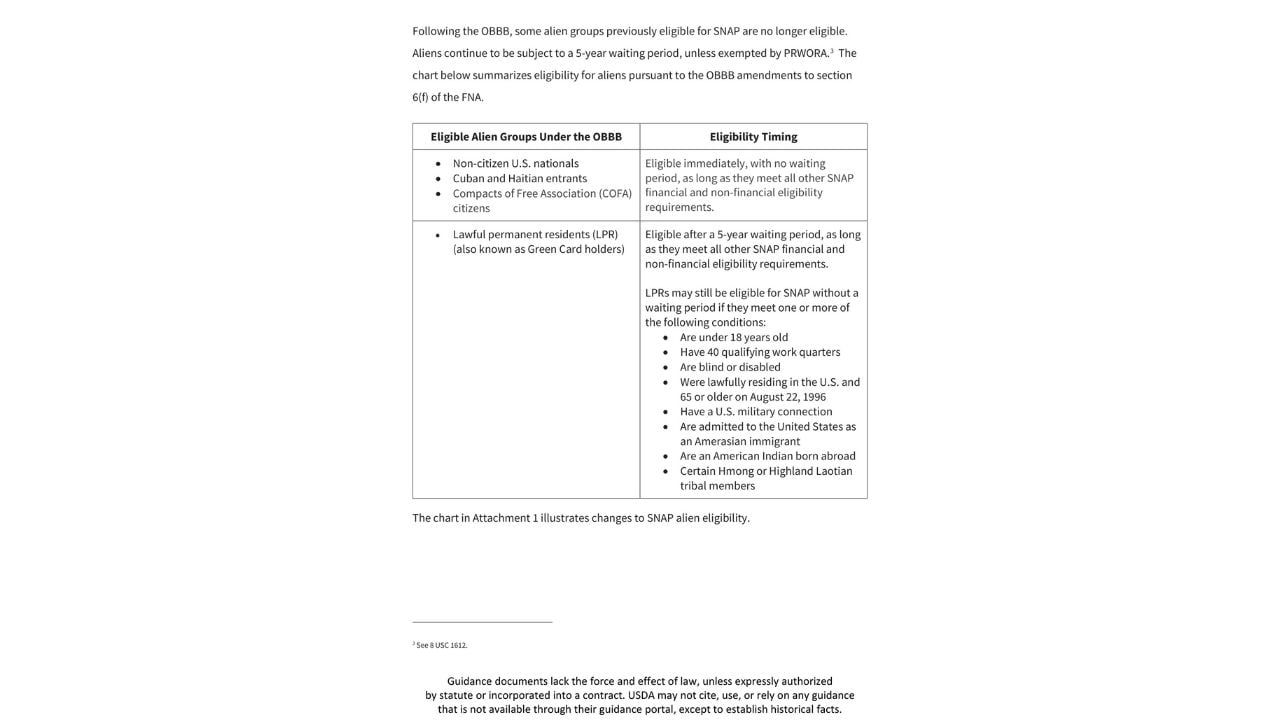
The USDA’s October 31, 2025 eligibility memorandum explains the changes made by Section 10108 of the One Big Beautiful Bill Act, enacted July 4, 2025. The law narrowed eligibility for some noncitizens but retained specific categories that can qualify for food assistance.
Under the amended federal law, SNAP eligibility can extend to U.S. citizens, U.S. nationals, lawful permanent residents, qualifying Cuban and Haitian entrants, and citizens covered by the Compacts of Free Association.
Those categories are subject to additional requirements. North Dakota’s SNAP policy manual, updated October 12, 2026, confirms that Cuban and Haitian entrants and eligible Compact of Free Association citizens can receive SNAP without a five-year waiting period if they meet the program’s other financial and nonfinancial conditions.
Lawful permanent residents generally must satisfy a five-year waiting period, although exemptions can apply, including for qualifying children, people with disabilities and individuals meeting certain other statutory criteria.
What Qualifies Someone as a Cuban or Haitian Entrant?
The term “Cuban and Haitian entrant” has a legal definition used for public-benefits eligibility. It is not automatically granted to every person from Cuba or Haiti, and it should not be confused with nationality alone.
Under Section 501(e) of the Refugee Education Assistance Act of 1980, the category includes certain Cuban and Haitian nationals who were paroled into the United States, have pending asylum applications or are in removal proceedings, subject to the statutory conditions.
For some qualifying applicants, the law requires that no final, nonappealable and legally enforceable removal order has been entered.
U.S. Citizenship and Immigration Services provides guidance to benefit-verification agencies about identifying the designation and reviewing the documentation associated with it.
None of these provisions determines whether Theodore, Jean Baptiste, Jean, Charles or Povea Rodriguez was personally eligible for SNAP. Individual immigration classifications, benefit records and other eligibility information would be needed to make that determination.
States Must Verify Immigration Status and Household Eligibility
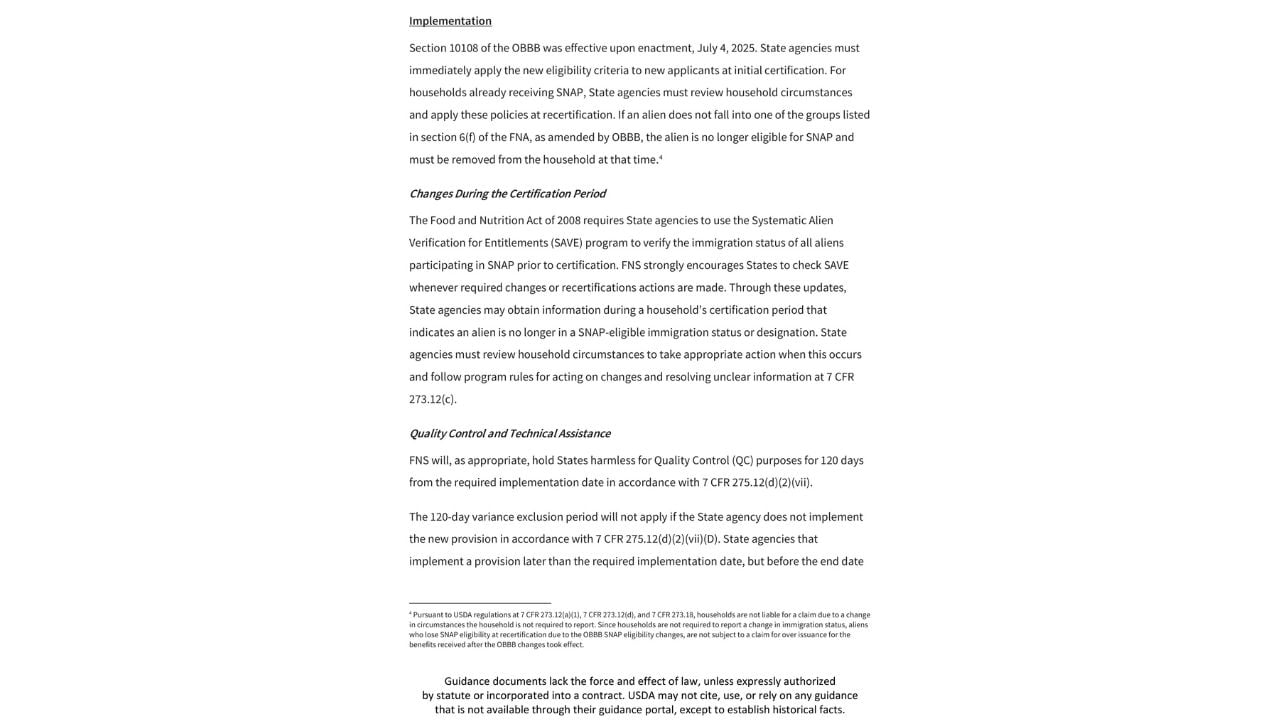
USDA instructed states to apply the new noncitizen eligibility criteria to new applications beginning with the law’s July 4, 2025, effective date. For households already receiving SNAP, the department directed states to apply the revised rules during recertification and other required eligibility reviews.
The October 31 memorandum also states that households losing eligibility at recertification because of the 2025 rule changes are not subject to overpayment claims for benefits received after the law took effect, because households were not required to report changes in immigration status.
State SNAP agencies use the federal Systematic Alien Verification for Entitlements program, known as SAVE, to verify qualifying immigration information. Eligibility workers must also assess income, resources and household circumstances under the applicable program rules.
An ineligible adult does not automatically make every other member of a household ineligible. USDA’s SNAP guidance explains that states must continue evaluating the eligibility of other household members seeking assistance, including qualifying children.
Fraud and eligibility are separate questions. The USDA identifies intentionally false information about income or household composition, as well as exchanging benefits for cash, as examples of violations. Being ineligible for SNAP does not, by itself, establish intentional fraud.
How to Check SNAP Eligibility or Report Suspected Fraud
People concerned about their eligibility can use USDA’s state SNAP directory to identify the agency responsible for their application. Applicants can request clarification of the immigration classification, household members, income and other information used in the decision.
People who believe their benefits were wrongly denied or reduced can request a fair hearing. USDA’s general eligibility guidance describes a 90-day request period for disputed decisions, although applicants should review their specific state notice and act promptly.
Suspected misuse of benefits can be reported through USDA’s nutrition program fraud page. Reports involving individual households generally go to the appropriate state agency, while large-scale schemes, multistate fraud and government employee misconduct can be referred to the USDA Office of Inspector General.
USDA recommends providing specific information such as names, dates, locations, relevant transactions and supporting documents when available.