Donald Trump picked a fight with the pope. Yes, the actual pope, the spiritual leader of roughly 1.4 billion Catholics worldwide. And somehow, the sharpest jab he landed was calling Pope Leo XIV “weak on crime,” which is the kind of insult that sounds like it wandered in from a local election debate and got completely lost on its way to the Vatican.
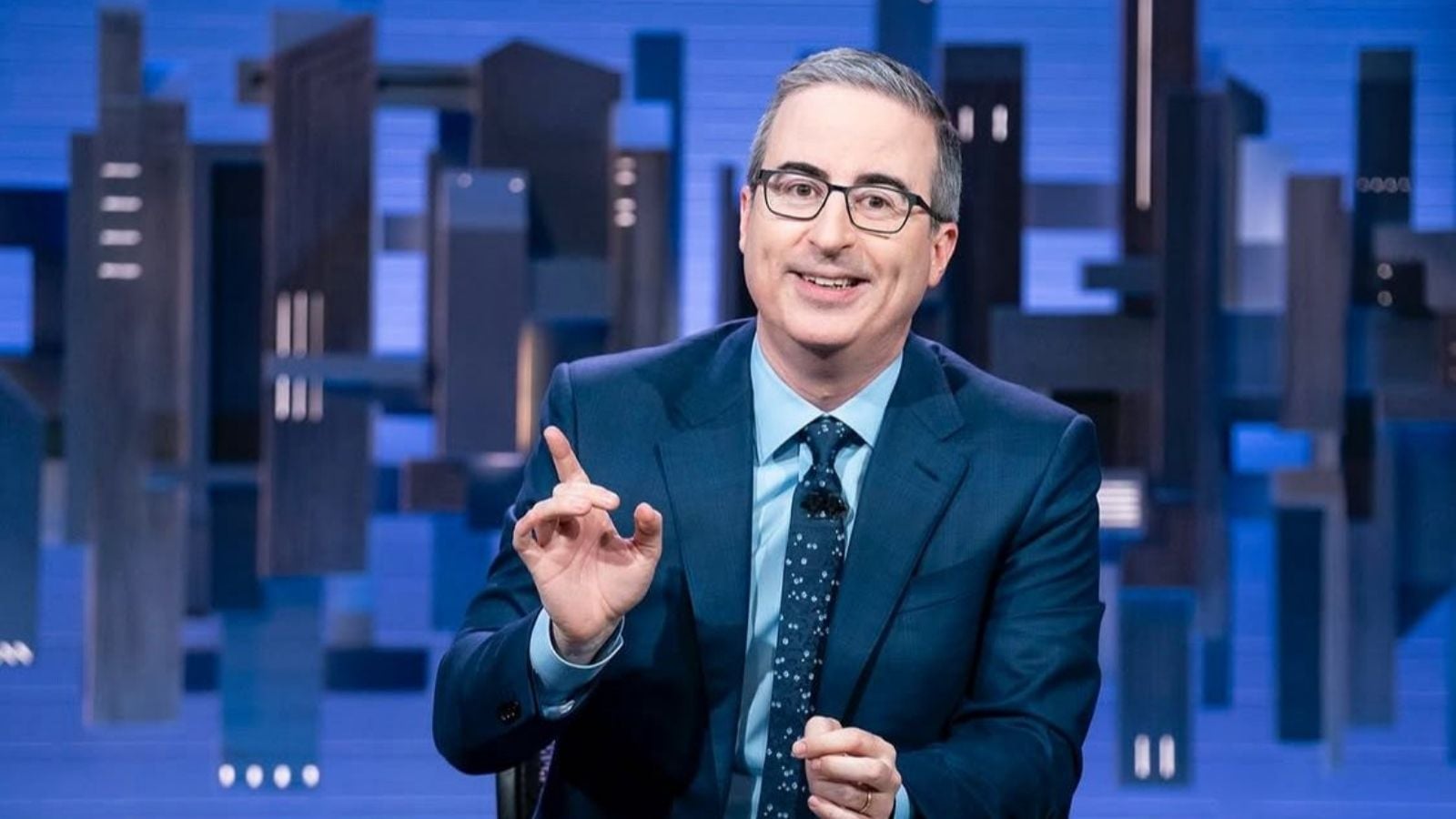
Naturally, this is where John Oliver stepped in on his April 19 episode of “Last Week Tonight,” delivering a reaction that felt less like outrage and more like a perfectly timed eye roll. His response boiled down to one brutally simple question, the kind that instantly deflates the entire situation, leaving it sitting there looking a little ridiculous.
A Beef Nobody Expected
The whole thing kicked off after CBS News aired a “60 Minutes” segment featuring Pope Leo XIV, who did not hold back when it came to criticizing the war in Iran and the Trump administration’s handling of immigration and Middle East tensions. After that segment aired, Trump reportedly did not enjoy what he saw and took to Truth Social with a lengthy post that labeled the pope “weak on crime” and “terrible for Foreign Policy”.
He did not stop there; he doubled down, insisting the pope was wrong on key issues and suggesting the Church strategically chose him because he is American, framing it as a calculated move to counter him.
Wait, Weak on Crime
That “weak on crime” line is really where everything tipped into full chaos. It is the kind of phrase usually reserved for politicians debating policing policies, not for someone whose day job involves spiritual leadership and moral guidance.
Oliver zeroed in on that disconnect immediately, pointing out that the insult simply does not land because there is no real-world context in which people are sitting around ranking the pope’s crime-fighting abilities. His punchline hit because it captured exactly how out of place the criticism felt, like trying to review a chef based on their basketball skills.
Enter The Viral Image
Just when it seemed like things could not get more surreal, they absolutely did. Oliver pulled up an image Trump had posted that showed him as a Christ-like figure, dressed in a flowing tunic with glowing orbs of light radiating from his hands, as if he had wandered straight out of a Renaissance painting and into a social media feed.
The backlash was immediate, and Trump’s explanation only added to the confusion. He claimed the image was meant to depict him as a doctor, which opened the door for Oliver to deliver one of those extended jokes that builds layer by layer until it completely collapses under its own absurdity.
The Joke Writes Itself
Oliver leaned all the way in, painting a picture of a doctor’s visit in which bald eagles are somehow part of the check-in process, and the treatment plan includes glowing orbs straight from the physician’s hands. It worked because the original premise was already so bizarre that the exaggeration barely needed to stretch.
Moments like this are where comedy thrives, when reality is doing most of the heavy lifting and the comedian just has to connect the dots. Oliver did exactly that, letting the absurdity breathe while still landing the joke with precision.
When Fact Get Messy
By the time the feud reached its next phase, things had escalated into even murkier territory. Trump claimed that the pope supported Iran having nuclear weapons, a statement that quickly drew pushback from a reporter who clarified on camera that no such position had been expressed.
The moment highlighted how quickly the narrative had spiraled, shifting from disagreement into outright mischaracterization. When asked if he would meet with the pope to resolve the tension, Trump dismissed the idea, effectively closing the door on any immediate reconciliation.
Oliver’s Final word
Oliver’s response to that refusal was sharp and effortless, noting that a meeting did not seem necessary anyway. He wrapped the segment with a biting observation that the two men might only agree on one thing, a shared appreciation for extremely gold-heavy interior design, a joke that managed to take aim at both Trump Tower and the Vatican in one clean swing.
It was the kind of closing line that feels light on the surface but carries just enough edge to linger. That balance has always been Oliver’s strength, knowing exactly how far to push without losing the audience.
Underneath all the jokes, a bigger story is unfolding. Oliver pointed out that Trump appears to be on a streak of picking fights that are not exactly working in his favor, suggesting that the sense of political invincibility he once carried might be fading.
It is a subtle shift, but one that becomes harder to ignore when moments like this stack up. The humor lands, but it also points to something more serious about how these public clashes are playing out.
The Bigger Picture
When a sitting president posts imagery casting himself in a near-religious light, publicly criticizes the pope using campaign-style language, misrepresents a major geopolitical stance, and then shrugs off the idea of resolving the conflict, it is no longer just a viral moment. It becomes a snapshot of a broader cultural and political mood.
That is what makes this story stick. It is not just about one late-night segment or one headline-grabbing comment, but about how quickly the line between spectacle and substance continues to blur, leaving everyone watching, reacting, and trying to figure out what part of this is supposed to be taken seriously.