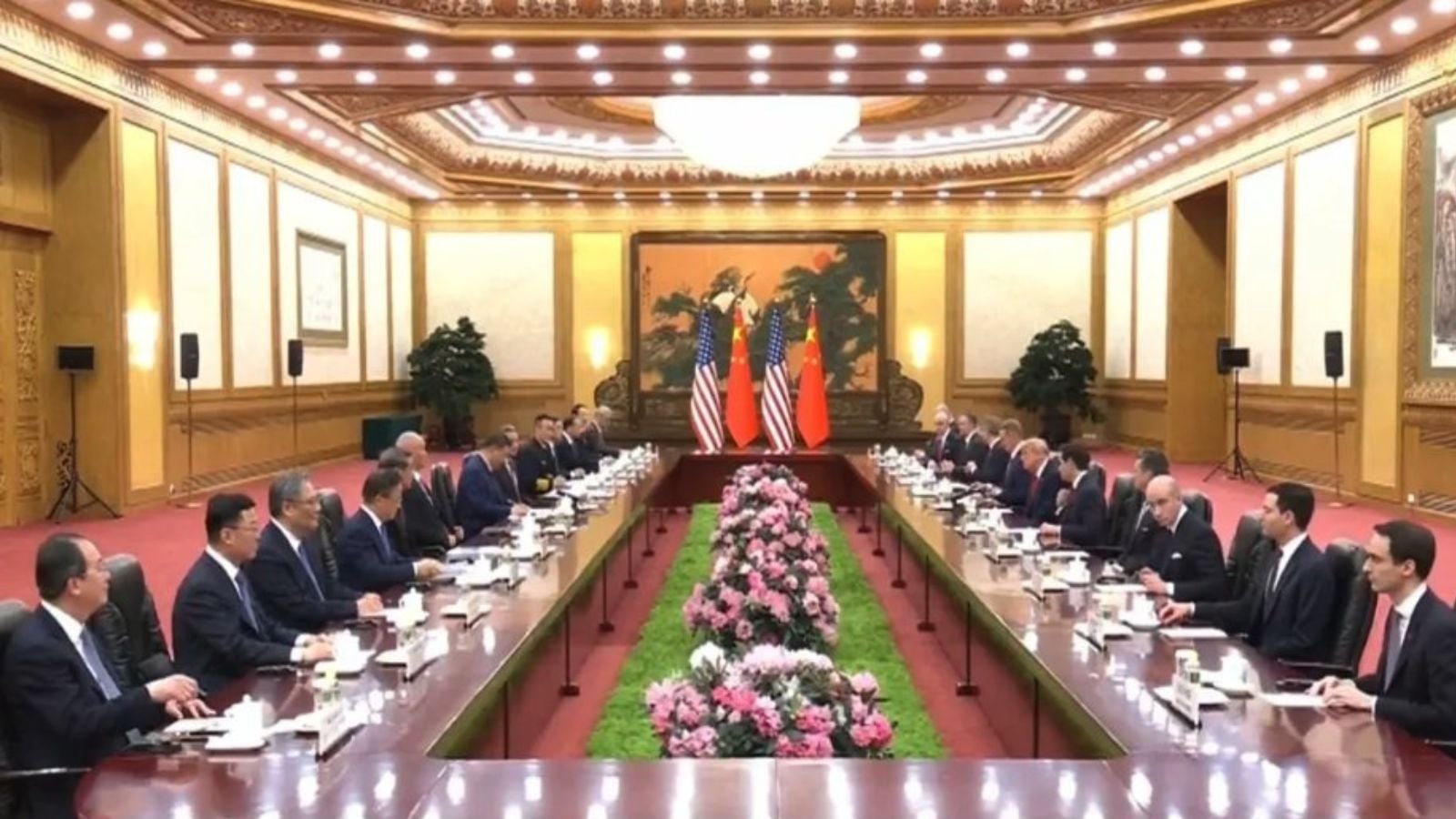
A post on X by Gita Gopinath is generating intense discussion online after she reacted to a high-level meeting between President Donald Trump, top American business leaders, and Chinese President Xi Jinping during the current U.S.-China summit in Beijing.
The accompanying image showed a room dominated entirely by male political and corporate power. On one side sat Trump alongside senior U.S. officials and executives from some of America’s largest companies. Across from them sat Xi Jinping and China’s top leadership team. No women appeared visible in the central leadership structure on either side.
The image itself was politically striking. Gopinath’s interpretation of it made it even more explosive because it touched multiple fault lines at once: gender representation, elite power structures, global leadership, corporate culture, and the definition of merit itself.
Her Comment Was About More Than Representation
At first glance, the post appeared to be a criticism of gender imbalance in positions of power, but the wording matters. Gopinath did not simply say the image reflected inequality or exclusion. She described it as “the end of meritocracy.”
The argument embedded within her statement is that if leadership positions in the world’s two most powerful economies are still overwhelmingly occupied by men, then the system itself cannot realistically be functioning as a pure merit-based structure.
In other words, the absence of women at that level is presented not as coincidence, but as evidence that structural barriers, institutional culture, or entrenched power networks continue shaping who rises to the top.
That is why the post immediately resonated far beyond gender politics. It challenged the legitimacy of the leadership pipeline itself.
A painting of the end of meritocracy: A meeting of the two largest economies and not one woman at the table. pic.twitter.com/FM7lwQrRGT
— Gita Gopinath (@GitaGopinath) May 14, 2026
The Photo Symbolized a Larger Reality About Global Power
The image also highlighted something many people rarely notice directly until it is visually concentrated in one frame.
Despite years of public commitments to diversity, inclusion, and expanded representation across politics and business, the highest levels of geopolitical and corporate power remain heavily male-dominated globally, especially in areas tied to defense, trade, finance, energy, manufacturing, and statecraft.
The United States has made visible progress in some sectors, particularly in media, academia, law, and portions of corporate leadership. China’s political system, meanwhile, remains overwhelmingly male at the highest decision-making levels.
When those two systems meet together at the top, the result becomes visually symbolic. The room begins to resemble an older model of global leadership that many people believed modern institutions were gradually moving away from.
That visual symbolism is part of why Gopinath’s comment spread so rapidly online.
Critics Would Likely Challenge the Premise Entirely
At the same time, the statement also touches one of the most polarizing debates in modern politics and corporate culture: what meritocracy actually means.
Critics of identity-based analysis would likely argue that leadership positions should be determined solely by experience, competence, political success, negotiation ability, business performance, or institutional influence, regardless of demographic outcomes.
Under that framework, the composition of the room would not automatically prove systemic failure. Supporters of that view would argue the meeting simply reflected the individuals who currently occupy the highest positions of power within their respective governments and industries.
Others would push back on the assumption that equal demographic representation is itself evidence of meritocracy. They would argue that merit-based systems do not necessarily produce identical representation across every field, institution, or leadership tier.
That ideological divide explains why a single sentence about one photograph immediately became politically charged.
The Timing of the Post Added Another Layer
The summit itself is already being viewed globally as one of the most important geopolitical meetings of the year. The United States and China are currently navigating tensions involving trade, artificial intelligence, semiconductors, military expansion, global supply chains, Taiwan, energy competition, and technological dominance.
Against that backdrop, Gopinath’s post shifted part of the public conversation away from economics and diplomacy and toward the people visibly occupying the seats of power.
That matters because political optics increasingly shape public interpretation as much as policy outcomes themselves. Images are no longer passive documentation. They become ideological symbols that people project broader societal frustrations onto.
In this case, the image became a debate over who governs the world, who gets excluded from those rooms, and what modern power still looks like underneath the language of progress.
The Debate Ultimately Goes Beyond One Meeting
The real significance of the controversy may not be the specific individuals sitting at that table. It may be what the image revealed psychologically to millions of people watching it.
For some viewers, the photo represented continuity, experience, hierarchy, and traditional power structures operating as expected during a high-stakes geopolitical summit.
For others, it represented stagnation and evidence that institutions still reproduce the same leadership archetypes despite decades of public conversation about inclusion and equal opportunity.
That tension now sits at the center of many modern debates involving politics, corporations, academia, media, and even technology itself.
If the most powerful rooms in the world still end up looking overwhelmingly the same despite decades of institutional change, does that reflect persistent systemic barriers, or simply the outcomes produced by highly competitive power structures?