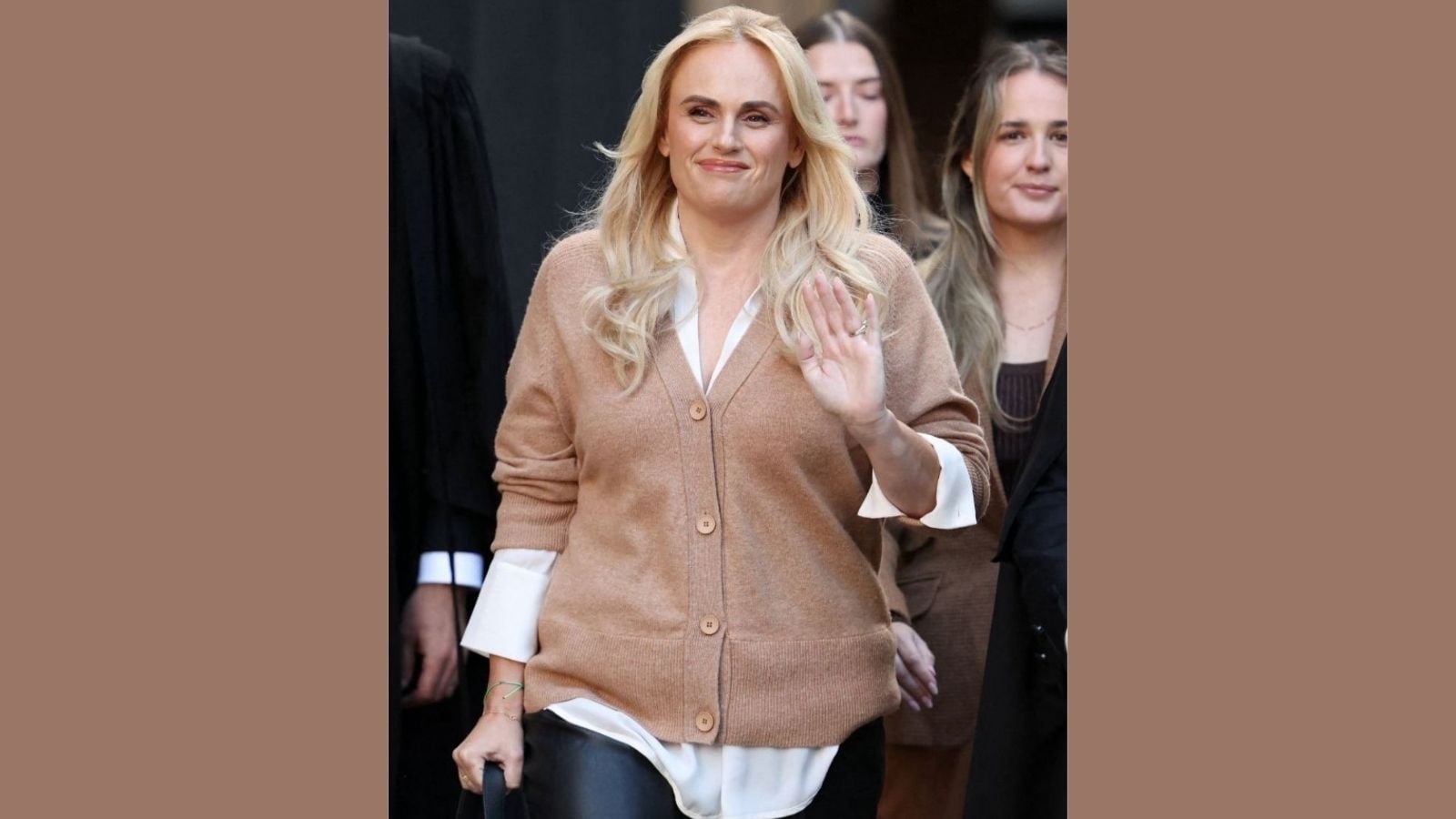
Rebel Wilson has officially swapped punchlines for legal punch-ups, and the energy right now is less Pitch Perfect and more courtroom chaos with front row seats.
The Australian star, who stepped behind the camera for her directorial debut The Deb, is now at the center of a nine-day federal defamation trial in Sydney that has turned a feel-good musical into a reputational battleground.
What was supposed to be her big creative era has instead become a headline-dominating saga involving her own lead actress, a crisis PR team, and allegations that feel ripped from a much darker script.
At the heart of it all is a lawsuit filed by Charlotte MacInnes, the film’s lead, who claims Wilson used her platform of more than 11 million Instagram followers to spread damaging claims about her.
According to court filings reported by BBC, the situation spiraled from behind-the-scenes tension into a public narrative that MacInnes says she never authorized and certainly did not benefit from.
With accusations of smear campaigns, explosive text messages, and multiple lawsuits, the film itself is effectively overshadowed while the drama off-screen takes over completely.
When Your Own Lead Files a Lawsuit Against You
Let’s get into the part that feels almost too wild to be real, because this is not a producer feud or a studio dispute. Charlotte MacInnes, the actual star of The Deb, is suing Rebel Wilson, the director of the same film, for defamation in a federal court.
That dynamic alone flips the usual Hollywood script, where leads and directors are expected to protect each other rather than face off in courtrooms.
According to filings reported by BBC , MacInnes alleges Wilson posted on Instagram suggesting that she had privately confided about being sexually harassed by producer Amanda Ghost. It does not stop there, because MacInnes claims Wilson also implied she leveraged or “sold” that allegation for career gain, a claim her legal team has strongly rejected.
Barrister Sue Chrysanthou representing MacInnes, described it in court as a “malignant allegation,” and made it clear they are pursuing “aggravated damages” along with an order to stop Wilson from repeating those claims anywhere.
The scale of the platform matters here because this was not a quiet misunderstanding or a private conversation gone wrong. An Instagram account with over 11 million followers turns any statement into a global broadcast, and MacInnes’s team argues that Wilson did not verify the claims before posting them.
Wilson on her part maintains her stand that indeed MacInnes changed her story for the incentives that comes with being linked to a powerful producer, who as Wilson’s lawyer says can “make her dreams come true.”
Wilson’s lawyer also went as far as to point out that though, MacInnes argues she suffered reputational harm, she didn’t. In fact according to the Lawyer, MacInnes “has continued on in her career to the same degree and at the same rate that she’d originally planned.”
But in court on Tuesday, April 21, MacInnes’s lawyer described the now infamous situation that is spiraling as a bathtub moment that is genuinely just normal.
According to Barrister Sue Chrysanthou, Ghost had an allergic reaction at Bondi Beach, MacInnes ran her a hot bath to warm up, and both women got in wearing their swimsuits. Barrister Sue Chrysanthou SC told the court they were not even touching.
So the question is, where did all those allegations come from? Or better yet, was it out of spite?
The Crisis PR Plot Twist Nobody Saw Coming
If you thought the Instagram drama was peak chaos, the courtroom receipts say otherwise. Evidence presented in Sydney suggests Wilson hired a crisis PR firm, The Agency Group, to manage the fallout from her dispute with producer Amanda Ghost. That alone is standard celebrity damage control, but what followed has turned the situation into something far messier.
According to claims aired in court, the firm was allegedly directed to create anonymous websites targeting Ghost with serious accusations, including labeling her a “sex trafficker”.
Then there are the texts, which might be the most jaw-dropping detail of all. Internal messages from PR staff, read aloud in court, reportedly described Wilson as “f***ing nuts,” which is not exactly the endorsement you want from your own crisis team.
Now here’s the backstory, a former employee of The Agency Group named Katie Case testified remotely from New York that her boss, Melissa Nathan, asked her to edit a draft of the copy intended for the website.
Text messages between the two, sent in August 2024 and referenced in court as reported by the Guardian, tell the rest of the story pretty clearly. Nathan allegedly wrote to Case, “Rebel wants one of those sites,” then added, “It can be really really harsh … making her a madam basically lol.” Case reportedly replied, “Oh my god lol ok this one will be fun.”
Case told the court she did not know who originally authored the document.
Wilson continues to deny responsibility for the alleged smear campaign. Her lawyer, Dauid Sibtain SC, acknowledged in court that the document’s metadata listed Wilson’s production company, Camp Sugar, as the creator, but argued the document could have been written or edited by someone else before it reached Case, per PEOPLE.
In all, the irony of a reputation management effort becoming part of the reputational problem is not subtle, and it has added another layer to an already complicated case.
What This Actually Means for Everyone Watching
It is easy to treat this entire situation like entertainment because parts of it genuinely read like a one. But beneath the headlines is a much larger conversation about power, platforms, and accountability in the digital age. When a global star speaks to millions of followers about sensitive workplace issues, the line between speaking out and causing harm becomes legally and professionally significant.
Charlotte MacInnes’s case puts that tension front and center, especially as a rising actress taking on a far more established figure. Her legal team argues that Wilson’s posts could have long-term consequences for her career, particularly if they are proven to be false or misleading. That shifts the conversation from celebrity drama to something with real industry implications.
The outcome of this trial could influence how actors, directors, and public figures handle disputes going forward. Social media may feel immediate and personal, but as this case shows, those posts can carry the weight of formal statements in a courtroom.
Right now, The Deb is caught in the middle of that reality, turning what should have been a celebration of a new project into a case study in how quickly things can escalate when the story behind the scenes becomes bigger than the one on screen.