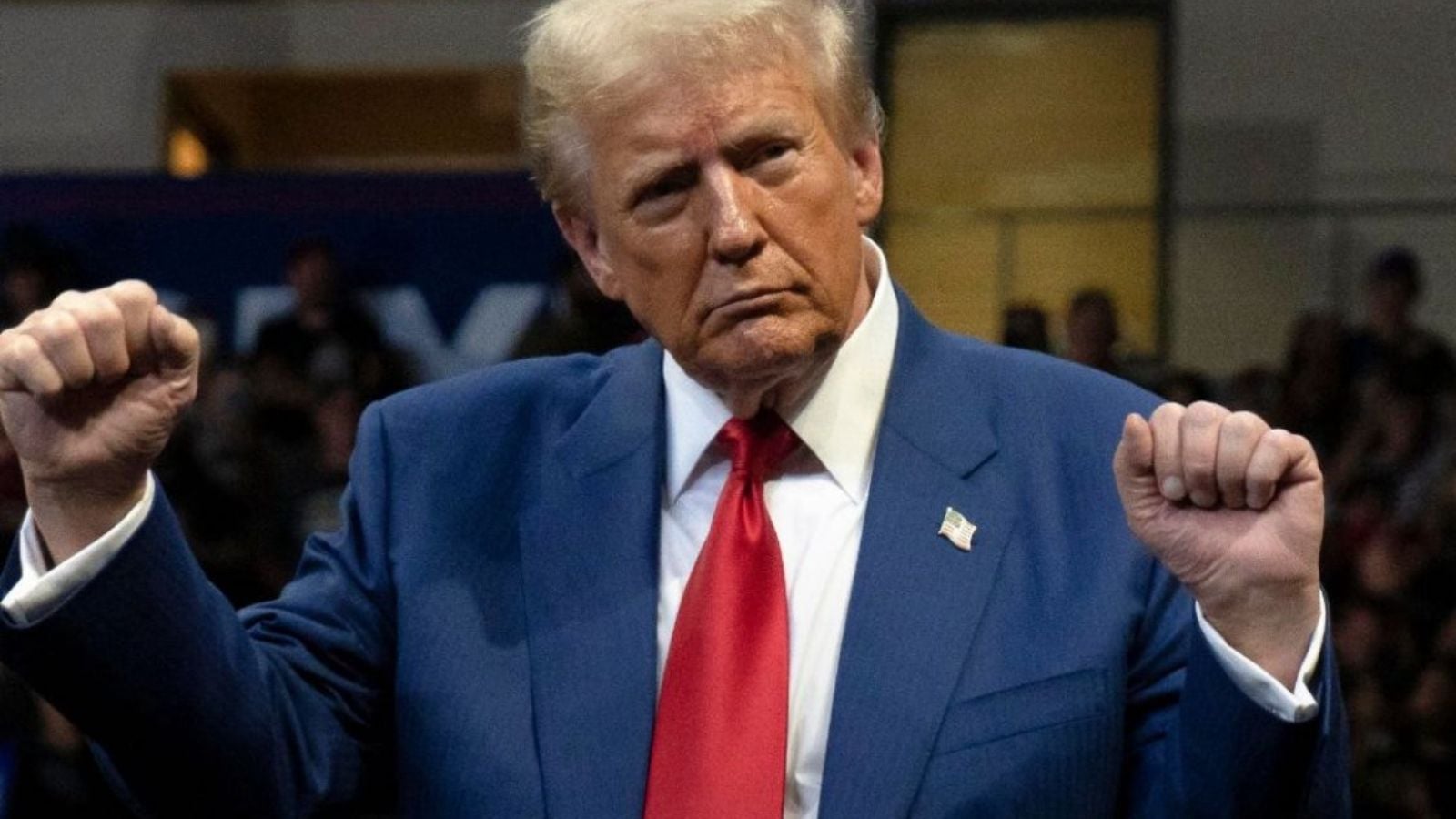
Donald Trump stepped in front of cameras on a live Fox News broadcast on Saturday, May 2, 2026, looking like a man ready to calm nerves about America’s military stance toward Iran. Instead, he dropped a line so oddly upbeat it felt like it belonged in a satire sketch, not a geopolitical briefing.
The president described an active U.S. naval blockade, the kind that squeezes a country’s oil exports and signals serious pressure, as a “very friendly blockade,” and the internet basically did a double-take in real time.
Within minutes, the clip was bouncing across X like a viral meme with a passport. The phrasing was not just unusual, it was wildly at odds with what a blockade actually represents in global politics. And the reaction came fast, sharp, and from a corner of the audience that roasted him with no mercy.
So, What Actually Happened Here?
To understand why that moment hit as it did, you need the timeline, because this was not a random slip of the tongue. On February 28, 2026, Trump kicked off Operation Epic Fury against Iran and notified Congress, setting the stage for a short but tense stretch of military activity. By April 7, he had ordered a two-week ceasefire, which was later extended, giving the impression that things were cooling down.
Then came the curveball. In a letter sent to congressional leaders on Friday, May 1, Trump declared that the ceasefire held and that no further exchange of fire occurred between U.S. forces and Iran. The letter declared, in Trump’s own words, that “the hostilities that began on February 28, 2026, have terminated.”
On paper, it read like a clean wrap, the kind of neat ending policymakers love to point to.
The problem is that reality did not quite match the script. The U.S. naval blockade of Iranian ports did not pack up and go home alongside that declaration, and it kept doing exactly what blockades do, putting real pressure on Iran’s oil exports.
So, less than 24 hours later, Trump is on live TV being asked the obvious question, how does an ongoing blockade fit into a story where the conflict is supposedly over?
The Quote That Broke the Internet
Reporter: In your letter to Congress, you said that hostilities with Iran have been terminated. How can you say that with the naval blockade still in place?
Trump: Well, it’s a very friendly blockade. pic.twitter.com/xtMXs1mRuK
— Acyn (@Acyn) May 2, 2026
His answer did not dodge the contradiction; it leaned right into it, then took a sharp left into surreal territory. Trump acknowledged the blockade and described it in the most casually upbeat way possible, calling it a “very friendly blockade” and emphasizing that nobody was challenging it. It was the kind of phrasing that sounds almost normal until you remember what the words actually mean.
He then pivoted, as he often does, shifting the conversation toward presidential authority and the War Powers Resolution. Trump argued that seeking congressional approval was unnecessary and framed it as something no other president had done, positioning himself as someone unwilling to follow that path.
That pivot did not exactly stick the landing. One commenter did point out that Trump was being misleading about no other president ever seeking congressional approval under the War Powers Resolution, but most viewers were not even focused on that.
They were stuck on the “friendly blockade” phrase itself, replaying it like a chorus they could not shake. A blockade is widely understood as an act of war under international law, not a neighborly gesture, and that disconnect is what made the moment explode online.
When The Crowd Turns on You
Let’s set up a “friendly blockade” on Trump.
— Chris Porter (💙-check) (@ChrisPorter22) May 3, 2026
Here is where the story gets genuinely interesting from a media standpoint. The critics who responded to the Fox News clip on X were described specifically as Fox News viewers, according to both The Mirror US and the Irish Star.
Now, the comments were anything but polite. One user flipped Trump’s wording back on him and suggested we “set up a friendly blockade on Trump”. Another asked flatly, “How does anyone listen to this and think we’re dealing with a sane, competent person?” Someone else went further: “He is laughing in our faces. He thinks it is all a funny game.”
He is laughing in our faces. He thinks it is all a funny game. And he fired the Sec of Def because he wouldn’t build WWII style battleships instead of aircraft carriers. He wants it to LOOK tougher. Get rid of this idiot!
— Getreal (@PGetreal) May 3, 2026
One viewer connected the moment to a pattern: “Truth is, he knows he’s not winning, and he is too stupid to extract the military without losing face. So we’re all stuck, with prices going up and him saying stupid things, lashing out at anyone criticizing him.” Another simply observed, “OMG — he actually said that — stupidity at the highest level.”
Perhaps the most pointed comment accused Trump of theatrical detachment from the letter he had sent Congress the day before: “Be honest, he didn’t write the letter, he probably hasn’t read it. He’s loving being the center of attention. He’s gonna watch some war movies tonight to rehearse.”
Whether fair or not, those reactions show how quickly a single phrase can shift the narrative from policy debate to full-blown character critique.
Truth is, he knows he’s not winning, and he is to stupid to extract the military without losing face. So we’re all stuck, with prices going up and him say stupid things, lashing out anyone who critizing him. It is time to remove him, before he can do further damage to the world.
— Graham (@parkeg1) May 3, 2026
There Is Also a Navy Secretary Who Is Gone
As if the situation needed another layer, there is also a personnel shakeup sitting quietly in the background. Secretary of the Navy John C. Phelan has been removed from his position, a move that happened in the same window as the blockade drama but without a clear public explanation tying everything together. It is the kind of detail that raises eyebrows simply because of the timing.
None of the outlets covering the story offers a concrete reason for Phelan’s departure, which leaves a vacuum that social media is more than happy to fill. One user on X floated their own theory claiming: Trump fired the Secretary because he refused to pursue World War II style battleships over aircraft carriers, suggesting the president wanted the operation to look tougher.
There is no official confirmation of that, and it should be treated as speculation, but it highlights how quickly narratives form when information is incomplete. When a high-level official exits stage left during a moment like this, people are going to connect dots, whether or not those dots actually line up.
4) NAVY SECRETARY FIRED DURING HORMUZ CONFRONTATION
Navy Secretary John Phelan was removed while U.S. forces are actively operating in the Strait of Hormuz amid the ongoing blockade and mine-clearing efforts.pic.twitter.com/fHNC7gTCV9
— NewsForce (@Newsforce) April 27, 2026
Why This Moment Is Worth Watching
What makes this story stick is not just the politics; it is the sequence, the pacing, the almost cinematic timing of it all. A president declares a conflict over in a formal letter, then appears on television the next day and casually confirms an ongoing military operation tied to that same conflict. Then he describes it in a way that sounds more like customer service than combat strategy.
The audience watching this unfold, responded with a mix of confusion, frustration, and straight-up disbelief. In less than 48 hours, this story moved from official correspondence to live TV to viral internet discourse, picking up layers and interpretations along the way.
“Friendly blockade” is now more than just a phrase; it is a snapshot of a political moment that feels both serious and strangely surreal, with real-world consequences still playing out in the background.