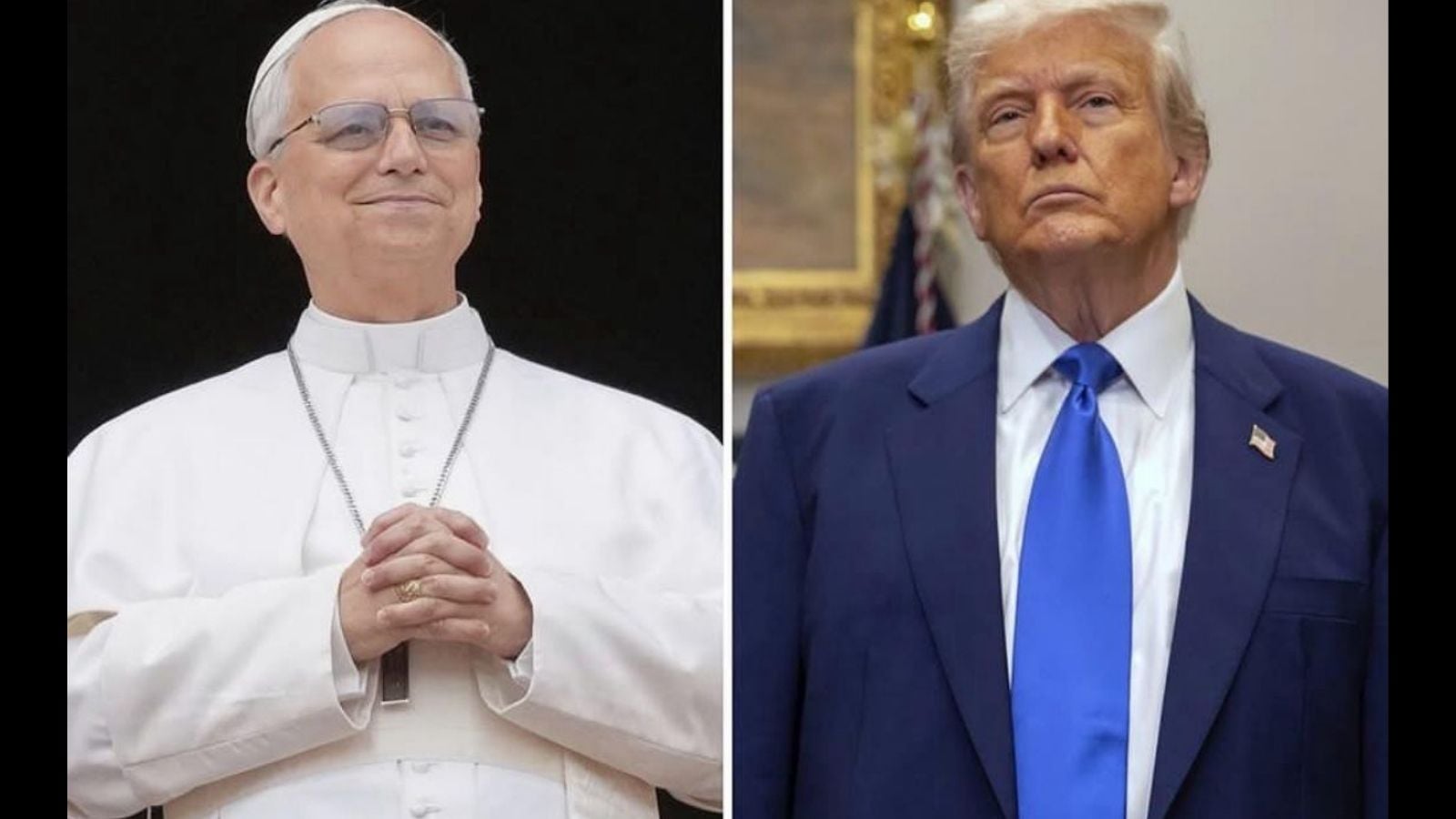
President Donald Trump went after Pope Leo XIV this past Sunday in a way American politics has almost never seen. In a lengthy late-night Truth Social post, Trump called the first American pope “WEAK on Crime” and “terrible” on foreign policy. Then he doubled down, telling reporters plainly, “I’m not a fan of Pope Leo.”
What makes this hit different is not just the tone; it is who he is going after. Polling cited by OSV News shows roughly 8 in 10 U.S. Catholics (84%) view Pope Leo favorably, and that number has only climbed since his election in May 2025. So yes, this is not just another Trump rant. This is Trump vs. a global religious figure with a very loyal fan base.
So, What Actually Set This Off?
The immediate trigger was Pope Leo’s ongoing criticism of the U.S. and Israel’s military conflict with Iran.
God does not bless any conflict. Anyone who is a disciple of Christ, the Prince of Peace, is never on the side of those who once wielded the sword and today drop bombs. Military action will not create space for freedom or times of #Peace, which comes only from the patient…
— Pope Leo XIV (@Pontifex) April 10, 2026
Leo has openly pushed back on Trump’s warning that “an entire civilization will die tonight,” calling it “truly unacceptable.” He has also described what he sees as a “delusion of omnipotence” driving the war.
Trump was not having it. He made it clear he does not want a pope who, in his words, “thinks it’s OK for Iran to have a Nuclear Weapon.”
Meanwhile, Leo has stayed in his lane, at least from his perspective. His focus has been on diplomacy, peace, and the idea that violence is not in alignment with the Gospel. So we have two very different worldviews, now colliding loudly.
When Sunday Sermons Start Feeling Political
This did not start over the weekend. For months, Pope Leo has been delivering a consistent message from the pulpit and on social media, that military action cannot create true peace, that “God does not bless any conflict,” and that disciples of Christ are “never on the side of those who once wielded the sword and today drop bombs.”
He has also called out U.S. officials for using scripture to justify military action, something several Pentagon figures including Defense secretary Pete Hegseth have done publicly.
Trump’s latest post took things to another level. Beyond calling Leo weak and terrible, he claimed Leo “wasn’t on any list to be Pope” and was chosen because he is American. According to Trump, this was so the Church could better “deal with President Donald J. Trump.”
He added, “If I wasn’t in the White House, Leo wouldn’t be in the Vatican.”
To be clear, those are Trump’s claims. They are not verified, and no reporting has independently backed them up. Still, the fact that they were said at all is what has people raising eyebrows.
The AI Jesus Post That Has Everyone Talking
Just when you think it cannot get more surreal, it does. Alongside his attack on Leo, Trump posted an AI-generated image of himself dressed as Jesus, healing the sick. Yes, that actually happened.
And this was not a one-off moment. Earlier, he had shared another AI image of himself dressed as the pope. And let me tell you, that one did not go over well. The Catholic bishops of New York State responded publicly, saying, “There is nothing clever or funny about this image, Mr. President. Do not mock us.”
National Catholic Reporter called it “sacrilegious,” and millions of Catholics expressed anger online.
Now, with a second round of AI religious imagery dropping right in the middle of an active feud with an actual pope, the reactions are basically split into two camps. Outrage or applause, depending on who you ask.
The Internet Is Laughing. The Church, Not So Much
There is nothing clever or funny about this image, Mr. President. We just buried our beloved Pope Francis and the cardinals are about to enter a solemn conclave to elect a new successor of St. Peter. Do not mock us. https://t.co/ortxbkDlT5
— NYS Catholic Conference (@NYSCatholicConf) May 3, 2025
As you might have imagined, reactions to the AI images, both old and recent have been anything but uniform. For every Catholic calling it sacrilegious, there is a conservative calling it genius. In fact, some Republican figures brushed it off or even found it funny. Reuters reported that several MAGA activists has reacted to Leo with open disdain, calling him “anti-Trump, anti-MAGA, pro-open borders.”
But the broader Catholic response is telling a different story. Polling trends cited by Newsweek show Trump’s support among U.S. Catholics slipping, especially around issues like war, Iran, and immigration. Which happens to be the exact topics Pope Leo keeps pressing.
The head of the U.S. Conference of Catholic Bishops, Paul Coakley, responded to Trump’s latest comments by saying he was “disheartened” by the President’s remarks. He added, “Pope Leo is not his rival; nor is the Pope a politician. He is the Vicar of Christ who speaks from the truth of the Gospel and for the care of souls.”
If you ask me, that is about as polite as a serious warning gets.
“Focus on Being a Pope,” Trump Says
Trump did not stop at criticism. He told Leo to “get his act together,” “use common sense,” cease “catering to the Radical Left” and should focus on being “a truly great Pope rather than a politician.”
He even brought family into it, saying he prefers Leo’s brother, Louis, “much better,” adding, “Louis is all MAGA. He gets it, and Leo doesn’t.”
The U.S. bishops kept their response measured but firm. They emphasized that the pope’s role is spiritual, not political, and that his responsibility is to convey “the truth of the Gospel.”
Leo himself has not responded with insults. But he has not backed down either. He continues to speak about what he sees as the moral failure of using force as a first option in global conflict.
This Is Bigger Than Just Another Feud
At this point, it is not just about policy disagreements. When a sitting U.S. president questions the legitimacy of a pope’s election, posts AI images of himself as Jesus, and calls the leader of about 1.4 billion Catholics “terrible,” something bigger is happening.
This is about what happens when no institution, no tradition, and no office feel off-limits anymore. Whether that approach costs Trump politically among Catholic voters is still an open question. But the fact that it is even a question says a lot.
Because this is no longer just politics. This is politics, religion, internet culture, and pure spectacle all colliding at once. And if this is how it starts, it is worth wondering where it goes next.