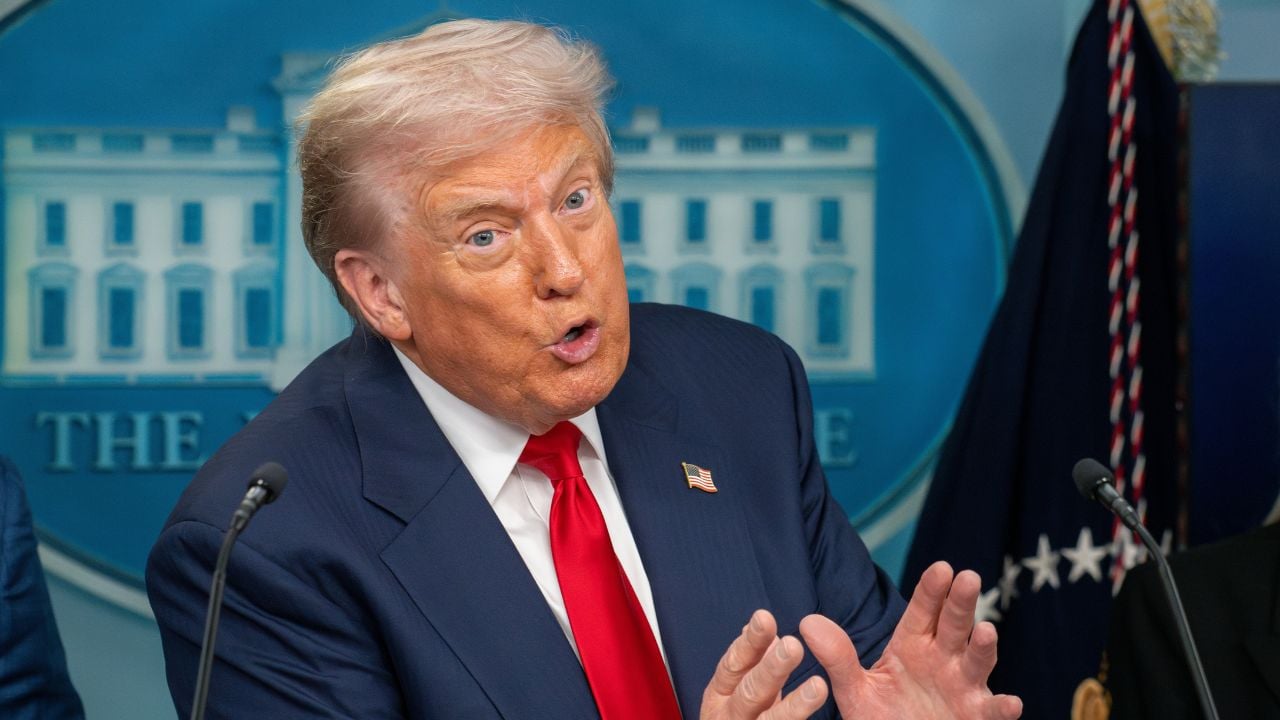
A question about fraud rewards turned into a series of personal rebukes from President Donald Trump during an Oval Office appearance on October 20. The president repeatedly cut off The Independent’s Andrew Feinberg as the reporter tried to question him, as Mediaite reported.
Vice President JD Vance, who chairs the administration’s Task Force to Eliminate Fraud, joined Trump for the announcement.
The event introduced the Fraud Whistleblower Incentive Program, or WHIP, backed by $25 million from the Treasury Department. The Justice Department’s National Fraud Enforcement Division administers the initiative.
Conservative content creator Nick Shirley also attended. His video alleging fraud at Minnesota childcare centers had attracted the administration’s attention, the Associated Press reported.
The Question Compared Trump’s Offer With Existing Whistleblower Rewards
Trump had described a 1 percent commission on fraud uncovered through tips, suggesting that people could receive millions of dollars for exposing sufficiently large schemes.
Feinberg initially referred to a 10 percent commission before someone corrected him. He then asked why a person with evidence would use the administration’s program when the False Claims Act offered a larger share of recovered money.
Feinberg cited a range of 10 to 25 percent during the exchange. The usual range is actually 15 to 30 percent for successful private plaintiffs bringing qualifying civil cases, according to Justice Department testimony. Those awards involve lawsuits filed on the government’s behalf, rather than an automatic payment for submitting a tip.
Vance called the question “fundamentally dishonest” and claimed that more than 99 percent of the fraud the administration was finding fell outside the False Claims Act. He did not provide a supporting breakdown for that percentage during his answer.
Trump Warned Feinberg After Asking Which Outlet He Represented
😳 Trump snaps at another reporter: “Hey! I don’t know who the hell you are but you better be careful” https://t.co/2QeC7cwZoR
Aaron Rupar (@atrupar) October 20, 2026
After the discussion about payments, Trump asked which publication Feinberg represented. The reporter answered, “The Independent,” then repeated the outlet’s name when the president asked again.
Later, after taking questions about Russia and Ukraine, Trump pointed toward the reporters. Feinberg began speaking, but the president interrupted him with the warning and selected another journalist.
The warning came roughly eight minutes after Feinberg identified his outlet, according to the Factbase transcript. Trump did not explain what he meant by telling him to be careful.
Writing in The Independent, Feinberg said he thought Trump was selecting him but apparently meant an AFP journalist standing behind him.
A Later Golf Question Prompted the ‘Sick Person’ Remark
More than 10 minutes after the warning, Feinberg tried again, beginning, “President Trump, you own a lot of golf courses.”
“Wait, wait. Quiet. Quiet. What’s wrong with you? Are you a sick person?” Trump responded.
“Not that I know of, sir,” Feinberg said, attempting to continue. Trump then told him, “I actually think there’s something wrong with you,” before taking another question.
Feinberg did not finish. AL.com identified the intended subject as the renovation and closure of East Potomac Golf Course in Washington.
Feinberg Challenges Vance on X
Mr. Vice President, if you’re going to insult me at least have the guts to tag my account.
Andrew Feinberg (@AndrewFeinberg) October 20, 2026
Vance subsequently amplified a post featuring footage of the confrontation and a caption describing Feinberg as an “imbecile journalist” who had misbehaved, as The New Republic reported.
The Trump Rapid Response account also named Feinberg in a post that included a disability-related slur, according to The National News Desk.
The Written DOJ Rules Describe Early Payments of Up to $30,000
The Justice Department’s October 20 announcement sets out payments of $10,000 to $30,000 for qualifying information leading to criminal charges. Awards ordinarily follow the unsealing of those charges. A conviction, completed appeal or recovery of stolen money is not required for that early award.
Those published terms do not establish the percentage-based formula Trump discussed. They do, however, leave recipients eligible for potentially larger payments through other government whistleblower programs if their information produces financial penalties or forfeiture.
Trump also said he would arbitrate disputes when multiple people claimed credit for the same tip. The department’s written guidance assigns award decisions to the DOJ’s sole discretion and permits it to decline payments.
Covered offenses include specified health care crimes and fraud involving government programs such as food assistance, housing and student aid. Participants must voluntarily provide original, truthful information, cooperate with investigators and meet eligibility requirements that generally disqualify people who meaningfully participated in the fraud.
The FAQ also sets no minimum financial-loss threshold. Tips about unsuccessful schemes, or schemes causing little or no loss, can qualify for consideration if the other requirements are satisfied.