
A Georgia marketing agency owner accused of making unauthorized charges to a client’s credit card now has a bond hearing scheduled for October 15, while separate court records reveal multiple lawsuits involving her and her business.
Madison Layton Hollimon, 30, of Lincolnton, owns Mad Marketing LLC, an Evans-based company serving businesses in the Augusta area. The Georgia Bureau of Investigation (GBI) charged her with financial transaction card fraud after investigating a customer’s complaint. Other clients subsequently came forward with additional allegations.
Hollimon surrendered to authorities on Sept. 30, 2026. A Columbia County criminal docket now identifies her warrant proceeding as case 2026W1494, with a hearing scheduled before Superior Court Judge Barry A. Fleming.
The criminal allegations emerged against a background of separate financial disputes. Records show a federal employment lawsuit and another civil claim filed against Hollimon and Mad Marketing earlier in the year, while local investigative reporting documented an eviction and an American Express debt lawsuit. Those matters are distinct from the GBI’s investigation.
Client’s Credit Card Complaint Triggers State Fraud Investigation
On July 28, 2026, the Lincolnton Police Department requested assistance from the Georgia Bureau of Investigation after receiving a fraud complaint. Preliminary findings indicated that Hollimon had allegedly made several transactions using a customer’s credit card without permission.
As agents investigated the complaint, additional Mad Marketing clients approached authorities with allegations of fraud. The GBI’s October 2 announcement did not assign a total financial loss to the suspected transactions or announce separate criminal charges arising from those additional complaints.
Agency Advertised Work With More Than 1,000 Businesses
Hollimon founded Mad Marketing House as a merchandise and graphic design business in 2014 before expanding into a full-service marketing agency in 2021, according to the company’s website. The firm advertised website development, social media management, branding, content production and paid advertising services.
The company claimed to have worked with more than 1,000 businesses, managed over $1 million in advertising spending and generated more than $50 million in revenue for clients. Those figures were promotional claims made by the business, rather than independently established financial results.
Federal Wage Lawsuit and Separate Small Claims Case Appear in Court Records
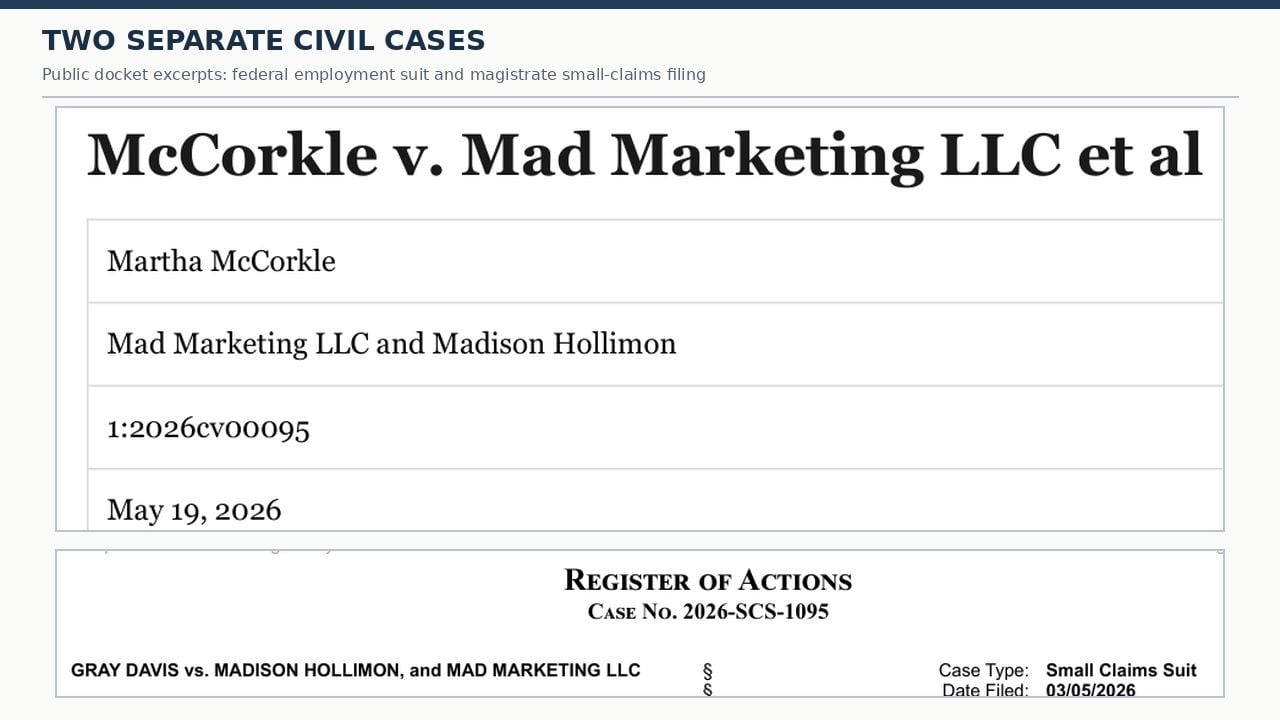
Former employee Martha McCorkle filed a lawsuit against Hollimon and Mad Marketing LLC in the U.S. District Court for the Southern District of Georgia on May 19, 2026. Separately, WRDW reported that a former Mad Marketing employee had complained of bounced payroll checks.
The federal docket, numbered 1:26-cv-00095, confirms that McCorkle filed an employment complaint against both defendants. It also records the issuance of summonses later in May. The lawsuit concerns employment allegations and does not establish that either defendant violated wage laws.
Another civil filing predates that lawsuit. On March 5, 2026, Gray Davis filed a small claims suit against Madison Hollimon and Mad Marketing LLC in Columbia County Magistrate Court. The public register of actions identifies the proceeding as case 2026-SCS-1095 and records service filed on March 10.
Eviction and Other Company Financial Disputes Emerge
During the summer of 2026, Mad Marketing’s Evans office was evicted over unpaid rent, according to WRDW’s investigation. The situation also generated a sheriff’s report concerning more than $17,000 worth of furniture reportedly missing from the property.
The broadcaster also examined Georgia Secretary of State records showing that two earlier ventures associated with Hollimon, Hollimon Tree and Hollimon Properties, had been involuntarily dissolved in 2025 for failing to satisfy state requirements. WRDW reported that Mad Marketing itself lost its standing to conduct business in Georgia in September 2026.
Another dispute involved American Express, which sued over nearly $27,000 in unpaid company credit obligations. That civil claim concerns debts allegedly owed by the business and is separate from the suspected unauthorized transactions involving a customer’s card.
Criminal Docket Sets October 15 Bond Hearing
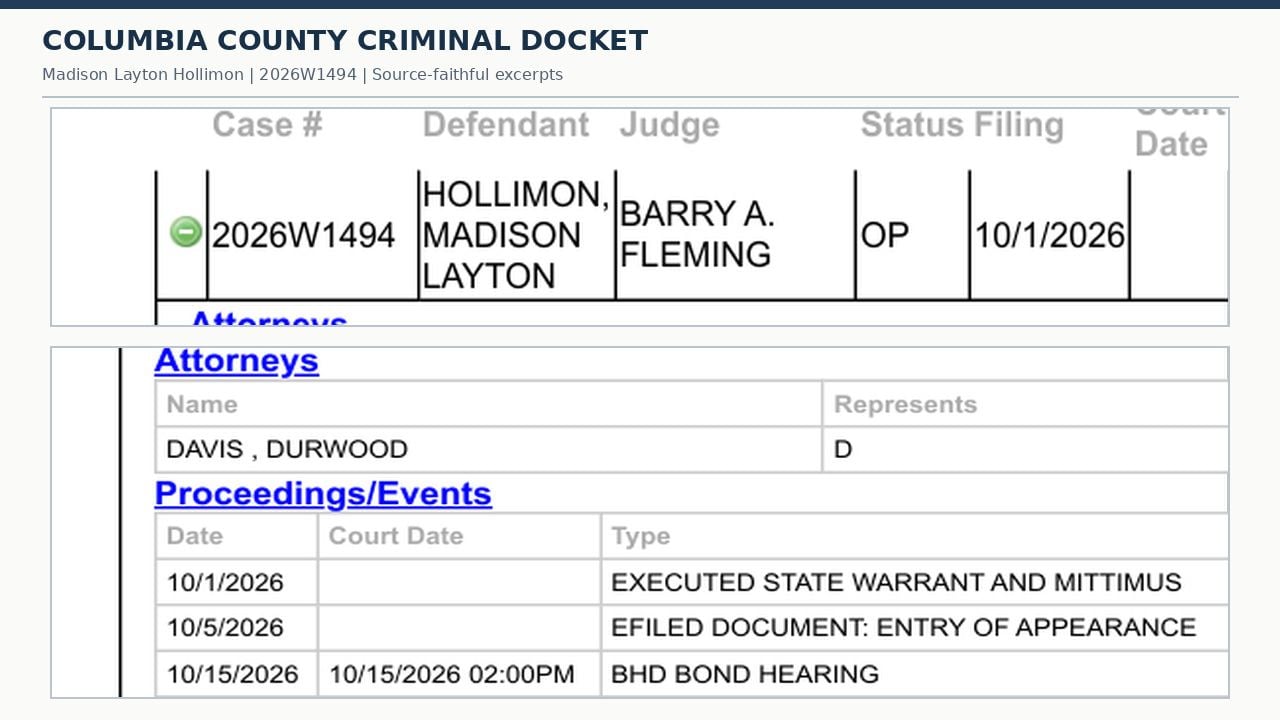
The Columbia County Clerk’s public docket identifies Hollimon’s proceeding as 2026W1494, assigned to Judge Barry A. Fleming. An October 1 entry records an executed state warrant and mittimus, while a subsequent October 5 entry records an appearance by defense attorney Durwood Davis.
The court’s October 15 bond calendar schedules Hollimon’s hearing for 2 p.m. in Courtroom 4 at the Columbia County Justice Center. The published calendar identifies financial transaction card fraud as the alleged offense and names Durwood R. Davis as her defense attorney.
Under Georgia Code Section 16-9-33, financial transaction card fraud can include using another person’s card without permission or providing a card number for billing without the cardholder’s authorization. The statute establishes different penalties depending on the circumstances and value of the conduct.
For qualifying offenses involving more than $100 during a six-month period, Section 16-9-38 provides felony penalties of one to three years in prison, a fine of up to $5,000 or both. The applicable penalty in Hollimon’s case depends on the charging allegations and evidence established in court.
The GBI said its investigation remains active and that the completed case file will be submitted to the Columbia Judicial Circuit District Attorney’s Office. Hollimon is presumed innocent unless proven guilty.
Anyone with information can contact the GBI’s Thomson Regional Investigative Office at 706-595-2575. Anonymous tips can also be submitted at 800-597-8477 or through the agency’s online tip system.
How Businesses Can Detect Unauthorized Marketing Agency Charges
Business owners who authorize outside marketing agencies to manage advertising should establish clear spending limits and document which services may be charged. Using dedicated payment cards or virtual card numbers can make it easier to distinguish advertising expenses from unrelated transactions.
Companies can also compare invoices against their advertising platforms’ billing records and credit card statements. Regular reviews conducted by someone other than the agency responsible for spending can help identify unfamiliar charges or payments that exceed agreed budgets.
If suspicious transactions appear, businesses should contact their card issuer promptly, preserve contracts and billing records, and review which outside parties have access to payment information. The Consumer Financial Protection Bureau explains the importance of timely disputes, although statutory protections and deadlines may differ for business credit cards.