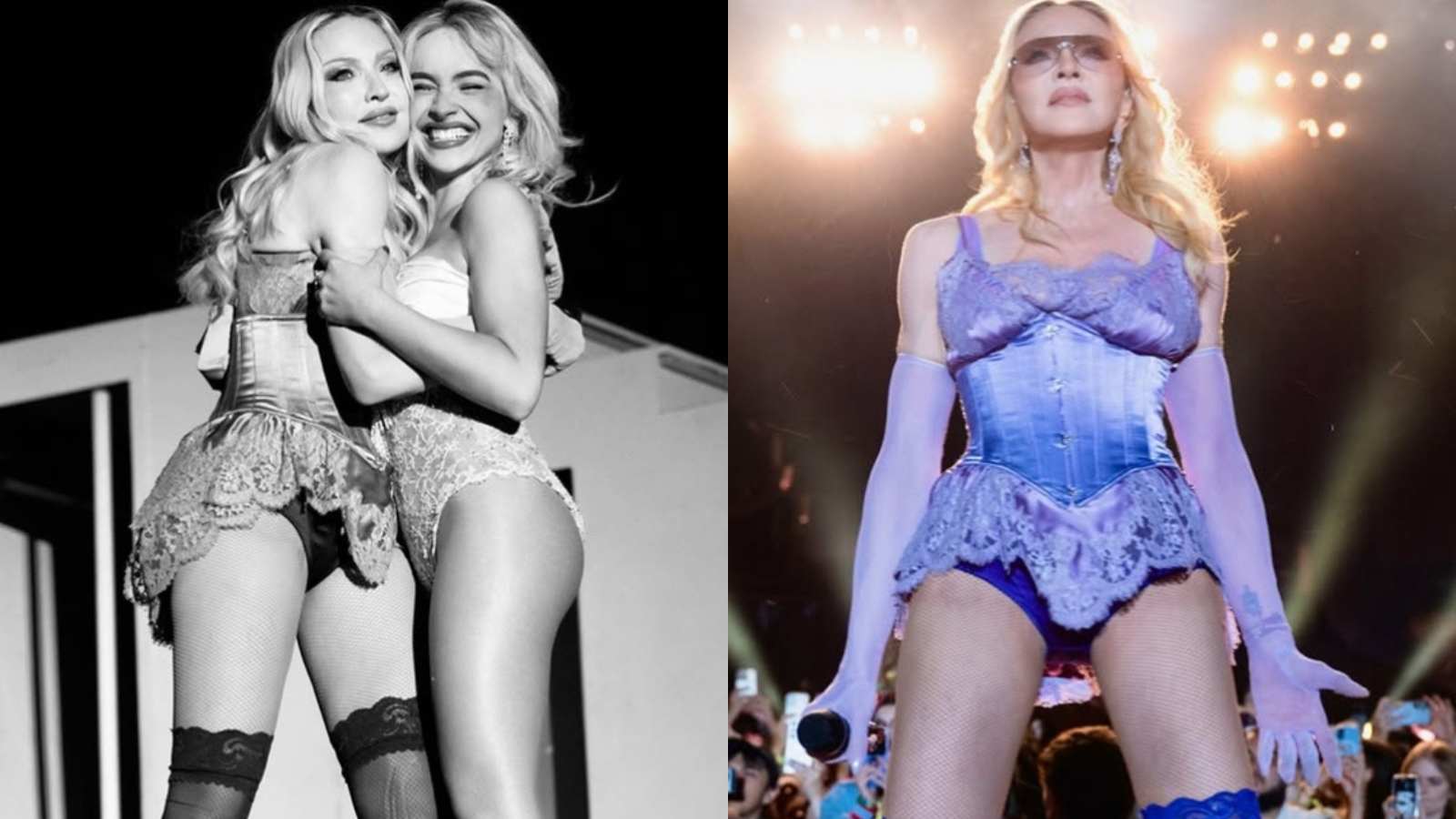
The desert air of Indio usually crackles with the kind of collective energy that defines a Coachella weekend, but for Madonna, that feeling of pure, unadulterated triumph soured into a gut-wrenching scramble within a matter of hours.
After a performance that was meant to be a career-affirming moment with Sabrina Carpenter, the pop icon found herself navigating a nightmare scenario that had nothing to do with her stage presence and everything to do with a sudden, baffling theft.
It wasn’t just a matter of misplaced gear; it was the disappearance of irreplaceable, historic wardrobe pieces that have served as the visual backbone of her legacy for decades.
We are talking about garments that act as tangible archives of her evolution, items that carry the weight of history and the signature aesthetic of her most iconic eras.
To see these pieces vanish into the haze of a festival crowd is a jarring, disorienting experience that forces us to question how we secure the most precious artifacts of our modern cultural history.
The juxtaposition is as stark as it is upsetting: the global stage, the adoration of thousands, and then the sudden, gritty, and frustrating reality of a police report.
It’s enough to make any fan stop and wonder how something so heavily guarded could simply fall off the grid, transforming a celebratory milestone into an investigation that leaves us all searching for answers in a desert that isn’t giving them up.
This is so disgusting and disrespectful way to act… that outfit is HISTORY pic.twitter.com/zxuOxVve5t
— Madonna Madgesty 👑 | CII 03.07.26 (@MadonnaMadgesty) April 20, 2026
The Logistics of Cultural Preservation in a Dust Storm
There is a load of audacity in choosing to expose museum-caliber archival fashion to the relentless environment of a desert music festival, a choice that inherently pits historical preservation against the chaotic, high-traffic backstage realities.
When we talk about “archival pieces,” we aren’t just discussing costumes; we are talking about the structural integrity of pop culture history, garments that have arguably seen more of the world than most of us ever will.
Bringing these items to Indio, an environment defined by its heat, crowds, and transient energy, introduces a level of exposure that borders on the extreme. While it is understandable that Madonna wanted to ground her 2026 performance in the authentic aesthetic of her 2006 roots, the incident raises legitimate questions about the vulnerability of such artifacts.
Managing a wardrobe of this magnitude, which likely requires specialized handling, climate control, and constant surveillance, is a monumental task at the best of times.
In the surroundings of a festival, where hundreds of people, crew, performers, guests, and security are constantly flowing through restricted areas, the physical security of personal archives becomes a complex puzzle.
This incident isn’t just a story about a missing dress; it is a case study in the risks of blurring the lines between a high-production concert tour, where security is locked down, and a festival cameo, where the sheer volume of humanity makes total control an elusive dream.
We treat these icons as untouchable, but their clothes, like everything else, remain subject to the laws of physical security, proving that even the most carefully curated historical narrative can be disrupted by the basic, unglamorous mechanics of storage and transit.
Shifting the Lens on the So-Called Heist
It is incredibly easy to leap to the narrative of a calculated, “Mission Impossible”-style theft, where a villainous interloper breaches security with the singular intent of swiping a piece of pop history.
However, there is a far more mundane and perhaps more likely reality that warrants consideration, especially when we look at the patterns of festival production.
It is entirely possible that this was not a malicious crime at all, but rather the result of a logistical mix-up that snowballed into a headline-grabbing disappearance.
We see it happen all the time in the industry: garment bags get misplaced, mislabeled, or accidentally loaded onto the wrong transport during the frantic load-out process that follows a surprise cameo.
the crowd at Coachella literally losing it when Madonna appeared on set !!!! Oh my god !!!! Also the same jacket and boots from mtv vmas 2005 when she premiered hung up!!! pic.twitter.com/EsGJGpAbzv
— Madonna Ultimate – CONFESSIONS II (@MadonnaUltimate) April 18, 2026
If we step back from the dramatic framing of “theft,” we have to consider the environment. It is far more plausible that these archival pieces were caught in the crossfire of a massive logistical operation involving multiple artists and tight turnarounds.
Suggesting that a fan or a criminal mastermind bypassed security to snatch a corset is a romanticized notion that ignores how these items actually move. Perhaps the real story here isn’t about an act of larceny, but about the inherent difficulty of maintaining archival standards in an environment built for speed and spectacle rather than preservation.
By reframing this as a potential inventory disaster, we stop looking for a villain and start looking at the systemic challenges of protecting high-value assets in a fast-moving, multi-party production environment.
It is a cautionary tale about the fragile nature of celebrity material culture, reminding us that even the most legendary items are susceptible to the same kinds of messy human errors that lead to lost luggage at the airport, only with much higher stakes and a lot more media attention.
A Legacy Left in Question
View this post on Instagram
Madonna has been transparent about the emotional weight of this loss, taking to social media to signal that these items are extensions of her career, not just fabrics or patterns.
By filing a police report and reaching out to her millions of followers for tips, she has effectively turned the search for her wardrobe into an extension of the festival experience itself.
The email address provided for the safe return of the items is a desperate, public-facing plea that highlights the personal nature of what is often viewed as a corporate operation.
When an artist of her stature treats these items as “part of her history,” it fundamentally changes how we view the incident. This is not about the retail value of a corset or a jacket; it is about the sanctity of the artist’s personal archive.
We, as an audience, often view the stage presence of an icon as a complete, static image, but in reality, it is a fragile collection of physical objects constantly being negotiated and protected.
If these pieces are not recovered, the void left behind will be more than just a gap in a clothing rack; it will represent a lost connection to the physical evidence of her artistic evolution.
The public response has been a mix of genuine concern and speculation, with fans and amateur detectives combing through footage and theories that only reinforce the depth of the connection between the icon and her audience.
Whether this was an unfortunate mix-up or something more sinister, the disappearance of these specific garments has undeniably added a layer of complexity to her 2026 Coachella narrative. It has ensured that this moment will be remembered not just for the new music and the “full circle” triumph but also for this strange, unsolved mystery that continues to linger long after the final notes have faded into the desert night.