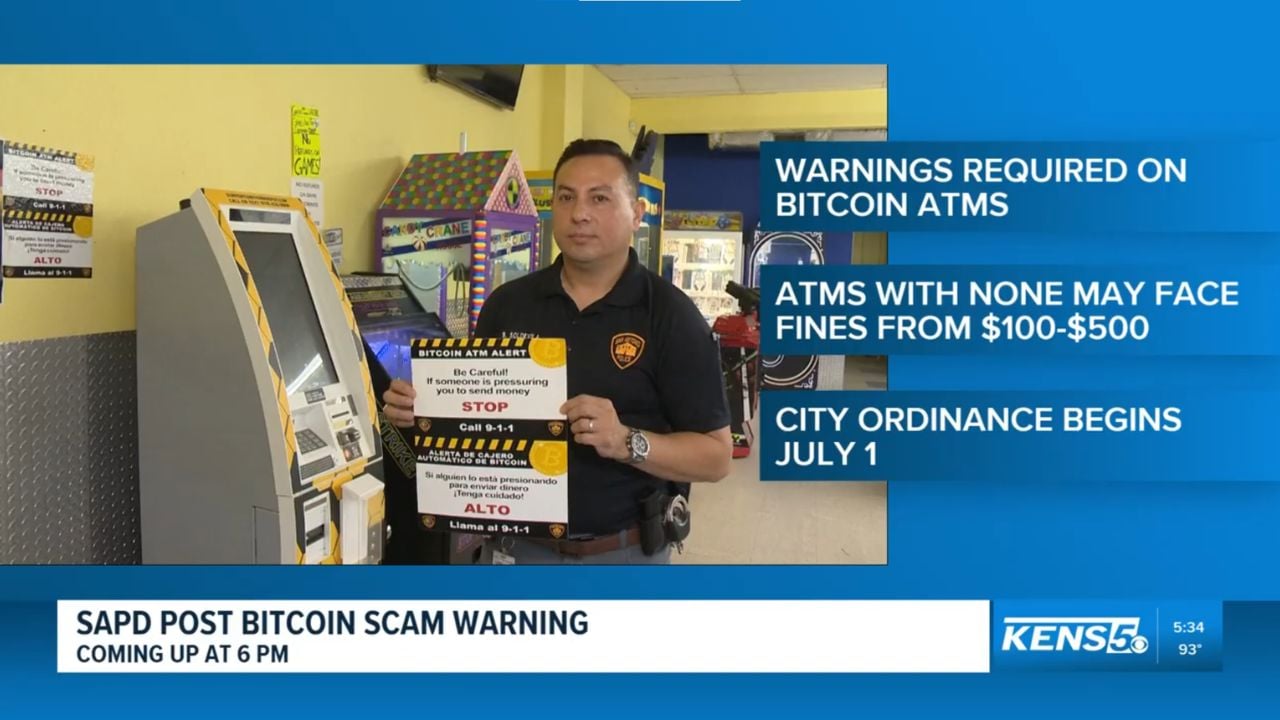
San Antonio police are warning residents about Bitcoin ATM scams as the city moves to put fraud warnings directly in front of people using cryptocurrency kiosks.
The scams often begin with a phone call from someone pretending to represent law enforcement, a court, a government agency, or a utility company, according to the San Antonio Police Department. The caller creates an emergency, then tells the victim to deposit cash into a Bitcoin ATM or send cryptocurrency to avoid arrest, fines, utility disconnection, or another threat.
SAPD says anyone being told to make a payment through a Bitcoin ATM should stop communicating immediately and call 911.
The warning is moving closer to the point of payment after San Antonio approved changes requiring bilingual signs at virtual currency kiosks, commonly called Bitcoin ATMs or crypto kiosks.
The Scam Keeps Victims On The Phone
SAPD says common warning signs include threats of arrest or utility shutoff, requests for secrecy, demands for immediate payment, instructions to use a Bitcoin ATM, and pressure to stay on the phone while making the payment.
Scammers keep victims connected so they cannot stop, call a relative, ask a store employee, or contact police before the transaction is finished. The person at the machine may believe they are following instructions from a real official while the money is being converted into cryptocurrency and sent away.
KSAT reported that SAPD and the U.S. Secret Service previously placed warning posters near dozens of cryptocurrency ATMs in San Antonio. U.S. Secret Service Investigative Analyst Laura Bravo told the station that crypto can move faster than traditional money and becomes harder to recover once it reaches a foreign exchange.
Bravo also said crypto ATMs can isolate victims because they remove the person from speaking with a teller at a bank. That gives the scammer more control while the victim is standing at a machine and following directions over the phone.
San Antonio Data Shows Hundreds Of Local Scam Reports
San Antonio Report said SAPD data presented during the ordinance process identified 660 reports referencing cryptocurrency scams between January 2024 and April 13, 2026.
The reported local losses were roughly $39 million. Nearly 88% of cases involved losses below $50,000, but four cases involved more than $1 million.
Older adults were heavily represented in the data. SAPD data showed nearly 38% of identified victims were 66 or older, though victims ranged from teenagers to people in their 90s.
The city also identified 193 known cryptocurrency kiosk locations in San Antonio, more than Dallas, Fort Worth, or Austin, according to San Antonio Report.
The New Signs Are Meant To Interrupt The Payment
The city ordinance requires warning signs in English and Spanish at virtual currency kiosks. San Antonio Report said the signs must use large, color-coded 18-point font and be visible to users standing directly in front of the machine.
The signs will warn users about common cryptocurrency scams and tell anyone being pressured to send money to call 911. SAPD will lead development, distribution, and compliance enforcement for the required signage.
Businesses that fail to post the signs can face administrative fines ranging from $100 to $500 per violation, with each day out of compliance counting as a separate offense. The ordinance is expected to take effect July 1.
Real Agencies Do Not Demand Crypto Payments
SAPD’s warning is direct: no government agency or utility company will ever request payment through Bitcoin or cryptocurrency. Legitimate agencies will not pressure residents to make immediate payments through Bitcoin ATMs.
That applies even if the caller knows personal details, spoofs a real phone number, uses the name of a real officer, or claims the victim is under investigation. Once cash is converted into cryptocurrency and sent to a scammer’s wallet, the transaction is not reversible.
If a caller sends someone to a Bitcoin ATM to solve a legal, utility, banking, or family emergency, it is a scam. Hang up, stop the transaction, and call 911 or the agency directly through a verified phone number.