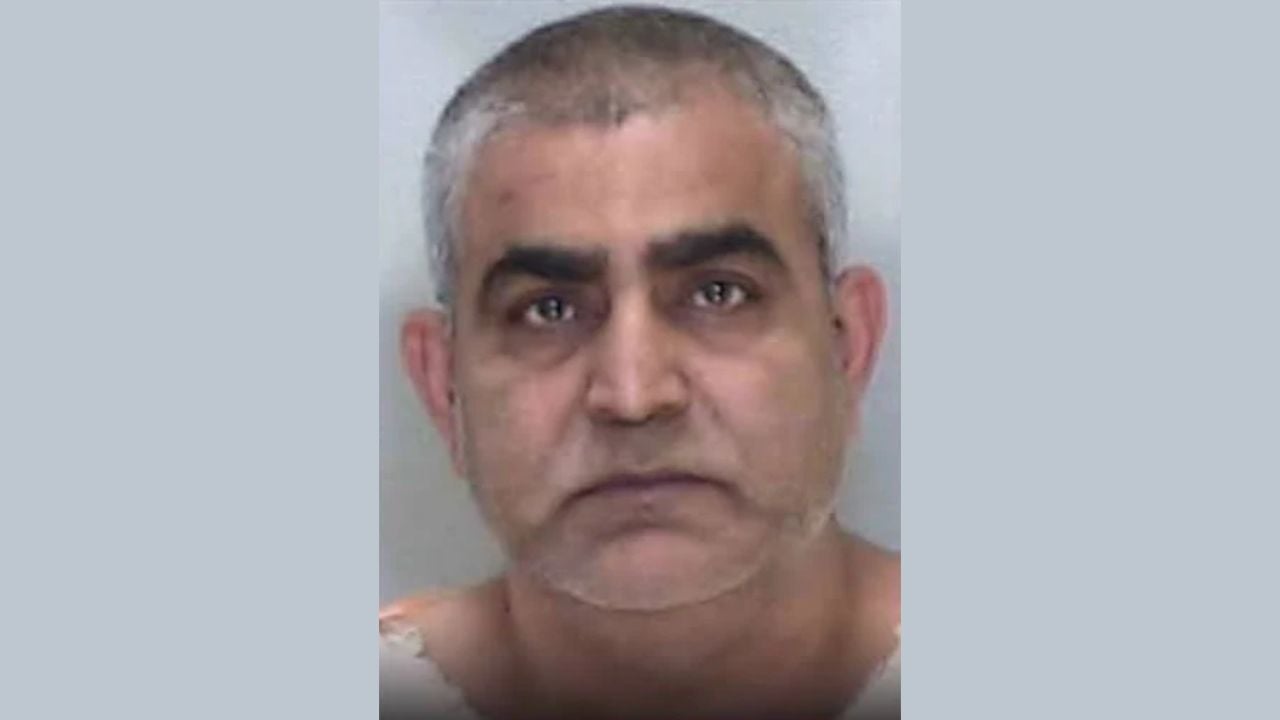
A woman in Florida wired $150,000 and bought 150 one-ounce gold coins for $691,500 after a caller posing as a U.S. Treasury official claimed her identity had been stolen, according to a Citrus County detective’s sworn affidavit.
She later handed over the coins at a Publix supermarket to someone she believed was helping protect her money.
Federal prosecutors say that collector was Manojkumar N. Desai, 44, of Ocala. On October 21, 2026, the U.S. Attorney’s Office for the Middle District of Florida announced he had been indicted on one count of conspiracy to commit wire fraud.
Citrus County authorities had previously pursued a state grand-theft case involving the same May 21 handoff. The charge was dropped on October 7, before the federal indictment was announced.
A $150,000 Wire Was Followed by 150 Gold Coins
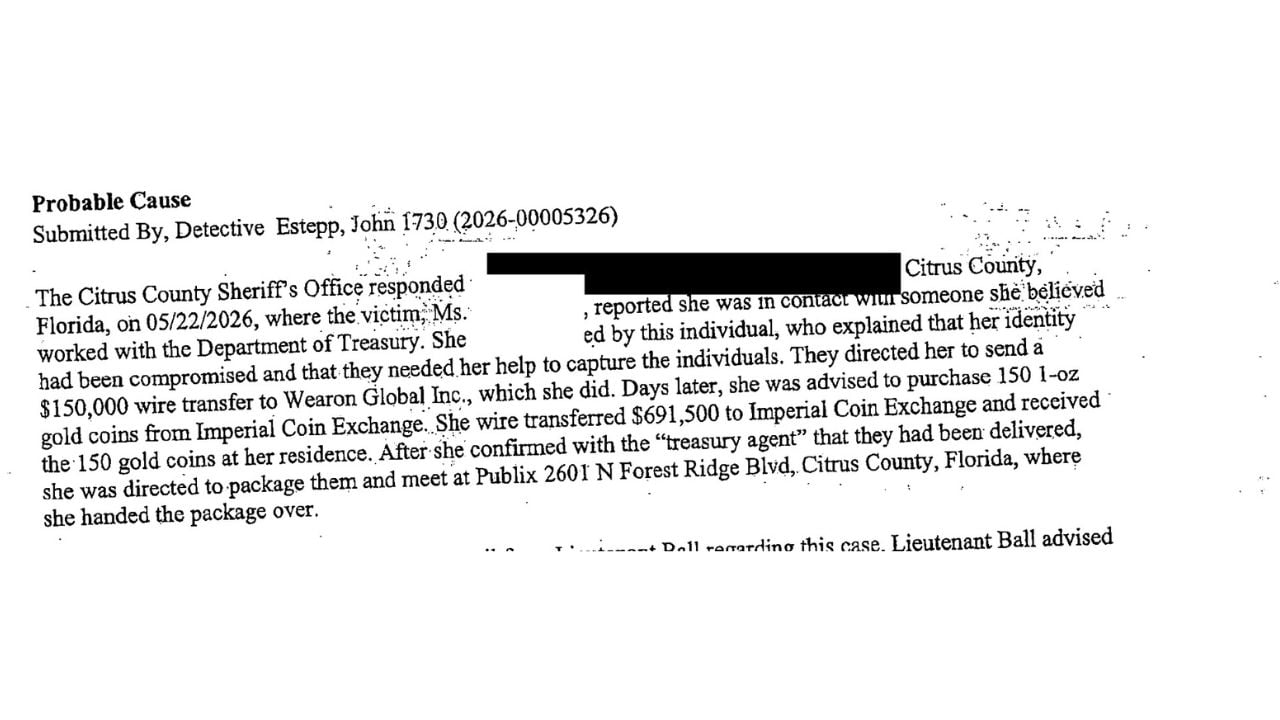
The victim told the Citrus County Sheriff’s Office that someone claiming to work with the Treasury Department said her identity had been compromised and that her help was needed to catch the people responsible. The account appears in an arrest-warrant affidavit submitted by Detective John Estepp, who investigated the alleged theft.
The detective wrote that she first sent a $150,000 wire to a company identified by investigators. Days later, she transferred $691,500 to a precious-metals dealer for 150 one-ounce gold coins, which were delivered to her home.
She Packed the Coins Into a Shoebox for a Publix Handoff
The supposed Treasury representative instructed the woman to photograph the gold and package it for the person collecting it. According to the detective, she placed the coins in plastic containers, wrapped them in duct tape and packing material, and put them inside a shoebox. The box went into a blue drawstring bag.
She was also instructed to photograph herself and her vehicle before the planned exchange. Investigators said the handoff took place on May 21 at a Publix in Citrus County. In the later federal case, prosecutors alleged that Desai met her while posing as the officer assigned to safeguard the coins and took possession of them.
Investigators Identified Two Gold-Coin Sales
Another woman, interviewed by Citrus County detectives said Desai had asked her to sell gold coins. The warrant affidavit describes receipts for three one-ounce American Eagle coins sold on May 27 for $12,873. She also described accompanying him to a Jacksonville business the following day, when 10 more coins were sold for $39,000.
The Justice Department’s announcement identifies the $12,873 as proceeds deposited into a joint bank account. Prosecutors allege that Desai sent $10,000 from that account to another conspirator by wire the following week.
A Texas Detective Supplied Photos and Gold-Package Videos
Estepp’s affidavit says a detective in Friendswood, Texas, contacted Citrus County investigators with information received from a source connected to another fraud investigation. The material included photographs relating to the Florida handoff and recordings showing a duct-taped package being opened to reveal plastic containers holding coins.
Neither video showed a person’s face. Investigators compared the supplied images with photographs saved on the victim’s phone and said they matched. When shown a photographic lineup, the victim spent more time examining Desai’s picture than the others but told detectives she was not completely certain he was the person who collected the package.
Florida Prosecutors Dropped an Earlier Grand Theft Charge
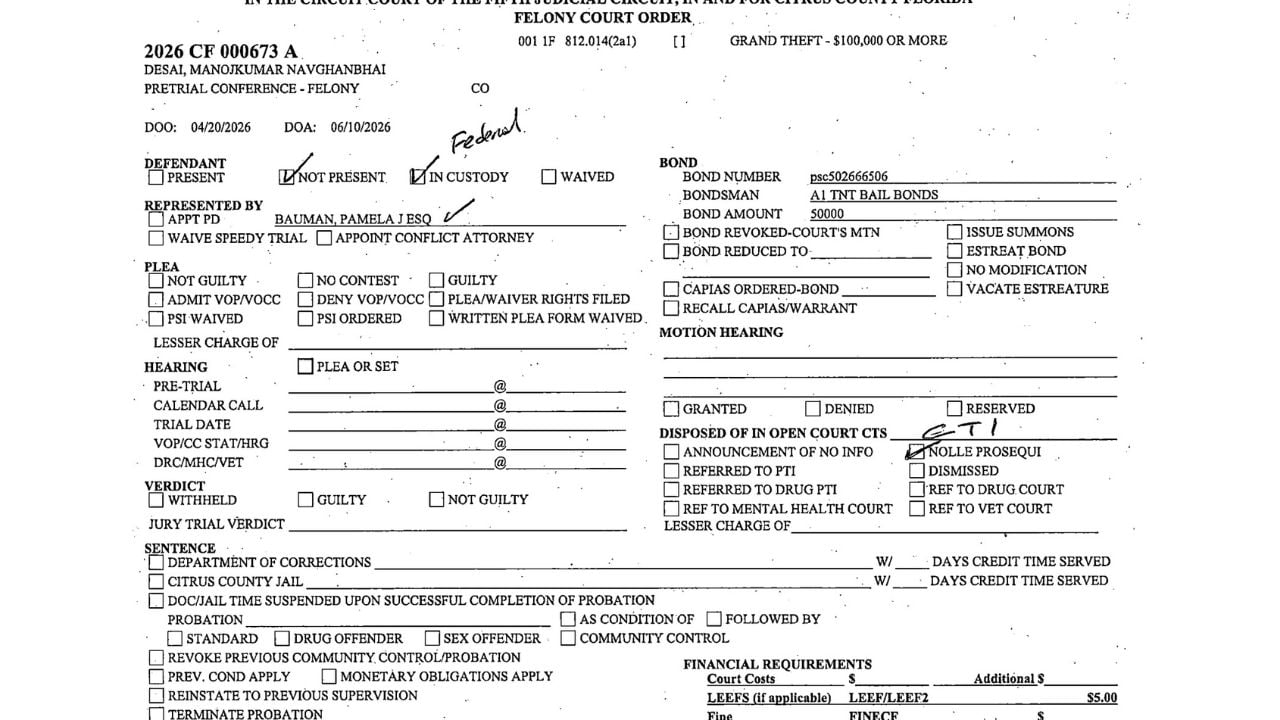
Citrus County prosecutors filed a state charging document on July 24 alleging first-degree felony grand theft involving gold coins and U.S. currency valued at $100,000 or more. The prosecution proceeded under case number 2026-CF-000673-A, after Desai had been arrested on a Citrus County warrant in June.
On October 7, a signed court order recorded a nolle prosequi, meaning state prosecutors discontinued the grand-theft charge.
Federal Prosecutors Seek $370,198.40 in Forfeiture
The October 21 indictment announcement says prosecutors are seeking $370,198.40 in forfeiture, including $55,970 in cash seized from Desai’s residence in June. The forfeiture request concerns property or proceeds the government alleges are connected to the offense. It is not a court-established total of the victim’s losses, and the seized cash is already included in the request.
Desai faces a statutory maximum of 20 years in federal prison if convicted of conspiracy to commit wire fraud. The U.S. Secret Service, Citrus County Sheriff’s Office and St. Petersburg Police Department investigated the case. Assistant U.S. Attorney Angela M. Palacios is prosecuting it. The federal charge remains an allegation, and Desai is presumed innocent unless proven guilty.
What to Do When a Supposed Government Agent Demands Gold
The Federal Trade Commission warns that legitimate government employees do not ask people to withdraw their savings, buy gold or deliver valuables to couriers to protect their accounts. Anyone receiving such a demand should end the contact and independently verify the claim using the agency’s or bank’s official website or published phone number.
People who have already wired funds should contact their financial institution immediately about a possible recall and report the incident through IC3.gov. The FBI advises including relevant bank and recipient details, phone numbers, communications and precious-metals dealer information in an IC3 report. Victims should also preserve receipts and details of any pickup. The Department of Justice’s National Elder Fraud Hotline, at 833-372-8311, can assist people aged 60 or older with reporting suspected fraud.