
An Indiana woman connected to a Columbia City gym faces 13 felony charges after an investigation into unpaid contractors, bounced checks, a construction loan and financial activity tied to the business.
Katherine Rena Parker, 50, helps operate IMPACT-X Performance. The investigation began after a contractor reported completing work at the gym but not receiving valid payment, according to InkFreeNews, which reviewed the underlying Whitley County court documents.
Investigators later examined business bank accounts, construction-loan records and payments involving several contractors. The court-document reporting describes three failed checks to one contractor, an allegedly altered construction-loan invoice, another $35,000 check that bounced and more than $180,000 in checks written during May that were returned for insufficient funds.
Indiana MyCase records show Parker’s criminal case, 92C01-2609-F5-001185, remains pending in Whitley Circuit Court. She is charged with six Level 5 felonies and seven Level 6 felonies, including corrupt business influence, fraud, theft and forgery.
Three Payments to One Contractor Failed

Flowtech contacted law enforcement on May 27 after completing work at IMPACT-X and agreeing to receive nearly $47,000 of the remaining balance through installment payments.
According to InkFreeNews’s review of the court documents, a Flowtech representative told investigators that three checks issued by the gym were returned unpaid. The company also provided police with text messages and emails in which Parker allegedly discussed making replacement payments.
Parker told police during a May 29 phone call that the checks had been written from the wrong account and that money was available but being held by a bank. A Flowtech representative later reported seeing a pending ACH transfer for the outstanding balance.
On June 4, Flowtech told investigators that the electronic transfer had also failed. Parker spoke with police again the following day and allegedly discussed problems involving the failed checks and ACH payment while saying the gym was struggling financially.
On July 23, Flowtech representatives told investigators that Parker had paid the company in full for the work it performed at IMPACT-X.
A Construction Loan Raised a Separate Question
Investigators also learned that Farmers & Merchants Bank had filed a foreclosure action involving the IMPACT-X building.
InkFreeNews, citing the court documents, reported that the bank’s complaint alleged an invoice submitted for payment through the construction loan had been altered even though the underlying work was performed at Parker’s home. The original invoice identified Schwartz Enterprises.
A bank representative later told police that Parker had submitted a blank invoice, resulting in construction-loan funds being paid for work outside the scope of the gym project.
A Schwartz Enterprises representative told investigators on July 14 that Parker had issued the company a $35,000 check from 1st Source Bank for work involving the gym, but the check was returned unpaid. He said the company was still owed $82,350 for work completed at IMPACT-X.
A Bank Manager Flagged Suspected Check Kiting
Police later obtained subpoenas for Parker’s accounts at 1st Source Bank. According to the court-document reporting, a bank manager told investigators that he had closed Parker’s account after concluding she was attempting to engage in check kiting.
Check kiting can involve presenting checks through two or more financial institutions and using funds that have not yet been collected while the checks move through the clearing process. The Office of the Comptroller of the Currency says the scheme takes advantage of the time required for checks to clear.
Records described in the Parker investigation showed that more than $180,000 in checks written during May were returned for insufficient funds.
That total included a $28,875 check to Pulver Asphalt and a $5,933.03 check to Classic Marble and Stone. Representatives of both businesses told investigators on Sept. 9 that they had not been paid and that checks Parker provided had bounced.
According to InkFreeNews, both companies also described receiving repeated explanations about why the payments had not been completed.
Court Records List 13 Felony Counts
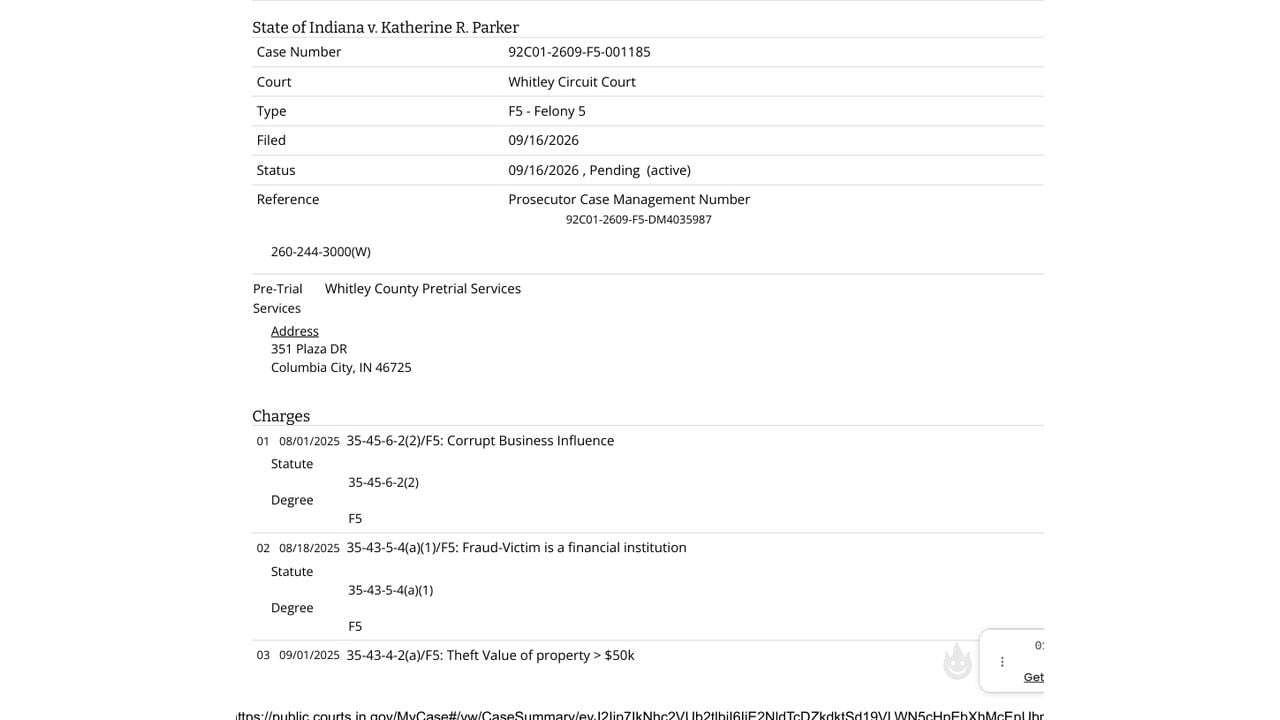
Indiana MyCase lists Parker’s case as pending in Whitley Circuit Court. It was filed Sept. 16 under case number 92C01-2609-F5-001185.
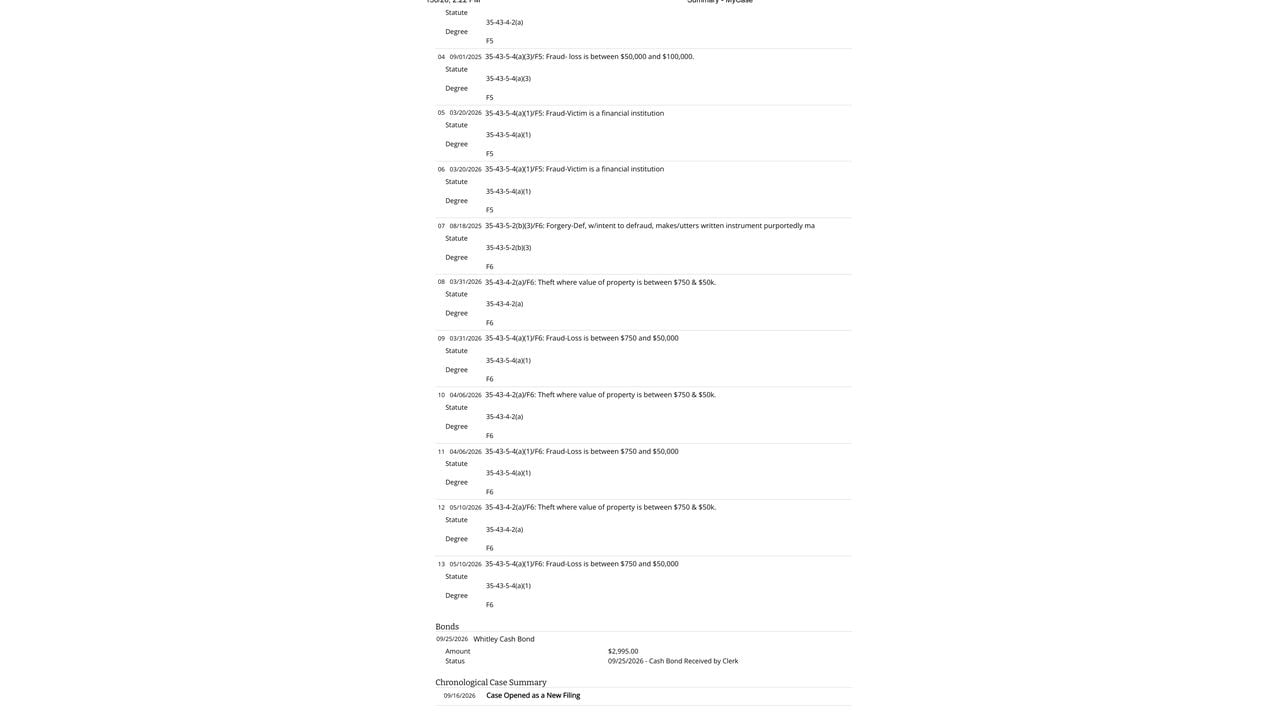
The first six counts are Level 5 felonies: corrupt business influence; three fraud counts in which the victim is identified as a financial institution; theft involving property valued at more than $50,000; and fraud involving a loss between $50,000 and $100,000.
The remaining seven counts are Level 6 felonies. MyCase lists one forgery count, three theft counts involving property valued between $750 and $50,000, and three fraud counts involving losses between $750 and $50,000.
MyCase lists offense dates ranging from August 2025 through May 2026. The investigative narrative involving the contractors, payments and bank activity comes from InkFreeNews’s review of the underlying court documents.
The Court Set a $30,000 Bond With a 10% Cash Requirement
The chronological case summary says the court found probable cause when the case was filed Sept. 16 and set bond at $30,000 with a 10% cash requirement.
MyCase later records a Whitley County cash bond received by the clerk on Sept. 25.
Parker appeared for an initial hearing Sept. 22 before Judge Matthew J. Rentschler. The court subsequently issued an order of pretrial release.
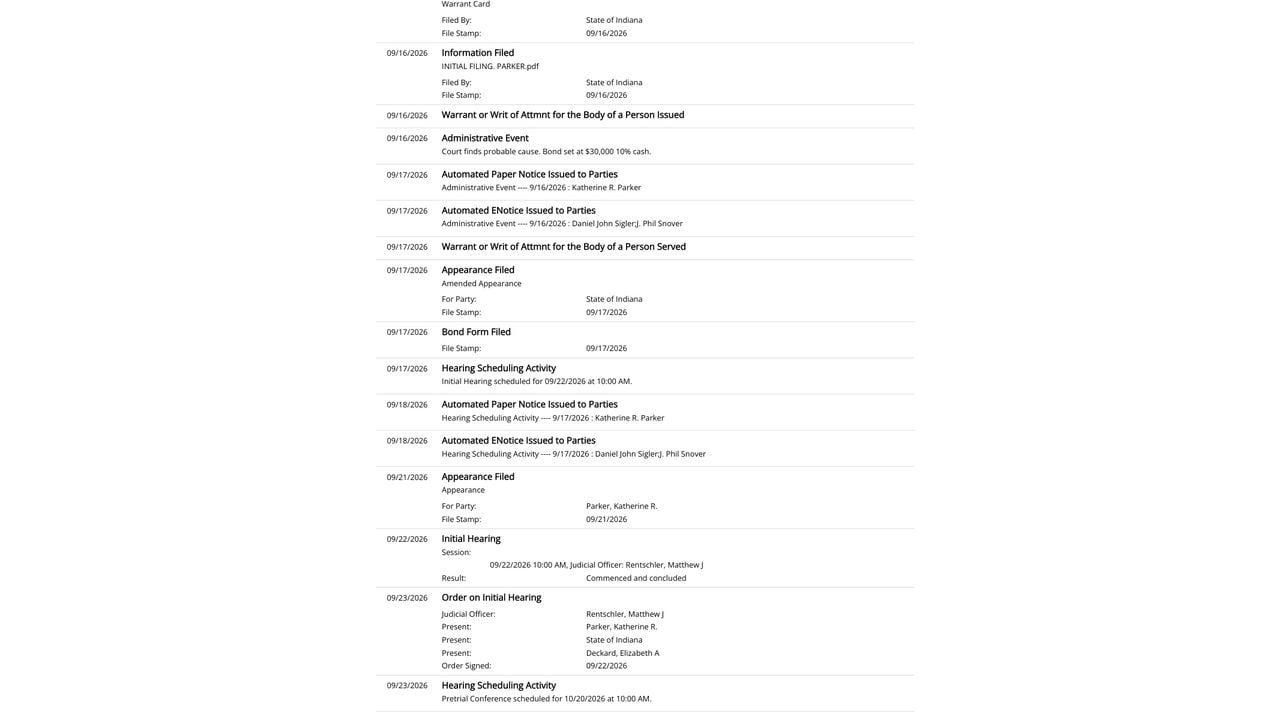
The next listed event is a pretrial conference scheduled for Oct. 20 at 10 a.m. The case remains pending.
Funds Can Be Available Before a Check Is Finally Paid
Several allegations in the case involve checks that were delivered or deposited before later being returned unpaid.
The Federal Reserve explains that federal funds-availability rules can require banks to make money from deposited checks available before the bank learns whether a check will ultimately be returned unpaid.
The Consumer Financial Protection Bureau also notes that banks may place longer holds on deposited checks when they believe a check may be uncollectible. For businesses accepting large check payments, availability of funds and final collection are therefore not necessarily the same event.